

Article / Cheng Chih-Ya
Photos / Wu Jui-Tai
Interviewees / Chang Wei-Chuan, Deputy Director-General, National Park Service, Ministry of the Interior、Huang Hsi-Ju, Appointed Research Fellow, Environmental Engineering Section, Environmental Planning Division, National Park Service
Riding along the South Link Highway in October, a group of cyclists pedaled with a rhythmic cadence and in perfect harmony, moving briskly forward as a team. At the well-known Shouka section, the downhill stretch finally came into sight. Yet, with every push of the pedals, tight muscles and the scorching sun tested riders’ willpower, forcing them to grit their teeth and sweat it out as the whistling wind and passing cars zoomed by…For everyone on the cycling team, this expedition had become much more than just a geographical journey. They were about to achieve a shining badge of honor in their lives: one for challenging their limits and exploring Taiwan in an extraordinary way.
A Journey Back to 2011: Cycling the First Loop of Taiwan’s National Parks
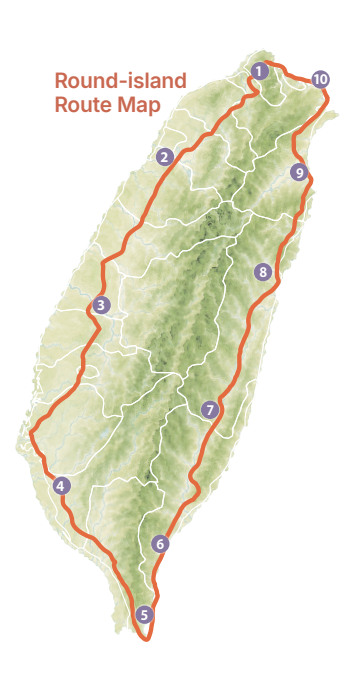
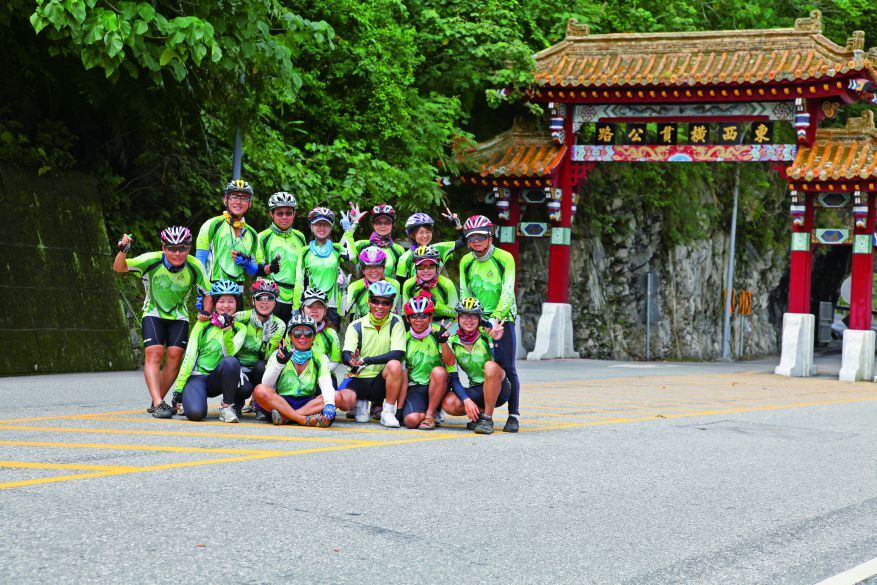
A Journey Back to 2011: Cycling the First Loop of Taiwan’s National Parks Around 2010, a craze for round- island cycling trips began to sweep across Taiwan. A cycling club formed by like-minded staff from the former Construction and Planning Agency’s National Parks Division (now the National Park Service) also independently organized a round-island trip, setting off on October 7, 2011.
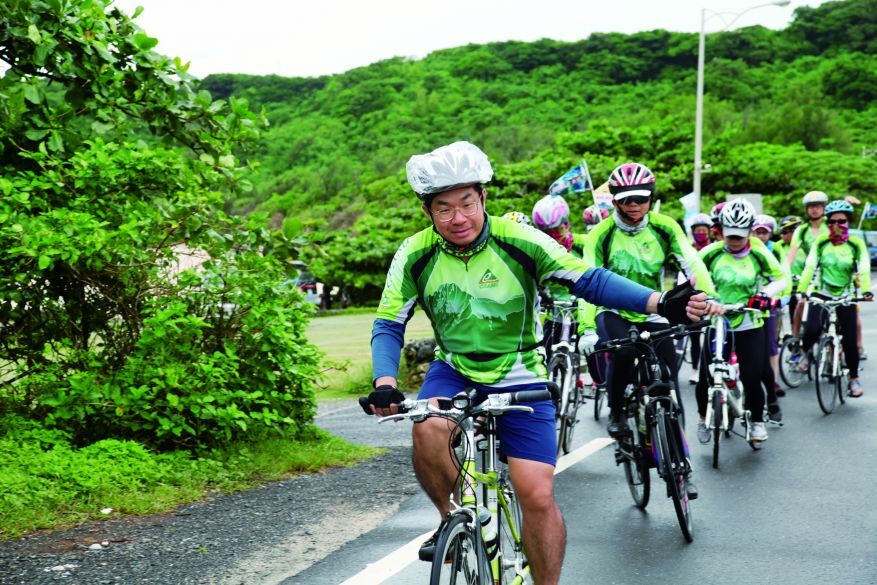
A team of 18 riders—supported by a scooter and a backup vehicle—participated in this trip. They successfully cycled 1,118 kilometers, completing the full round-island route in 10 days. The goal of the round-island trip was to connect the various national parks on Taiwan’s main island by passing through Shei- Pa, Taijiang, Kenting, Taroko,Yushan, and Yangmingshan, as well as the Marine National Park Headquarters.
Chang Wei-Chuan, Deputy Director-General of the National Park Service, was the cycling team’s captain. He explains,“A traditional round-island cycling trip in Taiwan covers just over 900 kilometers, and whether you ride clockwise or counter- clockwise, it generally takes 9 days to complete the route. Since we planned to stop by Kenting, which increased our distance, we added some extra time to our itinerary.”
When describing the trip, Chang’s voice still expresses the excitement he felt back then. “On Day 1, we set off from the Construction and Planning Agency on Taipei’s Bade Road, then took Provincial Highway 3 to visit Shei-Pa National Park. We stopped in Shitan for an overnight stay, and the following morning, we arrived at Shei-Pa’s Wenshui Visitor Center in Dahu. The whole route consisted of mountain slopes until we reached the Shigang area of Taichung, where we finally hit flat land.”
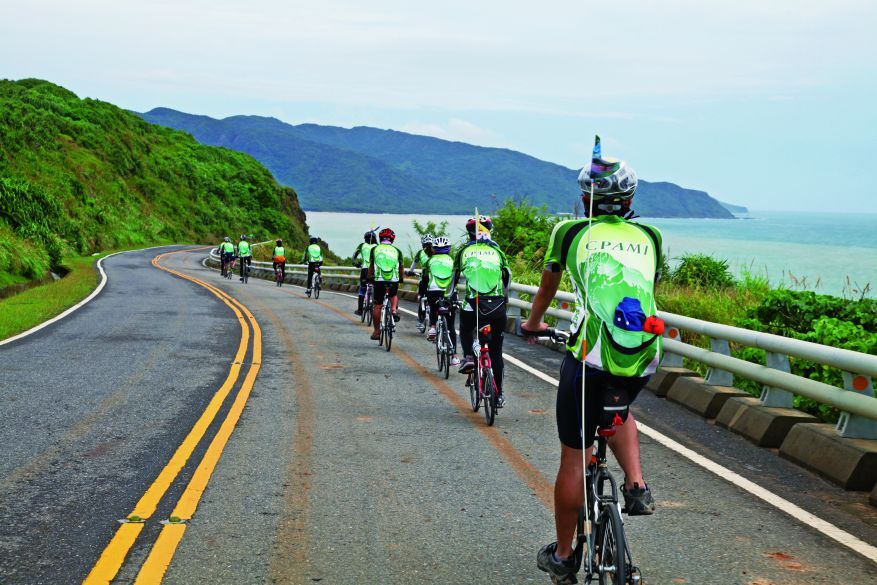
After an overnight stay in Douliu on Day 2, they set out on Day 3 for the longest and farthest ride of the trip. As the cycling team prepared to head to Taijiang National Park for check-in, the route gradually transitioned from the mountains toward the coast. Following a quick break, they rode straight to Zuoying and arrived later that same evening. The next day, they packed their gear and cycled toward Kenting National Park. For the following part of the round-island trip, they took the South Link Highway to visit the Nan’an Visitor Center of Yushan National Park. From there, they passed through Shoufeng and the entrance to Taroko Gorge, and for the final segment, they made their way back up to Yangmingshan in Taipei.
“Although there was a risk of falling rocks along the Suhua Highway section of the route, the scenery was incredibly beautiful. It’s something well worth experiencing once in your life. However, once is enough,”Chang says with a smile.
The Slower the Ride, the Richer the View
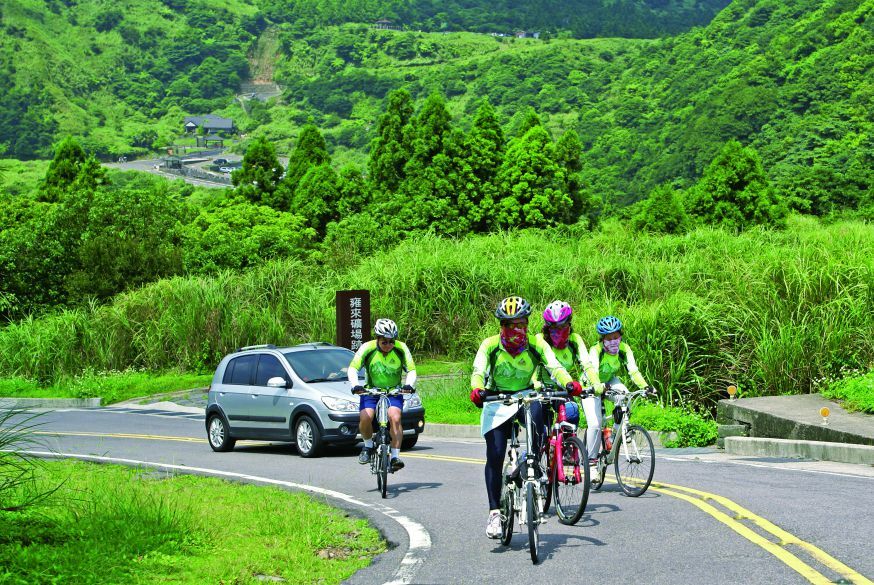
Chang points out with deep feeling,“The greatest thing about cycling is that you can experience much more than you can when traveling by car.”For example, as you cycle across the Chianan Plain toward Qigu, you can feel the air getting increasingly humid; as you traverse the Suhua Highway and speed down the descents, you can admire the magnificence of the cliffs; and on the winding roads of Yangmingshan, every turn brings you a fresh landscape painting.
During that journey, with an average cycling speed of under 50 km/h, every single scene was incredibly vivid—probably because cycling allows you to directly experience the island’s mountains and sea, day and night, with all your senses. Combined with the spectacular, colorful landscapes and heartwarming human interactions, these precious moments made the trip an unforgettable, lifelong memory for all participants.
Pick the Right Season and Prepare Yourself
However, a round-island cycling trip like this one requires careful and comprehensive planning. Chang explains,“We scheduled the trip in October, which wasn’t simply to take advantage of the holiday weekend. The main reason was that the timing allowed us to catch the northeast monsoon on the counter- clockwise route.” Riding with a tailwind can help cyclists save energy and pick up speed to some extent. He further explains that the intense summer heat exposes cyclists to the risks of heatstroke and sunburns, whereas in the winter, frequent rains make the roads slippery and hazardous. Therefore, autumn remains the ideal season for cycling.
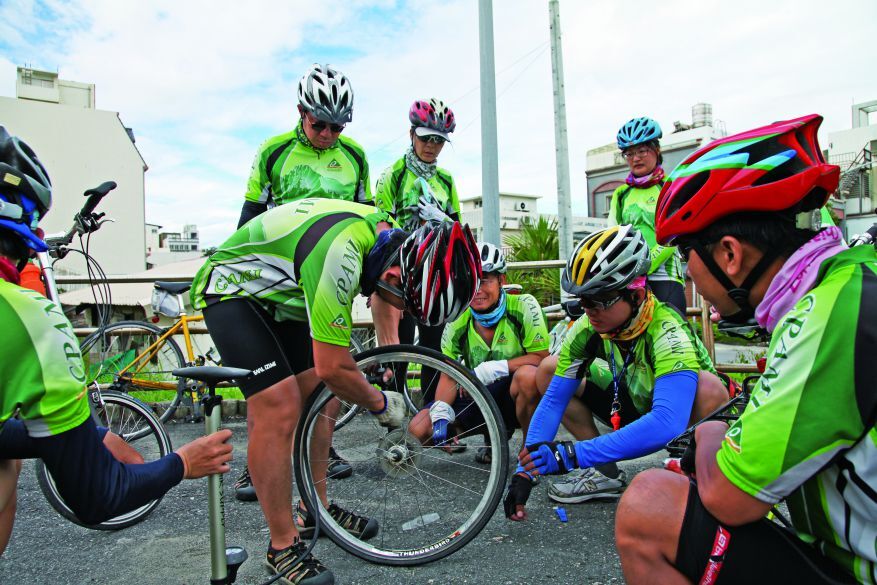
Chang proudly notes that,“Although we were all amateur riders, we did sufficient group training beforehand.”Every weekend, they cycled about 70 to 100 kilometers on the outskirts of the city, which included repeated training at various intensities on both climbs and flat roads to build their stamina. Moreover, before departure, everyone was required to perform a thorough bicycle safety check, including the brake pads, tires, gears, and lights.
Chang emphasizes that unlike professional round-island cycling teams, who travel with dedicated mechanics, all members of his team needed to be able to handle basic bike repairs on their own.“Throughout the entire journey, we only encountered one major mishap. One of our members got a wheel stuck in the tracks at a railroad crossing, which caused a fall and a few scrapes. Even so, all of us still completed the challenge in the end.”

Unexpected Guardian Along the Journey
The presence of Huang Hsi-Ju, an appointed research fellow at the Environmental Engineering Section under the Environmental Planning Division of the National Park Service, unexpectedly added an extra layer of security to the journey. Huang explains that, because he was unsure of his stamina and worried that he wouldn’t be able to finish the entire route, he asked his supervisor if he could tail the group on a scooter. Nobody knew it at the time, but he would end up becoming the team’s indispensable guardian.
Along the journey, Huang took on several seemingly minor tasks that proved crucial to the whole team. Sometimes he rode ahead to check the way, and sometimes he rode back to the middle of the group to check on everyone and offer words of advice to fellow riders. Smiling, he recalls,“When a rider is battling pure physical exhaustion, hearing a voice call out,‘Hey, there are only 500 meters left!’will shift their mental state.”Therefore, the support vehicle handled the team’s transportation, while the scooter performed the role of mobile communication. They complemented each other perfectly, making the entire journey much smoother.
是車隊的強大後盾,提供補給、維修、行李運送及體力不支時的人員接駁等協助.jpg)
Through Mountains, Seas, and Years —— 15 Years later
Fifteen years after the round- island trip, the National Park Service is now promoting a low- carbon eco-tourism initiative. By launching cycling tours in Kinmen and Taijiang, it encourages the public to explore local destinations at a rhythmic, leisurely pace to understand more about Taiwan. In addition to these beginner- friendly routes, the national parks also offer some highly challenging options, the most notable being the routes up to Wuling. Chang points out, “Wuling (altitude: 3,275 m) is the highest point of Taiwan’s road network. The northern route up to Wuling is the most difficult route; it’s not for casual riding, but an extreme challenge!”
As for the round-island team formed in 2011, some members are still working at the National Park Service; others have retired and are enjoying a carefree life. Sadly, the team lost two members, who have passed away. Looking back, it seems that the trip perfectly illustrates the journey of life: you have some great company on the ride; when you’re completely exhausted, someone will say,‘You’re almost there!’; and someone will go on ahead to scout out the next rest stop or starting point.
A thousand-kilometer nature odyssey on two wheels also allows us to step outside the concrete jungle and discover a side of Taiwan that we could never see from our offices or cities. By exploring national parks through cycling, we can discover two beautiful rewards: people and scenery.
Three Routes to Wuling
Cyclists tackling Wuling have their choice of three different routes. The Eastern Approach Route, which starts at Qixingtan in Hualien and winds through Taroko National Park, is a spectacularly scenic and iconic ride that attracts cycling enthusiasts from around the world. The Western Approach Route starts from the Stele of Taiwan’s Geographical Center in Nantou and follows Provincial Highways 14 and 14A through the Renzhiguan Pass, Wushe, and Qingjing Farm, riding upward from the heart of Taiwan. The Northern Approach Route starts in Yilan, runs along Provincial Highways 7A, 8, and 14A, and passes through Qilan, Nanshan, and Wuling Farm area, crossing two national parks (Shei-Pa and Taroko) before reaching the Wuling summit. These routes all contain long, sustained climbs, making them classic challenges for iron-legged adventures.

Welcome to Cycling 101!
Different trails bring their own unique flavor and terrain. Beyond checking your bike before setting off, be sure to plan your itinerary around your fitness level and riding experience. For longer or more challenging routes, a helmet and padded cycling shorts are well worth having. It’s also smart to pack essential gear like spare tubes, a pump, basic repair tools, and lights. Along the way, stay hydrated and keep your energy up, while dressing for the weather with sun protection, windproofing, or extra layers to stay warm.
If your route is all about taking in the views and spotting local wildlife, bring along a pair of binoculars to appreciate the ecosystem up close. Above all, don't feel pressured to chase speed or distance. Riding within your limits and taking things step by step is the real secret to staying safe and truly enjoying the ride.
Lesson 1: The Ultimate Perks of Cycling
1. A High-Efficiency, Low-Impact Cardio Workout
Because the saddle supports your weight, cycling is remarkably gentle on the knees. Cruising at a steady 20 km/h burns roughly 500 to 600 calories an hour—all while boosting blood circulation, improving arterial flexibility, and elevating overall cardiovascular fitness.
2. Balanced Muscle Development for Both Legs
Unlike sports that favor a dominant side, cycling requires equal effort from both legs. This helps correct muscle imbalances and poor posture caused by long-term one-sided movement habits.
3. Tapping into Your Lower Body’s“Second Heart”
Fighting gravity to pump blood back to the heart relies heavily on your lower body muscles. As your thigh muscles contract and release while pedaling, they act like an active pump, squeezing blood vessels and pushing blood back up—drastically reducing the workload on your heart.
4. Building Thigh Strength for Aging Well and Preventing Falls
Nearly two-thirds of the human body’s skeletal muscle is concentrated in the lower body, but studies show that by age 60, lower-body strength often drops to just 40% of its peak. Cycling is, at its core, a workout for the thighs. It strengthens key muscles supporting the pelvis and sharpens your sense of balance—your best defense against accidental falls.
--------------Source: "Fly & Ride: Kinmen Cycling Safety Guide"
Lesson 2: The Art of Cycling Breath Work
1. Focus on the Exhale
When cycling, make a conscious effort to exhale deeply and fully. Emptying your lungs creates room for fresh air to rush in naturally. Keeping your oxygen levels topped off wards off fatigue, preventing you from holding your breath and losing steam during high-speed sprints or steep climbs.
2. The 3-Count Rhythm (The Waltz): One Long Exhale, Two Short Inhales
Ideal for steady cruising. Take one long exhale as one pedal drops, followed by two short inhales over the next two pedal strokes. Switch your leading leg on the next exhale, letting your legs alternate in driving the breathing rhythm.
3. The 2-Count Rhythm (The March): One Powerful Exhale, One Powerful Inhale
Perfect for top-speed pushes or grueling uphill climbs. Exhale sharply as one leg pushes down, then inhale deeply as the other pedal drops—keeping up a strong, energizing rhythm to pump maximum oxygen into your body.
--------------Source: "Fly & Ride: Kinmen Cycling Safety Guide"
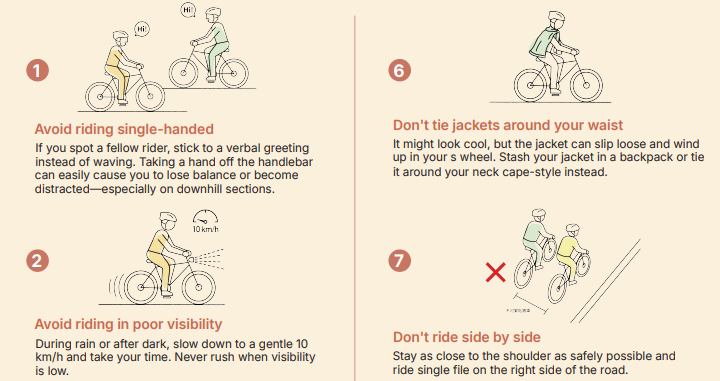
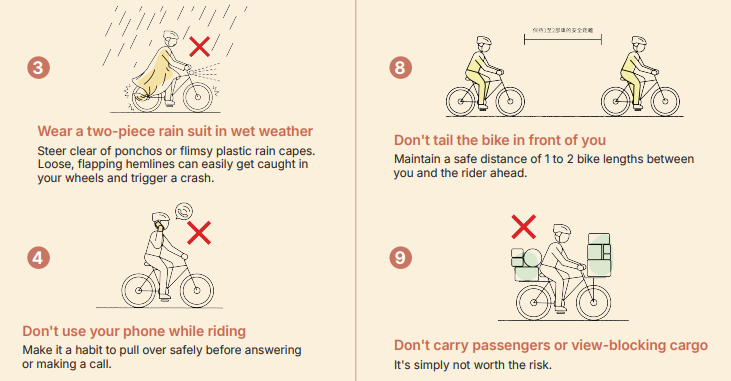
Lesson 3: 10 Dangerous Cycling Habits to Avoid
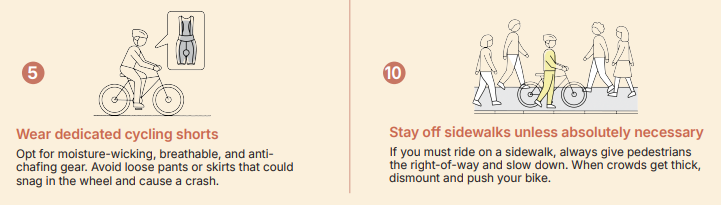
--------------Source: "Fly & Ride: Kinmen Cycling Safety Guide"


