Derict to middle content area
:::

:::

Restoration of the Formosan Landlocked Salmon: A Collaborative Effort in Conservation

alt-Restoration of the Formosan Landlocked Salmon: A Collaborative Effort in Conservation-1
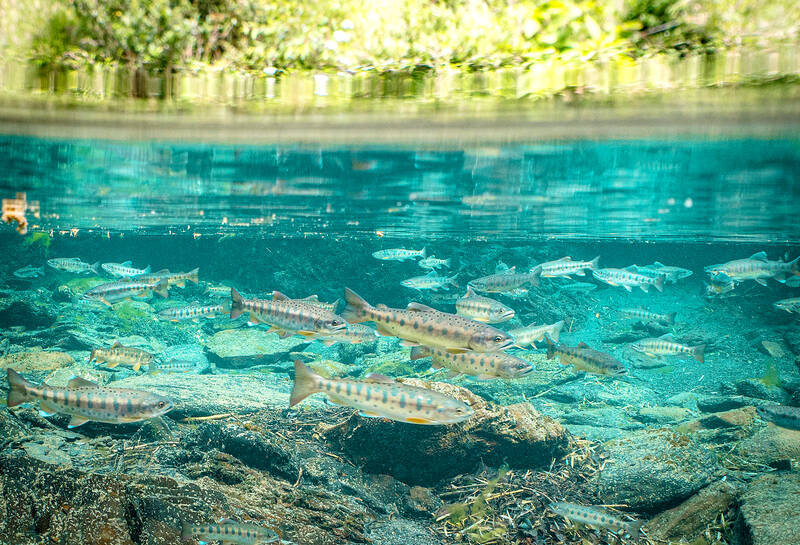
The Formosan landlocked salmon has gradually moved away from the brink of extinction (Photo by Shei-Pa National Park Headquarters)

The Formosan landlocked salmon, once on the brink of extinction, has experienced a remarkable recovery over the past three decades. From a population of roughly 200 individuals in 1994 to 18,630 by 2023, and its habitat now spans five major river basins. This transformation stands as a testament to the power of collaboration between local communities, indigenous groups, and government institutions.

When Shei-Pa National Park was established in 1992, the salmon faced threats from pollution, habitat fragmentation, and declining numbers. The Qijiawan River, a critical habitat, was polluted by agricultural runoff, compounded by deforestation and development. By 2000, the population had dwindled to alarmingly low levels.

To address these issues, the park launched artificial breeding programs, producing approximately 10,000 salmon annually under the leadership of LIAO Lin-Yen, the program now produces around 10,000 salmon annually, ensuring the species' sustainability. The early years were challenging, as the wild population dwindled to just 450 individuals, making capturing even a single salmon a major hurdle.

Despite early setbacks, such as Typhoon Aere destroying the Qijiawan hatchery in 2004, efforts intensified. A new ecological center opened in 2005, and by 2006, salmon were released into historical streams, including Hehuan and Nanhu Rivers, and Sijielan, Leshan, and Luoyewei Creeks. Although initial results were discouraging, with some failures reported in 2008, the team persisted, employing innovative methods like small radio transmitters to track individual salmon and understand their behavior.

Habitat restoration was equally crucial. In 1997, the park began planning a wastewater treatment system to address pollution from agricultural activities and recreational areas nearby Wuling Farm. By 2002, the first facility was operational, significantly reducing contaminants in the river. The park also partnered with Wuling Farm to from agriculture to eco-tourism, reclaiming farmland for reforestation. Over 500,000 native trees were planted along riverbanks, and in 2006, the park acquired 8.1 hectares of private land to further protect salmon habitats.

In addition, hydraulic structures like silt traps and weirs disrupted salmon migration. In 1996, the park began studying the feasibility of removing or modifying these barriers. Over time, several silt traps were dismantled, and boulders were returned to riverbeds, stabilizing the substrate and creating deeper pools for spawning. A major breakthrough came in 2011 when the 15-meter-high No. 1 Weir was removed, allowing salmon to migrate upstream even after typhoons. By 2012, the population in the Qijiawan River had rebounded to 5,400 individuals, underscoring the importance of restoring ecological connectivity.

A key component of the recovery efforts was the involvement of local communities. Recognizing the effectiveness of local participation, the Park formalized partnerships with indigenous Atayal communities. In 2000, the Sqoyaw Village and Nanshan Tribe communities formed informal fish protection teams, helping to safeguard salmon habitats and monitor ecological changes. Over the years, these partnerships grew, and in 2004, the park began collaborating with the Sqoyaw community to patrol streams such as Yousheng, Sijielan, and Nanhu River. Subsequent collaborations included partnerships with the Nanshan, Tabuk, and Qalang Mkbubun communities to monitor and protect other key salmon habitats.

The salmon’s recovery also required the team to explore new habitats. With global warming posing a serious threat to the species, as rising temperatures make it more difficult for the salmon to thrive in lower-altitude streams, the team began releasing salmon into higher-altitude locations such as Hehuan and Nanhu Rivers, which provided more suitable conditions for the salmon’s survival.

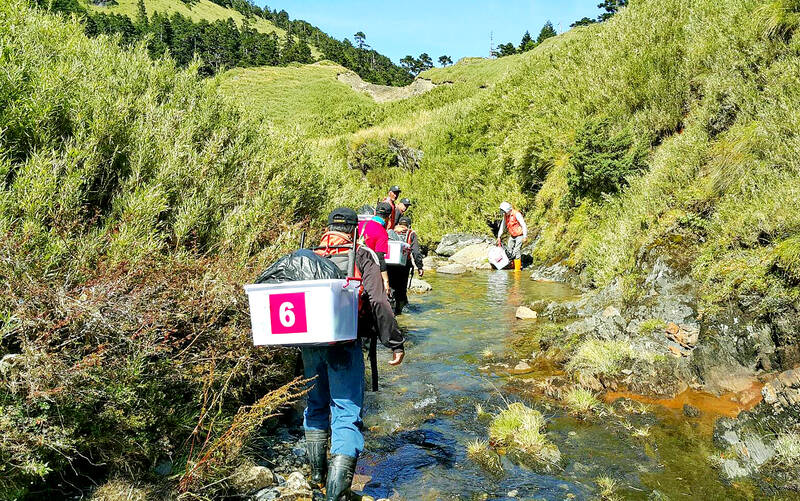
The restoration team carries Formosan landlocked salmon fry and eggs on their backs, trekking through rugged terrain to release them at higher-altitude locations (Photo by Shei-Pa National Park Headquarters)

In 2017, Shei-Pa National Park collaborated with Taroko National Park to release salmon into the Hehuan and Nanhu rivers. By 2018, successful wild populations were observed in Hehuan River, the second-largest population outside the Qijiawan River. This marked a significant step forward in the conservation efforts for the Formosan landlocked salmon.

By 2022, the wild population of Formosan landlocked salmon had reached 15,374 individuals, a 60-fold increase from the early stages of restoration. And in 2023, the team achieved a breakthrough in fish transport techniques, successfully moving over 10,000 fertilized salmon eggs to the Zhongyangjian River at an altitude of 2,200 meters. This pioneering method, which involved waterless transportation, allowed the team to expand the salmon's range further, and by 2024, they discovered that the salmon had established a viable population in the Zhongyangjian River.

The population of Formosan landlocked salmon has not only rebounded, but its habitat has expanded, and the species is now thriving in multiple locations across Taiwan. This success story is a shining example of how collaboration, innovation, and long-term commitment to conservation can reverse the damage done to fragile ecosystems and endangered species. The recovery of the Formosan landlocked salmon serves as a reminder of the importance of preserving our natural heritage for future generations.

Updated:


Sheipa

Sheipa

Accommodation in Shei-pa

Published: 2009-08-12

Please read articles in our website for more information about accommodation in Shei-pa National Park.

  1. Chiu- chiu villa:(035)218-853
  2. Wuling Farm:(04)590-1257
  3. Shei-pa Leisure Farm:(03)585-6192~3

Last Updated: 2019-02-23


How To Get There

Published: 2009-08-12
deer 

Transportations

  1. Traveling by trans
  2. Routes for car drivers

Traveling by trans
Traveling by trans→ Miaoli railway station→ transfer bus to Dahu or Zhuolan (Hsinchu bus line) to Fayunsi station or Shuiweiping station→ Shei-Pa National Park Headquarters.
For traveling information, please contact the followings.
1.http://www.railway.gov.tw/index_ok.htm Taiwan railway administration(TRA)
2.Hsinchu bus line, Miaoli main station 037-320115,Dahu station 037-991017
Routes for car drivers
  1. Follow the Sun Yat-Sen Expressway to Miaoli interchange (132.8K, No.28 exit) → toward Gongguan direction (The 6th Taiwan Provincial Road ) → transfer to No.62 Miaoli County Highway to Taian Hotspring → approximately 100 meters, turn left and arrive Shei-Pa National Park Headquarters.
  2. Follow the Sun Yat-Sen Expressway to Miaoli interchange (132.8K, No.28 exit) →connect Line No.72 of the east and westbound expressway → connect 3rd Taiwan Provincial Road when arrive Wenshu i → transfer to No.62 Miaoli County Highway to Taian Hotspring → approximately 100 meters, turn left and arrive Shei-Pa National Park Headquarters.
  3. Follow the Sun Yat-Sen Expressway via Fengyuan, when reach the interchange of Taichung (165.5K, No.31 exit) transfer to National Highway No.4 (direction to Fengyuan, Houli, eastbound) → connect 3rd Taiwan Provincial Road to Dongshih and Zhuolan direction → Dahu → transfer to No.62 Maioli County Highway to Taian Hotspring → approximately 100 meters, turn left and arrive Shei-Pa National Park Headquarters.

Last Updated: 2018-09-20


Map Of The Park

Published: 2009-08-12
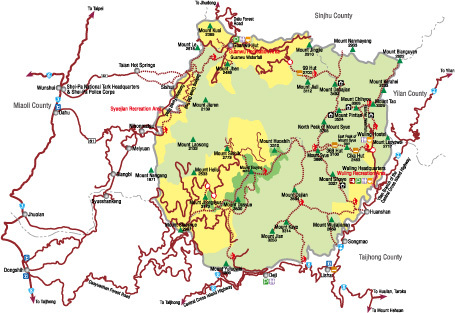
map of Shei-Pa
Shei-Pa National Park covers an area of 76,850 hectares on the central Taiwan range, slightly to the north of central Taiwan. This is a region of magnificent mountains: within the park are 51 peaks over 3,000 meters high. It is a mostly wild and undeveloped area with a range of wildlife that includes many rare and endemic species. The park was founded to protect and study this splendid wilderness, maintaining the natural environment and all forms of life it includes. Conservation is therefore the first priority for Shei-Pa National Park, and a large proportion of its land is protected as Conversation Area, or Special Scenic Area, with limited access for ordinary visitors.

Last Updated: 2018-09-19


Park Contacts

Published: 2009-08-12

LocationOpening HoursContact Information
Shei-Pa National Park Headquarters-Tel:886-37-996100
Wenshui Visitor Center09:00am ~ 16:30pm
※Close on Mondays and Holidays
Tel:886-37-996225
Wuling Visitor Center09:00am ~ 16:30pm
※Close on Mondays and Holidays
Tel: 886-4-25901350
Huanwu Headquarters-Tel:886-37-276300

Last Updated: 2020-11-20


Visitor Safety

Published: 2009-08-12

Notices to visitors
wild animal


  1. Before departure, visitors should inquire for traffic information, weather, and accommodation.
  2. All signs with prohibition and warning should be followed in the public garden area.
  3. If any situations happen in the garden area, please inform the staff as necessary, and follow up the safety instructions
  4. Information Inquiry:(037)998100
  5. Earthquakes, typhoons and heavy rains may make the roads and trails dangerous or impassable. Contact the park headquarters for advice on your proposed route.
    Useful addresses and telephone numbers:

    ※ Headquarters:
    Tel: 886-37-996100
    Fax: 886-37-996302

    ※ Wuling Visitor Center:
    Tel: 886-4-25901350

    ※ Guanwu Administration Station:
    Tel: 886-37-276300

    ※ Website:
    Shei-pa National Park

Last Updated: 2019-04-12


Travel Guide

Published: 2009-08-12

SiteSuggestion of Visiting
Shei-Pa National Park HeadquartersTwo-day Trip

Day 1:Shei-Pa National Park Visitor Center → Fayun Temple → Wenshui Old Street → Cingan Tofu Street → Tai-an Hot Springs (Staying over night).
Day 2:Tai-an Tribe → Strawberry-Pick at Dahu Township (If it is not seasonal, Sunflower Garden Visiting is also provided) → Dahu Wine Village → Returning home.

Wuling Recreation AreaTaipei-Wuling

Day 1:Taipei → Wuling Recreation Area →Wuling Visitor Center →Wuling Farm (Fish watching and landscape visiting) → Dinner and overnight stay in Wuling.
Day 2:(Route 1) Wuling Recreation Area → Taoshan Waterfall→ Lunch → Returning home.(Route 2) Wuling Recreation Area→ Trailhead of Syue Mountain → View-watching Platform → Cika Cabin → Lunch → Returning home.

Taichung-Wuling

Day 1:Taichung → Puli → Wushe → Lishan → Wuling Recreation Area → Wuling Visitor Center → Wuling Farm (Fish watching and landscape visiting) → Dinner and overnight stay in Wuling.
Day 2:(Route 1) Wuling Recreation Area → Taoshan Waterfall → Lunch → Returning home.(Route 2) Wuling Recreation Area → Trailhead of Syue Mountain → View-watching Platform → Cika Cabin → Lunch → Returning home.

Guanwu Recreation AreaTwo-day Trip

Day 1:Jhudong → Cingcyuan → Guanwu → Guanwu Waterfall Trail → Overnight stay in Guanwu.
Day 2:Guanwu → Leshan Sunrise → Kuaishan Big Trees Trail → Returning home.

Three-day Trip

Day 1:Jhudong → Cingcyuan→ Guanwu → Guanwu Waterfall Trail → Overnight stay in Guanwu.
Day 2:Guanwu → Leshan Sunrise → Kuaishan Big Trees Trail → East Branch of Dalu Forest Road.
Day 3:Guanwu → Jhenshan Trail → Returning home.

Last Updated: 2021-01-22