
The Ageless Legend of Datun Volcano Group-
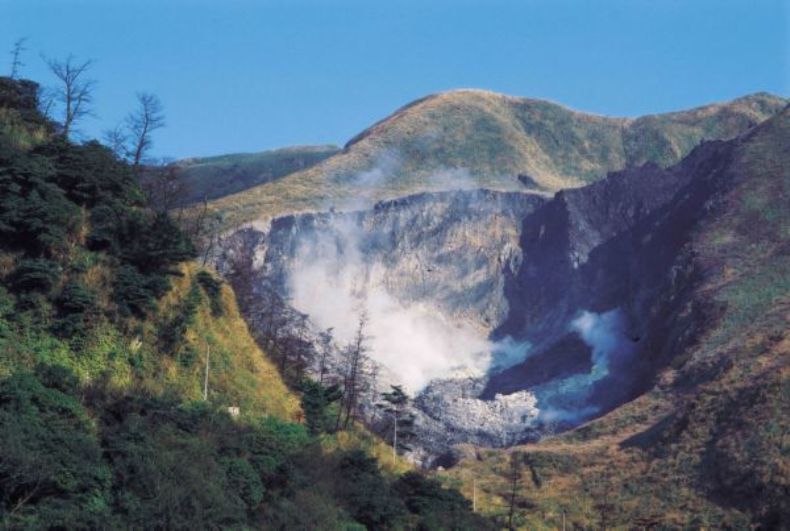
The Datun Volcano Group of Yangmingshan National Park is the largest volcano group in Taiwan and the only active volcano on the Taiwan Island. The boiling hot spring and scorching volcanic gas that gush out of the ground are both indications of an active magma chamber underneath this area. The tectonic and geological evolution of the earth are all recorded here through orogeny and volcanic activities in the past, leaving us a living geological history to study.
Within the Datun Volcano Group, every mountain is a spectacular scene of volcano topography and no human expression can possibly describe its beauty.
In the primitive eons of the earth’s geological history, massive magma erupted out of the ground due to mutual pushing and pressing and then cooled down and heaped up repeatedly. The scraping and scratching by typhoons and erosion by rain helped to shape the accumulated magma into the present look of the Datun Volcano Group.
“The Datun Volcano Group is still fairly young,” says Sheng-rong Song, Professor of Department of Geosciences of NTU, telling about the cause of the Datun Volcano Group in a steady voice. He points out that Taiwan is situated at where the Eurasian Plate and the Philippine Sea Plate meet. As the Philippine Sea Plate subducted northwest toward the Eurasian Plate, the tip of the former submerged beneath the latter which had a lesser specific gravity. The acquiferous minerals of the submerged part became dehydrated when the pressure and temperature rose gradually. Fluid with lesser specific gravity was produced and moved up to the cuneal mantle (where the 2 plates pile up), causing the rock sphere to melt under the geothermal heat and become liquid magma. When the magma rose upward, the gas inside it inflated with the change of pressure and erupted together with the magma through the fissure of the surface of the earth, and the Datun Volcano Group was thus formed.
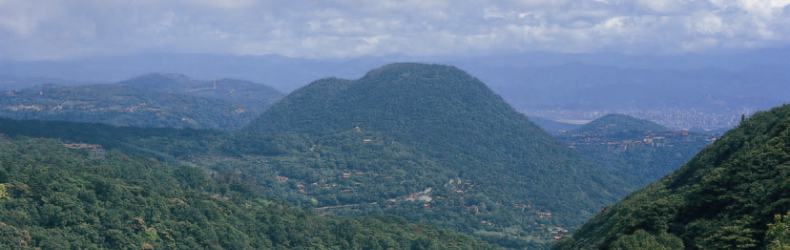
According to the inspection made by Yangmingshan National Park, the eruption of the Datun Volcano Group started from 2.8 million years ago to 0.2 million years ago. At the first eruption, the site the Datun Volcano Group was simply a hilly land a little above the sea level. As the magma from the underground mantle kept looking for fissures to erupt, volcanoes and craters of different sizes were formed, i.e. the volcanic landforms constituted by Mt. Cising, Mt. Miantian, Mt. Huangzuei, Mt. Jhuzih and Dayoukeng.
From age dating of research in the past, the reliable date of the last eruption of Datun Volcano Group is 0.2 million years ago. Professor Song says that the drilling through the core of Taipei Basin made by IESAS and Central Geological Survey, MOEA discovers volcanic ash deposit in the part of Songshan formation formed 12,000 to 15,000 years ago. The volcano ash contains volcanic glass that can be formed in natural geology only when the magma cools down drastically, therefore the academia estimate that the latest eruption of the Datun Volcano Group probably happened 10,000 years ago.
10,000 years may be a very long time for mankind, but it’s merely a moment in a flash for the 4.5-billion-year-old earth. “So the Datun Volcano Group is still quite young!” As Professor Song explains, the reason why the volcanic landforms of the Datun Volcano Group remain rather intact while suffering frequent typhoons and rainstorms typical of Taiwan’s climate is just the same as why a youth has a young look.
- image: Located at Anbu of Mt. Chishing, Siaoyoukeng is actually an opening for high-temperature volcano gas eruption. / by Mike Yang
Text / Ann-hua Chuang
Photographer / Wen-sung Wang.Bei-yan Kao.Mike Yang
Resource / Sheng-rong Song, Professor of Department of Geosciences, National Taiwan University
The Active Underground Magma Chamber
The volcano activities of the Datun Volcano Group are vigorous and alive with fumaroles, hot springs and geothermal landscapes seen everywhere. Quite on the opposite, its neighboring Guanyin Volcano and Keelung Volcano Group are both announced dead and labeled as “extinct volcanoes”.
In the past, the academic definition of an active volcano used to refer to the written historical record of mankind, thus a volcano that has an eruption history recorded by mankind is active, whereas all other volcanoes without any recorded eruption are said to be dormant or extinct.
“The earliest recorded volcano eruptions in human history are found in Greece and Italy 3,500 years ago.” Professor Song adds that since too many volcanoes had erupted long before any human record, IAVCEI later suggests a law of empiricism. According to this law, a scientific method is adopted to decide the date of a volcano eruption, and an active volcano is one that has erupted in 10,000 years ( 2,000 years according to Japan).
However, this empirical law may not suit for all cases. For example, the volcano ash and clastic deposit would be eroded by wind and rain and leave no trace of a volcano that erupted 10,000 years ago. Another definition of an active volcano according to the law of phenomenon proposed by IAVCEI in 1994 suggests that, since the eruption of a volcano depends on the underground magma, a volcano is active if any active magma chamber can be detected underneath it by scientific method.
Based on the aforementioned phenomena as well as the inspections on the ratio between volcano gas and magma conducted by the Institute of Geology of NTU and Academia Sinica for successive 7 years, maybe the Datun Volcano Group can redefine as an active volcano. Currently Dayoukeng is the part with most active magma found within the Datun Volcano Group.
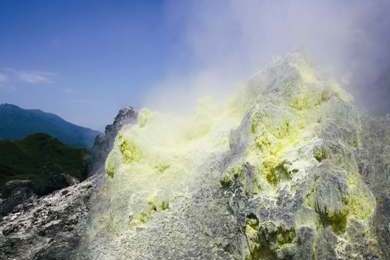
- left: A 2m-tall cuneal crystal column of yellowish white color is formed at one fumarole at Dayoukeng. / by Wen-sung Wang
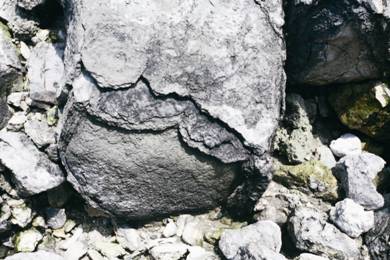
- right: Almost all the lava flow of the Datun Volcano Group is andesite that contains black mineral crystal of primarily iron and magnesium. / by Wen-sung Wang
Volcano Activities of Dayoukeng
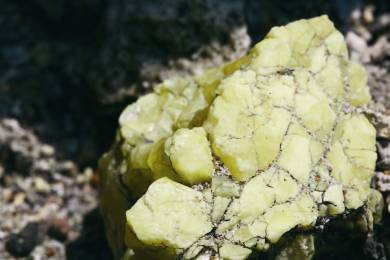
Dayoukeng was once an important place of sulfur production and now all mining operations have stopped, except that the 2 large fumaroles there are still fuming noisily. The sulfur surfaces above the ground together with the volcano gas and forms crystals near the margins of the fumaroles, and one of which even forms a 2-m-tall cuneal crystal column of yellowish white color.
90% of the white misty fume released from these 2 fumaroles is steamy vapor, and the rest comprises CO2, SO2, H2S and other chemicals. “Just a little bit of sulfur (SO2) can fill the volcano gas with pungent smell,” says Professor Song. Therefore every part of the Datun Volcano Group with fumaroles found will smell sulfur.
“According to scientific monitoring, it is true that there is magma underneath Dayoukeng, but that doesn’t mean the magma will soon erupt. It takes a long-term monitoring to make any prediction. However, there isn’t any sign of immediate eruption for the present. There’s no need to panic!” says emphatically Professor Song.
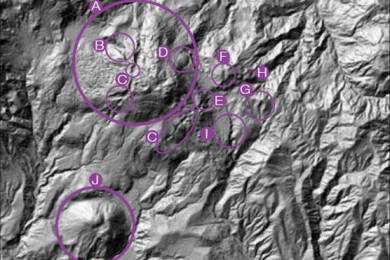
Then professor Song shows us a LiDAR image of the Datun Volcano Group from the computer file. On the topographic image made by scanning and determining distance to a surface with laser pulses, one can see clearly all the fissures of a volcano landform, the volcano bodies, lava plateaus and other landforms.
Airborne high-frequency laser beams are shot from the air to the ground, and by measuring the time delay between the transmission of a pulse and the detection of a reflected signal we can determine the three-dimensional coordinates of the buildings, vegetation and the landforms. Professor Song says, “LiDAR can directly erase the information about the building and vegetation to exhibit a complete appearance of the landforms. Judging from the LiDAR image of the Datun Volcano Group, between the Menghuan Pond and Lengshueikeng there are several fault fissures caused by volcano eruption, and is the reason for the leak of the Menghuan Pond.”
Various changes happened to the Datun Volcano Group millions of years ago have been gradually recovered by LiDAR images. “Volcanology in Taiwan has gained a lot more new information about volcano detection thanks to the improvement of scientific apparatus in these 2 years,” says Professor Song smilingly. By observing the present to learn about the past with the help of scientific monitoring and detection, geologists will discover more and more interesting stories about the Datun Volcano Group.


Doctor of Science of Department of Geosciences, National Taiwan University, and once a visiting research fellow of Brookhaven National Laboratory, USA. He is now Professor of Department of Geosciences, National Taiwan University, specializing in volcanology, petrology and Geochemistry.
- upper: Shamao Mountain is sulfuric fumaroles in west of Mt. Chishing, and around many natural sulfur. / by Mike Yang
- lower left: The sulfur gas erupts from the opening, sublimates on the rock surface and becomes fragile crystal nuggets. / by Wen-sung Wan
- lower right: The LiDAR image of the Datun Volcano Group. / by Sheng-rong Song A.Cising Mountain B.Siaoyoukeng C.The Fissure of Volcano D.Lava Dome EMenghuan Pond F.Chiku Mountain G.Cinder Cone H.Cingtiangang I.Lengshueikeng J.Shamao Mountain


