Derict to middle content area:::

:::
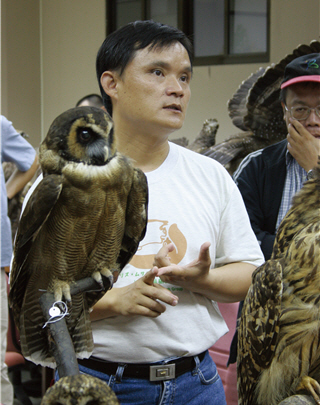

 Profile of Jheng-de Yao
Director of Medium-altitude Experimental Station and student of Ph.D. program at National Cheng Kung University, he has served at TESRI for a long time. He used to be an assistant in the Birds Laboratory of Academia
Sinica and engaged himself in studies on bird ecology and production of ecology-promoting films for a long time. Therefore, he is good at both bird studies and photography. He is engaged in bird ecological studies in the Aowanda National Forest Recreation Area, Da Xue Shan Forest Recreation Area, and Hehuan Mountain.
Blue Crisis-Between Urocissa caerulea and Urocissa erythrorhyncha
Blue wings, cherry-like beak, and claws that are like on high heels, when the bird takes off and overlook the world underneath, it is the most adorable and pitiful little creature.
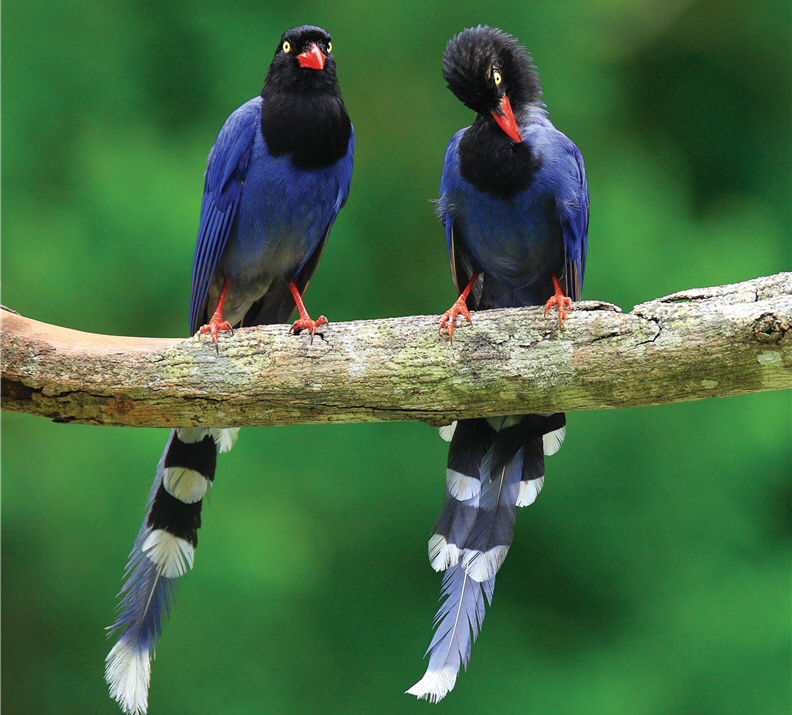
Voted one of symbols for Taiwan in 2007, this is the state-grade bird, Urocissa caerulea Gould.
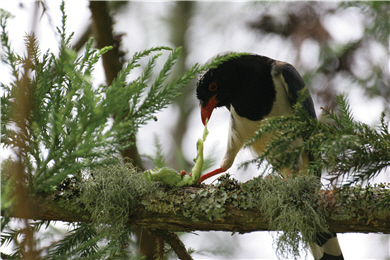
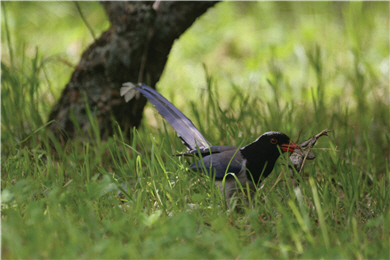
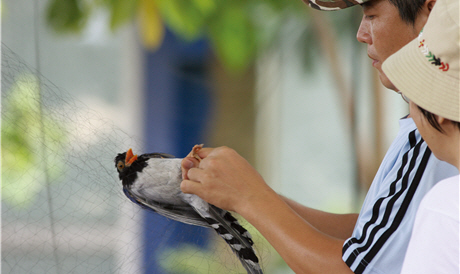
- lower left and right: Urocissa erythrohyncha an omnivorous bird feeding a variety of food sources./ by Cheng-te Yao
Interview & Text/ Hsin-hua Lian
Special thanks to/ Jheng-de Yao, Associate Researcher and Station Director, Endemic Species Research Institute
Translator/ James Chang
Photo provider/ Jheng-de Yao
Best of state run across accidentally
Urocissa caerulea Gould was first found in China. Migrating from Mount Everest, through Hainan Island to Taiwan, their return trip was blocked by the Taiwan Strait and accordingly evolved to become Taiwan specific bird.
About 65cm in length, Urocissa caerulea Gould lives primarily in broad-leafed forests at middle to low elevations. Its tail occupies nearly 2/3 of the total body. The busy chirping sound has brought it an interesting nickname, “long-tailed village girl.” The plump body, bright red beak and claws, and white strip at the tail end are the reasons that they people’s favorite.
Urocissa caerulea Gould is an omnivorous bird feeding a variety of food sources. Every year between March and April, Urocissa caerulea Gould will build rough but steady bowl-shaped nests in higher areas in trees with branches and leaves. However, elegant as they seem, they are not as tame as we believe. Complicated and enriched as their social behavior, they work with their spouses and a couple of helpers, their offspring, to guard their home against outside threat or invasion. The attacking behavior exacerbates in nursing seasons and continues until enemies retreat.
They are monogamous and have social features reflective of indigenous people, making a bird exclusively for Taiwan.
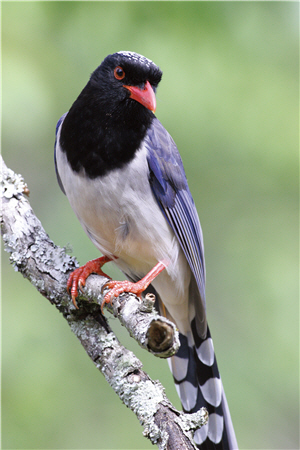
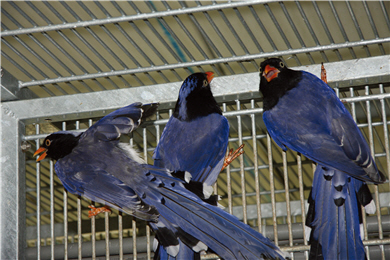
Urocissa erythrohyncha has darker grayish blue feathers, a white crown and belly, and bright red iris and beak. Other than that, they are highly identical to Urocissa caerulea Gould. Suspicious to have been introduced into Taiwan on purpose, they surprisingly turned from a traveler to a settler and were named after China despite the fact that they are available not only in China. As a result, the two species encountered with each other and a territory fight began. Urocissa erythrorhyncha was introduced and freed on Wuling Farm at 1800 to 2100 meters, while indigenous Urocissa caerulea Gould lives at lower to 1000 meters above sea level. With better survivability and adaptability, the territory of the former may expand as time. A news coverage on March 2007 said that around 20 Urocissa erythrorhyncha were spotted at 2100 meters and caused a big concern among conservationists. Jheng-de Yao, Director of an endemic species research institute station confirmed the possibility but added “Wuling Farm was not the habitat of Urocissa caerulea Gould.”
Urocissa erythrohyncha has darker grayish blue feathers, a white crown and belly, and bright red iris and beak. Other than that, they are highly identical to Urocissa caerulea Gould. Suspicious to have been introduced into Taiwan on purpose, they surprisingly turned from a traveler to a settler and were named after China despite the fact that they are available not only in China. As a result, the two species encountered with each other and a territory fight began. Urocissa erythrorhyncha was introduced and freed on Wuling Farm at 1800 to 2100 meters, while indigenous Urocissa caerulea Gould lives at lower to 1000 meters above sea level. With better survivability and adaptability, the territory of the former may expand as time. A news coverage on March 2007 said that around 20 Urocissa erythrorhyncha were spotted at 2100 meters and caused a big concern among conservationists. Jheng-de Yao, Director of an endemic species research institute station confirmed the possibility but added “Wuling Farm was not the habitat of Urocissa caerulea Gould.”
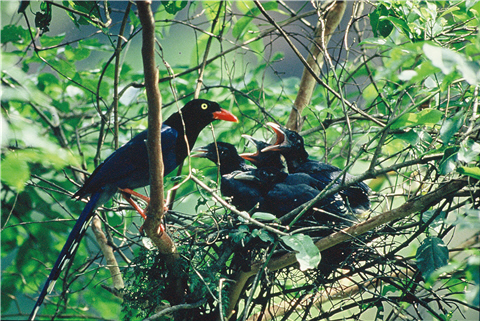
- upper left: Urocissa erythohyncha is referred by Taiwanese to as the blue magpie from China and has a darker feather color./ by Cheng-te Yao
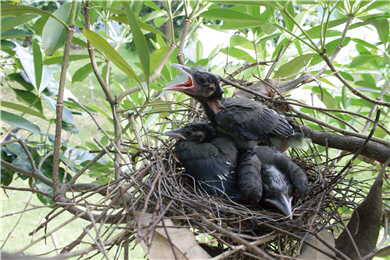
- upper right: A nursing scene of Urocissa caerulea: complicated and enriched social behaviors make Urocissa caerulea Gould a friendly bird of people./ by Cheng-te Yao
- lower left and right: Hybirds of Urocissa caerulea and Urocissa erythrohyncha: adult(right) and babies(left)./ by Cheng-te Yao
“Hybrid” worries remove protection
In July 2007, 3 babies of Urocissa caerulea Gould and Urocissa erythrorhyncha were found in Taichung, proving the possibility for the two to hybridize. Once urocissa erythrorhyncha in the wild adapts to the natural environment, it will be worse. Fortunately the species has not formed a stable population and these three babies should be only a single case, indicates Yao. Nonetheless, they are taking measures to protect endemic species by controlling the number of urocissa erythrorhyncha through elimination, live catches and caged raise. During March and June, the mating season for urocissas each year, Yao and the station staff find urocissa erythrorhyncha’s nests and relocate them to avoid hybrid and control their propagation. Yao says that the quantity of urocissa erythrorhyncha is generally under control. As long as everyone is focused, the balance can be maintained and the state birds we love will all have their own living space.
Loving all and stopping sorrow
I believe that no one will ever forget the chirping sound of
Garrulax in early morning in the park. But do you know they are endemic or out-coming species?
Announced a protected species in 1992, TESRI indicate that Garrulax taewanus is endangered by the excessive number of Garrulax canorus introduced and uncontrolled trafficking or managerial loopholes. It takes more time and energy to invest in and mobilize human resources in order to protect the primitive endemic gene against even worse hybridization. “Human factors are the hardest to overcome. Persuasion, communication, and determination of rights take more time and efforts than handling wild species. We should think about whether it is the foreign species or the selfish mindset of humans that must be removed,” reminds Yao.
Having spent 16 years at TESRI for bird studies, Yao has never changed his love for birds since childhood. His love is encompassing. “Sometimes, I migrate with them just to see them, you know,” he teases, “Everyone should know that for state-grade birds or other birds alike, they need respect for their way of survival and space and should not harm them.”
Director of Medium-altitude Experimental Station and student of Ph.D. program at National Cheng Kung University, he has served at TESRI for a long time. He used to be an assistant in the Birds Laboratory of Academia
Sinica and engaged himself in studies on bird ecology and production of ecology-promoting films for a long time. Therefore, he is good at both bird studies and photography. He is engaged in bird ecological studies in the Aowanda National Forest Recreation Area, Da Xue Shan Forest Recreation Area, and Hehuan Mountain.
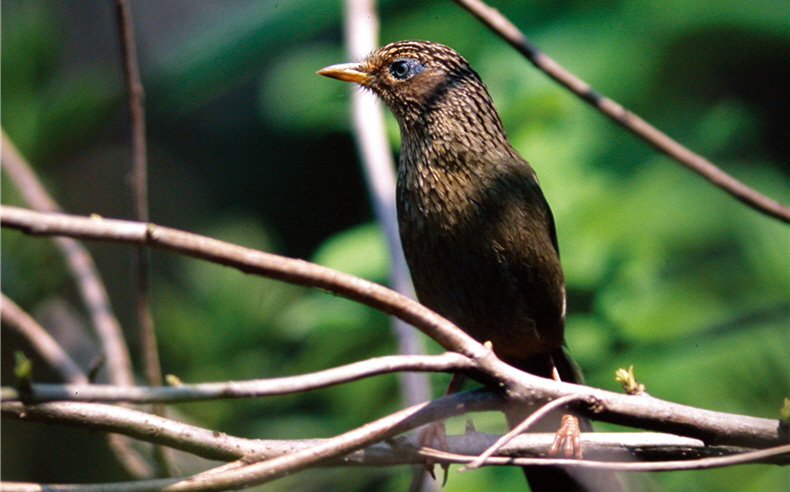
- upper: The hybirdization between Garrulax taewanus announced to be a protected species, and Garrulax canorus is far worse than experienced by Urocissa caerulea./ by Cheng-te Yao
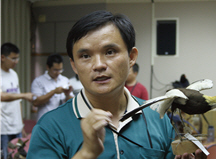
- lower left: Director Yao, a 16-year old professional in bird researches, has long extended his love for birds to the surroundings of the birds./ by Cheng-te Yao
- lower right: Without underming animal protection, Endemic Species Research Institute is working on removing Urocissa erythrohyncha by catching them alive or putting them in cages in order to control their number./ by Cheng-te Yao


