
The Impressive Space Esthetics of Kinmen -
All around the world the cultural historic sites or natural ecological areas follow the trend and try to apply for registration as a “World Heritage”. In addition to being economically benefited from tourism, the emphasis is put upon the positive recognition of the heritage’s value in preserving the natural and cultural tracks. On this premise, Kinmen is now actively preparing itself for becoming one of the “12 Potential World Heritage Sites as Taiwan” and stepping onto the stage of the world.
Three distinctive cultural and landscape features can be seen in Kinmen —— the traditional Southern Fujian Style houses, the Western Style houses, and historic battle sites. They must not be observed separately, for interactions happen all the time…
The Reapperance of Traditional Charm, Southern Fujian-Style Settlements
People travel, customs change, and architecture moves. As most population of Kinmen originally came from Quanzhou and Zhangzhou in southern Fujian Province of China, their architecture style also landed in Kinmen. Now Kinmen has the highest density of traditional southern Fujian-style buildings in
whole Taiwan.
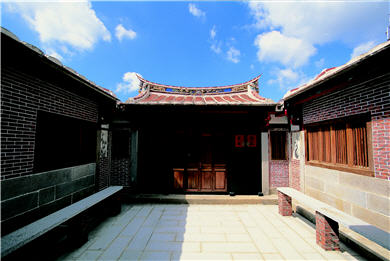
Traditional settlements in Kinmen was formed approximately 700 years ago in late Sung and early Yuan dynasties, but the existing old buildings are mostly built in Ming and Qing. The majority of these southern Fujian-style settlements are villages with single family name, located close to water source, with structures designed against cold winds, and the Ancestral Shrines of the villagers show a clear pecking order. Villages with multiple family names are located near docks, military strongholds and new townships. Because people in Kinmen pay high respect to rituals of life, their traditional settlements are not just properties of a collection of old houses, but the activities among them also represent a living cultural landscape.
Shanhou Folk Culture Village
Shanhoudistrictconsistsofthetop,middleand lower parts, with the Folk Culture Village located in the middle part. Different from the popular amusementparks,theFolkVillage is a community constructed year by year under a general plan of overseas Chinese. A father and son of Wang’ s family from Shanhou emigrated to Japan and prospered by trading grains and beans from China. They then planned to build a village for the entire family back home, and hired a fengshui master to choose a site nestling in the mountain and faceing the sea with each house being able to greet the morning sunshine from the sea. Executed with meticulous care and materials from Zhangzhou, Quanzhou and even Jiangxi Province, the construction started from 1876 and after 25 yearswasfinallycompletedin1900.
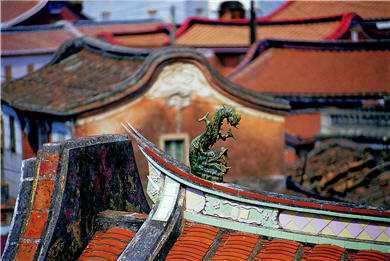
The houses built by early home-coming overseas Chinese are conservative in style that retains the Fujian architectural fashion. The symmetrical chessboard settlement of “Shanhou 18 Buildings” includes 16 two-courtyards grand houses,Wang’s Ancestral Shrine and HaizhuHall (the country school). The “swallowtails” (perked cornice)of neighboring ridges paired face to face, the multple doors with granite frames to protect the place from bulgary as well as and the delicate craftsmanship of ceramic tiles on the wall are all marvelous sights. The “swallowtail” is characteristic in southern Fujian, southwest and southeast Asian architecture. Traditionlly it is said that only a family with a member of high-ranking official can build a house with swallowtails. However, Associate Professor Bowei of Kinmen Technical College finds that, according to some Japanese scholars, it may be inspired by the buffalo-worshipping culture in Southeast Asia and the cornice a transormation of a buffalo horn.
When looking from the courtyard on the slope down at the whole village, one cannot but admire the magnificent gut and unselfish intention of the planner, for it is truly a classic representation of traditional southern Fujian settlement.

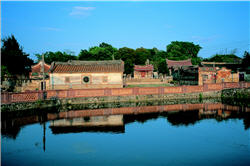
- Location: Southwest Kinmen
- Major Family Name: Xue(Hedong Branch)
- Settlement Type: In addition to providing draining and temperature moderating functions to most of the houses facing it, a large lake sits in the center to “collect water from all directions”, symbolizing the prospect of incoming fortune. Under the overall maintenance project by the government, both the old houses and the surrounding public space have been well recovered.
- left & right: Kinmen / by Chun-hsien Lee‧Dong-kun Liao
Text and Photographer / Chun-hsien Lee
Photo provider / Chun-hsien Lee‧Dong-kun Liao
A Natural Village Settlement: Cyonglin
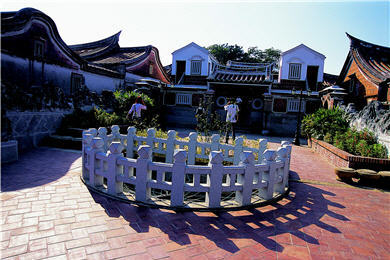
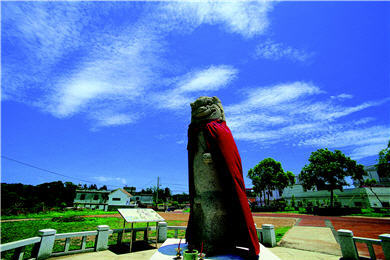
Cyonglin is the larges natural village in Kinmen, with residents mainly related to Cai's Family. Of the settlement formed by two or three hundred houses and with a few exceptional modern buildings and three western style houses, most belong to Fujianstyle architecture, and the number of tripleentrance houses is the greatest on the island. In contrast to the neat order of Shanhou Folk Culture Village, Cyonglin exhibits the fun of a labyrinth with winding paths. Make a turn at the corner and you might encounter a cute statue of the Wind Lion God. The seemingly irregular arrangement actually has a hidden plan in it.
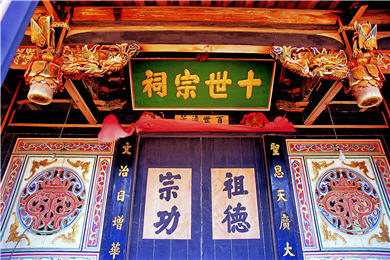
Scholasticism used to prevail in Kinmen. 43 Jinshis (bests of official examinations) came from Kinmen during Song, Yuan, Ming and Qing dynasties, and 6 of them were from Cyonglin. The “8 Ancestral Shrines in 7 Houses” in Cyonglin is most special. Whth the large shrine of the entire Cai’s Ancestral Shrine as the grand center of the settlement, when some member of a branch became a Jinshi, a new small shrine was built and became a small center community. The villagers obey two space laws, the first stipulating that no village house may be taller than the shrine, the second saying that no village houses may be built in front of or behind the shrine. Based on these laws, all the houses spread outward from the central shrine like a tree branching. The horizontal inscribed boards suspended on the shrine have significant meanings. A board has an inscription of “Grandfather, Father, Sons, Siblings and Cousins Got Enrollment” tells that all three generations of the family passed the official examinations. Cyonglin is entitled to be nicknamed “Jinshi Village”.
Sharing the Glory the Western
Style Houses that Honor the Family
The western style house is a new architectural variation after the cultural exchange, with the emigrants playing the introducing media. While similar cases are found in Fujian, Guangdong and Taiwan, the quality and quanty of buildings in Kinmen are most impressive.
In 1821 when the Qing dynasty lost the Opium War and signed the Treaty of Nanking with Great Britain, Xiamen became one of the five ports open to foreign trades, and England, France and the Netherland started to recruit laborers to work in their South Asia colonies. As “life always finds a way for itself”, although in the beginning most people from Kinmen could only earn a living as contracted workers, they continued to go abroad to look for opportunities of development and became the socalled “overseas guys”.
Money Cannot Buy a House as
Spetacular as the Ones in Shueitou
The western style houses in Shueitou Village are the most representative ones in Kinmen, and the exotic Deyue Tower stands out above all others.
The outstanding Deyue Tower is an elegant defense gun tower, and its height of 11.26 m was once the tallest landmark in Kinmen. In late Qing dynasty and early Republic times, the growing richness of hometowns of overseas Chinese along the southeastern coast attracted the covet of pirates and bandits, and the Shueitou Village close to the port had to defend itself against raids. In 1931, Mr. Huihuang Huang from Indonesia provided fund to build Deyue Tower in his hometown. The building was fortified with crenels on the roof and iron gun racks on all sides, and served as the security stronghold and war room. It is interesting to note that the fierceful gun tower has a poetic name popular for gardens in Jiangsu Province.
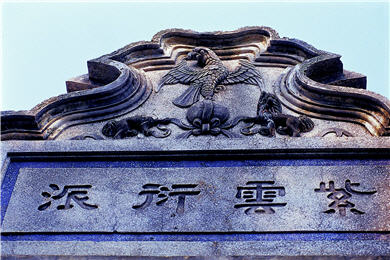
Most of the western style houses near Deyue Tower are built by Huang’s family, illustrated by the residence of Huang brothers “No. 42 Shueitou”. The living space is enriched with ancestors’ name plates placed upstairs, and the living room and bedrooms downstairs. Designs on the walls are symbolic paintings, e.g. angels with westerners’ looks (innocence), clay eagles (endurance of overseas Chinese),
lions (regality), melons and fruits (offsprings) and red-brick characters of double joys, etc. Some residences have western style gables added to traditional front instead of upstair floors and are called “foreigner’s house”, illustrated by the Naifu Huang’s residence “No. 6 Shueitou”.
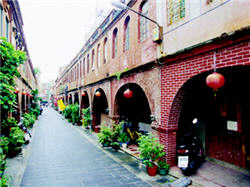
- Location: Jincheng Town
- Type: 32 coving storied shop buildings in southeast Asia fashion
- Features: the five–foot way arcade copying the southeast Asia fashion to provide shelter from the sun and rain as well as ventilation, also known as “oudiv>
- left: The country school at Shanhou Folk Culture Village–Haizhu Hall. / by Chun-hsien Lee
- right: The 10–Generations Ancestral Shrine in Cyonglin. / by Chun-hsien Lee
Reviving from Bombardments
the Scars of War that
Inspires Aspiration for Peace
The name of Kinmen (Golden Gate) stresses on its strategic importance. It is the model of a place that is fortunate and always lives through rough lucks. It has survived from the seasonal pirate raids in Ming and Qing dynasties to the Allied Force’s air raids during Japanese occupation, the heavy bombardments during the confrontation between the communists and KMT, and the harass bombardment every other day for almost 20 years until 1978. Now Kinmen is still a sensitive battle front area with occasional conflicts and strict information control.
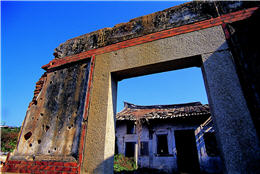
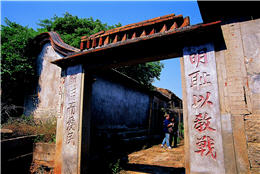
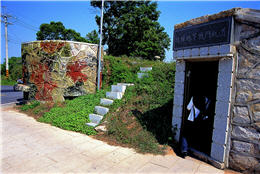
While the war causes damages, the military control and complicated property inheritance system become unexpected protectors that have preserved many historical buildings. The famous Kimen steel kitchen knife is a kind of absurd byproduct of the shells from millions of cannon shots. The countless bullet holes in Beishan old Western Style House give only a glimpse of the severe Battle of Guningtou. The underground tunnels and military posters have turned Cyonglin from a “jingshi village” into a “battle village”. Since the defection of Captain Yifu Lin (now a commissioner of China) who swam from Mashan Observation Station across the channel with the help of a basketball, sport balls have become controlled items. All these are visible and invisible scars of the war.
When in 1995 KMNP was established, the park authority has started to restore historic buildings and some old residences are now open to the public for bed and breakfast. The protected buildings remind us of the world-class treasure that stands tall on the battlefront. When people try to direct the form of a place, they are reshaped by the place itself.
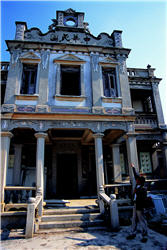
- Location:No. 2 Houjhai, Jinsha Town
- Type:two-story turtle–shape western style house
- Features:the lower part of the wall uses base stone, and the upper par t uses car ved red br icks and colorful glazed tiles. The front gable has a hollow rel ief inscr iption saying “the 21st year of ROC”, an exhibition of local custom and folk art.
- upper left: The Wind Lion God of Cyonglin. / by Dong-kun Liao, provided by KMNP
- upper right: On the gable of the residence “No. 6 Shueitou”, the clay eagle symbolizes the perseverance of overseas Chinese. / by Chun-hsien Lee
- lower left: The half–collapsed Beishan Western Style House with countless bullet holes in it. / by Chunhsien Lee
- lower center: The military slogan posted on the wall of a residence in Cyonglin. / by Chun-hsien Lee
- lower right: The entrance to the underground tunnel in Cyonglin. / by Chun-hsien Lee


