
Autumn Festival of Silvergrass-A Visit to Miscanthus on Ancient Trails in Yangmingshan National Park
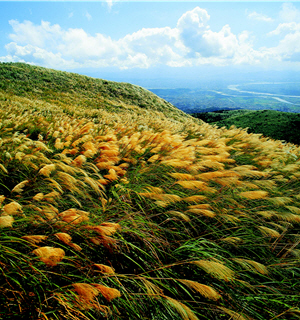
I sat alone in silence as usual, but at a loss. I didn't feel a thing as I saw the flowers of silver grass keep flashing by outside the window and flashing by. As simple as that at first, the flowers spread along the hill parallel to my line of sight, coming and going fast as bits and pieces of snowflakes, or on farther slopes, like countless sheep bowing their heads quietly as the sound of cars heard on and off.
– from Yang Mu's Silvergrass in November
The renowned writer-poet Yang Mu once wrote a touching and spontaneous work using silvergrass (Miscanthus ) as a metaphor for a mother's love. Differing from colorful blossoms in spring, plants in autumn and winter display their upstanding beauty in the chill, a well-liked subject among writers. As silvergrass was in full bloom during the making of this issue, let's follow Ms. Wu-mei Chen, a veteran of Interpretation and Education Section, YMSNP, on a visit to Miscanthus in ancient trails.
Not Weed but Treasure
In the agricultural society, farmers used to use silvergrass as materials in building thatched huts or use its stem to make brooms. But the practical values of silvergrass, in fact, are far beyond people's imagination.
Silvergrass has strong vitality and adaptability as its seeds may emigrate through wind to anywhere, even the toughest environments such as damaged lands, wastelands, high mountains, etc. Some experts even depict silvergrass as an officious, vagrant swordsman because it could preserve the organic compounds in the soil and recover lands from heavy metal pollutions. With its healing effects on soil and water conservation, silvergrass plays an indispensible role in the ecological environment.
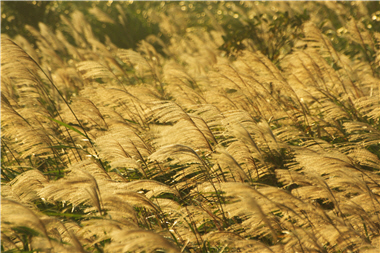
- upper right: How could one miss this spectacle of a sea of silvergrass exclusive in Yangmingshan National Park? / Photo provided by YMSNP and taken by Zhi-ming Chen
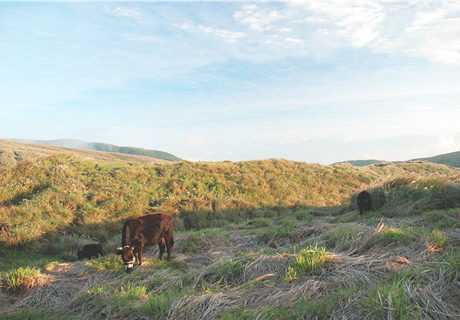
- upper left: Cattle are grazing on the meadow in a backdrop of silvergrass on Cingtiangang Grassland. / by Matt
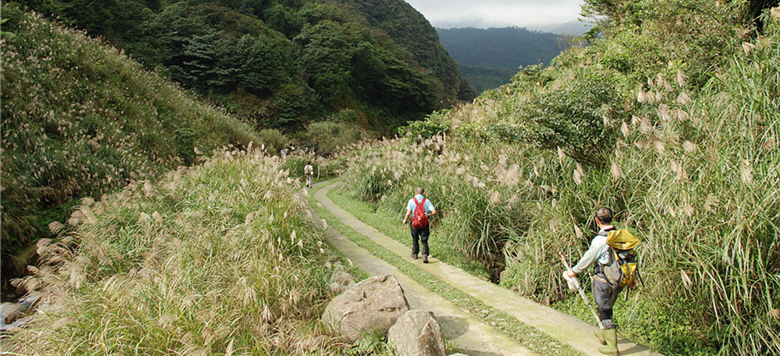
- lower: Be sure to take an autumn silvergrass trip along the ancient trails in Yangmingshan National Park. / by Matt
Text/ Hsin-hus Lian
Special thanks to/ Ms. Wu-mei Chen & Ms. Shu-chun You of Interpretation and Education Section
Yangmingshan National Park Headquarters (YMSNP)
Translator/ Kuan-yu Ou
The advantage silvergrass shows in its fast growth in damaged lands has been noticed by EU countries. Scientists in Europe have refined and crossbred silvergrass and used it as fiber, fuel for electricity, and carbon dioxide fixation. The high genetic variation of Miscanthus in Taiwan has also made it the basic source for research on crop domestication. Thus, this “weed” widely viewed by most people in Taiwan has indeed become a “treasure” highly valued by European researchers. Once further utilized and applied to various aspects, this precious bio-genetic resource will be of relative values in facing the challenges brought by climate change.
A Date with Silvergrass in Autumn
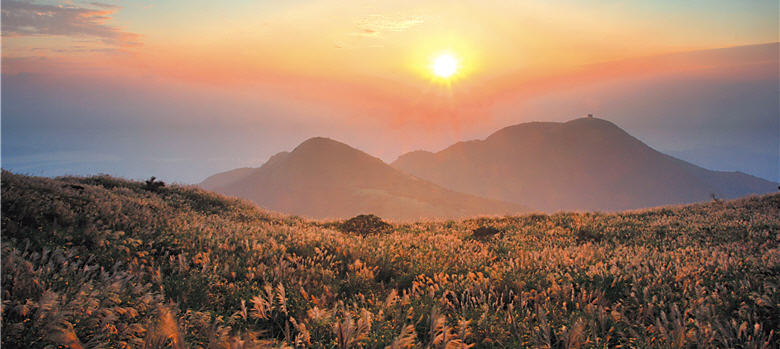
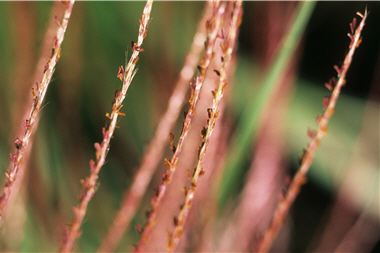
The main species of silvergrass in Yangmingshan is Miscanthus sinensis Anderss var. glaber (Nakai) J.T.Lee. Its flowers are characteristic bright red in the beginning and turn grayish white or yellowish brown upon maturation. After absorbing the sulfurate hot air amid volcanic terrain, the flowers exhibit a particularly red color, creating a dream-like, flaming-red charm for Yangmingshan in autumn and winter.
In late autumn the whole mountain would become the stage for silvergrass, whose flowers, like tour guides, lead visitors everywhere from Mt. Datun, Mt. Cising Mountain, to Historic Fisherman Trail, a must-visit with a rich history and humane qualities.
Starting from Shanghuangxi, one may see blossoming silvergrass waving in the northeast monsoon. Along the stone stairway upwards is the brick kitchen range relic, while past Syuyan Bridge the historical Hangbing's House Ground and Earth God Temple are also great tourist spots. And be sure to look back on the spectacle of a sea of silvergrass when walking on the steep One Hundred and Twenty Stairs along Ho-Nan-Braves Military Road. Afterwards, reaching the gate at Jinbaoli Trail and then Cingtiangang Grassland, one might see cattle grazing on the meadow in a backdrop of silvergrass.
Every autumn YMSNP would organize events guided by the Park's interpreters for tourists to enjoy a trip of reminiscence and romance as they relish the beauty of silvergrass and listen to historical stories of the ancient trails.
YMSNP highly recommends a tour to the silvergrass in the Park. In addition to Historic Fisherman Trail, other attractions, such as Mt. Cising Trail, Mt. Datun, Cingtiangang, and Jingshan Suspension Bridge, are also worth a visit. Only by up-close appreciation will people truly understand the value of and guard this perseverant and beautiful plant.


Profile of Ms. Wu-mei Chen
Once serving in the Shei-pa National Park Headquarters, Chen currently works at Interpretation and Education Section, Yangmingshan National Park Headquarters. As a Nature-lover, she enjoys mountaineering and has long been promoting environmental education activities and one of the traditional cultures – vegetable dyeing.
- upper: Silvergrass in an autumn sunset cast a dream-like, flaming-red charm for Datun Mountain. / Photo taken by Fu-kang Xu.
- lower left: How could one miss this spectacle of a sea of silvergrass exclusive in Yangmingshan National Park? / Photo taken by Fu-kang Xu.
- lower right When the tassels of slivergrass come off, they would split like a broom./ Photo provided by YMSNP and taken by Cheng-ming Liu.
Silvergrass (Miscanthus ) is commonly mistaken for its look-alikes listed in the following chart. Here is a comparison among these similar plants. Try to distinguish them when you see them next time!
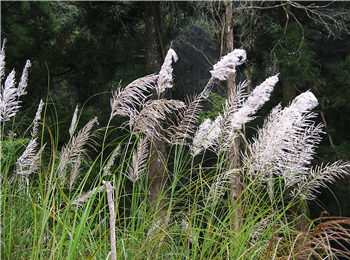
Saccharum spontaneum L.
- habitat: riverbed
- soil type and environment: gravel ground
- leaf shape and width: long, slim, shaped like sharp blades or swords; about 1 cm wide.
- flowering period: around Sep. (Mid-Autumn Festival)
- color of new tassels: pure white
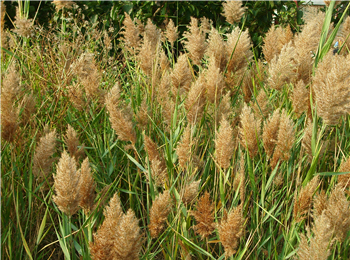
Phragmites australis (Cav.) Trin. ex Steud.
- habitat: seashore
- soil type and environment: flooded mud flats
- leaf shape and width: short, broad, resembling the bamboo leaf; about 3 cm wide.
- flowering period: around Oct.
- color of new tassels: brownish
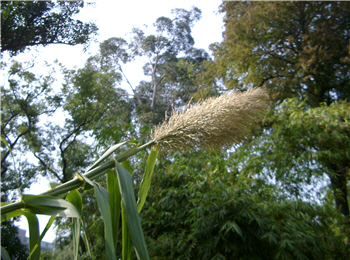
Arundo donax L.
- habitat: inland riverside
- soil type and environment: mud flats and riverbank soil
- leaf shape and width: short, broad, resembling the bamboo leaf; about 5 cm wide.
- flowering period: around Oct.
- color of new tassels: brownish
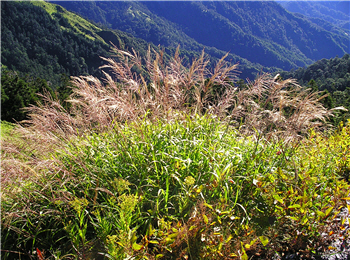
Miscanthus sinensis Anderss var. glaber (Nakai) J.T.Lee.
- habitat: everywhere
- soil type and environment: damaged land at lowand mid- altitude
- leaf shape and width: long and oval; about 4 cm wide
- flowering period: Sep. to Dec.
- color of new tassels: red


