
Safeguarding Our Home under the Sea-Marine Conservation at Dongsha and Kenting
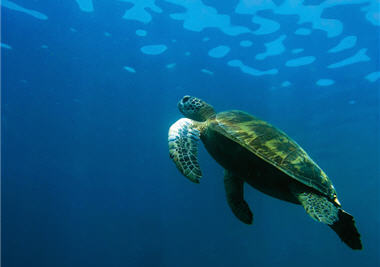
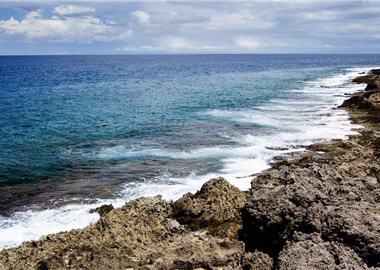
The ocean may well be Taiwan’s best friend and greatest asset.
Accounting for less than 0.03% of Earth’s land surface, Taiwan has little to boast of in terms of geographical size, but the island is truly extraordinary when it comes to marine ecology. About 10% of the world’s marine species could be seen near Taiwan, including all sorts of local fish, corals, seaweeds, crustaceans as well as dolphins and sea turtles. The number of marine life species near Taiwan is more than 500 times greater than the average of other coastal nations, thanks to the island's special location (near the edge of one of Earth’s largest continental shelf and on the northern side of East Indian Islands, the world’s leading treasury of marine life) and the highly diverse ocean habitats that surround it.
However, pursuit of economic development over the decades has taken a toll on Taiwan’s marine environment, and its resources, once considered inexhaustible, are already showing signs of depletion. It’s time that marine conservation had to be a top priority for all Taiwanese.
Since its founding in 1984, Kenting National Park (KTNP) has been a steadfast proponent of marine conservation, paying close attention to issues in the area such as fishing, coastal development, industrial waste pollution, and eutrophication. KTNP also pushes for eco-friendly policies in order to maintain a sustainable marine ecosystem for Taiwan.
In addition, a petition was made during an IUCN East Asian conference back in 2002 that the Dongsha Atoll should be designated as an MPA (Marine Protected Area), which, under the planning of the Ministry of the Interior, eventually led to Dongsha's establishment in January 2007 as Taiwan’s first marine national park, a milestone in the history of the island’s marine conservation.
Finally, a more integrated and comprehensive project was on its way for the protection of Formosa’s marine environments.
Marine National Park, The Font Line of Marine Conservation
“If we don’t do it today, we will regret it tomorrow.”
A simple quote like this epitomizes the deepest concern of Mo-lin Yang, Director of the Marine National Park Headquarters (MNP).
An amazing shot of the clear, blue ocean is the first thing that greets the eyes of visitors to the MNP’s website. For most people, it may only inspire thoughts of relaxation and recreation, but some see in it our responsibilities to protect the extraordinary environment for future generations.
In terms of either management or research, marine national parks pose a greater challenge than their land-based counterparts.
- upper left: The ocean breeds countless creatures, and is also closely related to the survival of mankind. / by Blogger Simon
- upper right: There are precious coral reef lagoon landscapes in Houbihu Marine Resources Protection Demonstration Area, which can be natural breeding fields for marine creatures. /by elwynn
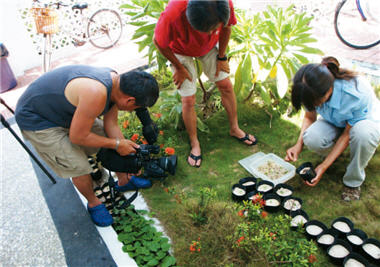
- lower left: Long-term conservation research projects have been implemented by the staff of MNP. / Photo provided by Jui-hsien Wu
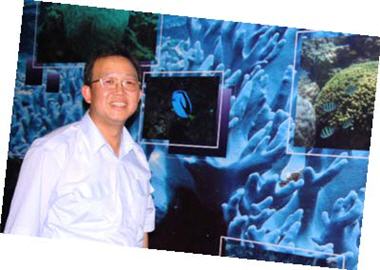
- lower right: Director Mo-lin Yang of Marine National Park Headquarters felt an immense gratitude to the efforts and passion that MNP staff have invested in the promotion of marine conservation. / by Wan-ching Lai
Interview & Text/ Wan-ching Lai
Special thanks to/ Mo-lin Yang, Director of the Marine National Park Headquarters
Xie-qun Ma, Chief of Conservation Research Section of Kenting National Park
Translator/ Cary Chuo
First of all, it is hard to draw clear boundaries for a park on the sea. And problems inherited from Dongsha’s pre-national park days, like the effects of a long history of dynamite and poison fishing, are difficult to handle. To give the ecosystem enough time for recovery, and to help researchers focus on marine restoration, MNP is currently closed to the public. Besides, Taiwanese fishermen no longer go to the Dongsha Atoll nowadays because of successful environmental education as well as the full support of Taiwan’s Coast Guards.
What can be done with relative ease in Taiwan proper may suddenly turn costly and arduous when the setting becomes the distant Dongsha Islands.
“Photographer Yung-chuen Tsai once went to Dongsha for an MNP assignment. The pictures he took were beautiful and breathtaking, though it’s a pity that magnificent shots of schools of fish swimming had not been included. Yet it was by no means the photographer’s fault. A lot of factors—time, ship schedules, proper conditions for underwater shooting—must cooperate. It’s easier to make repeated attempts in Taiwan than in Dongsha,” Yang said.
League of Extraordinary Gentlemen and Ladies
Safeguarding the beauty of the ocean is not the only task for MNP. Conducting various researches is also necessary. But the expenses for doing so under the sea are much higher than on land.
“We have to continue all the projects under tight budgets, so the employees of MNP have all acquired the extraordinary skill to complete their respective studies with minimal resources,” Yang said with deep gratitude.
Some of the MNP staff have studied Dongsha's migratory birds over a long period of time, others have worked on coral reefs, still others have examined the restoration of fish populations. For them, Dongsha has already become a second home. Once a researcher even found a Japanese-made, 65-year-old bottle, which bore witness to the Japanese occupation of Dongsha.
“To facilitate their research, these MNP staff even acquired the skills of sea floor survey and photo shooting,” Yang said.
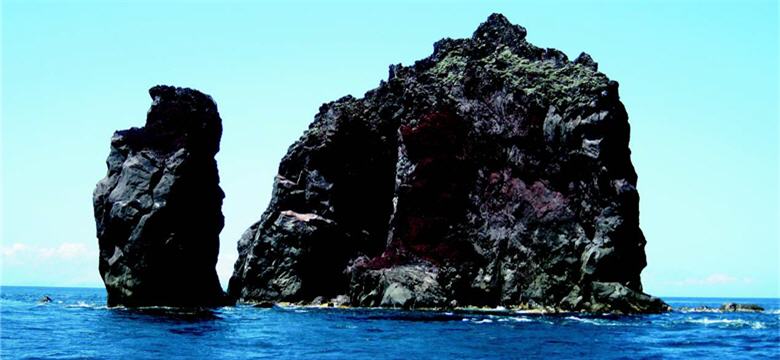
- upper: Marine National Park Headquarters has brought up a project called “Sustainable Islands” and has expanded the area of marine conservation, aiming to make a sustainable future for our marine resources. The Picture is Huaping Islet and it belongs to “The Three Northern Islands.” /Photo provided by Marine National Park
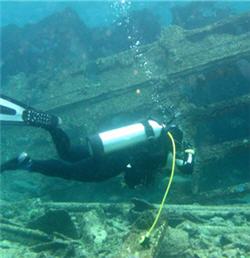
- lower left: The Marine National Park staff have acquired excellent diving skills, which are a requirement for the job. /Photo provided by Yi-chuan Chiu
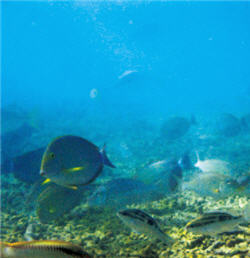
- lower center: After Houbihu was designated as an MRPDA, the marine creatures in it finally have a chance to flourish./ Photo provided by Kenting National Park
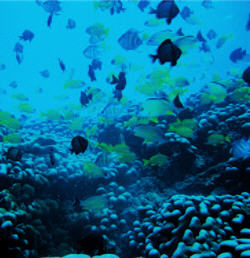
- lower right: Later numerous tropical fish can be spotted swimming in the lagoon. / Photo provided by Kenting National Park
Aside from the Dongsha Atoll, the MNP's research targets also include the Three Northern Islands, Gueishan Island, Lutao, Lanyu, Small Lanyu, South of Penghu Islands, and Itu Aba Island.
“Scientists estimate that about one third of the world's fishery resources have been exhausted, so 20% to 40% of Earth's oceans must be designated as MPAs to keep them sustainable. According to the Durban Accord, reached during the Fifth World Parks Congress in South Africa in 2003, governments should expand MPAs to at least 12% of their territorial waters in the next 10 years, and set up a global MPA database by 2012,” Yang explained.
Even after the establishment of the Dongsha Atoll National Park, Taiwan is still 7% short of the Durban standard. It is hoped that Lutao, the Three Northern Islands and Penghu may soon follow suit and become marine parks, though the support of local governments, fishermen and inhabitants must first be won. Achievement of this goal will not only represent a step forward for marine conservation, but also boost Taiwan's international standing.
“Viewed from the sky, the ring-shaped Dongsha Atoll seems to symbolize a sustainable future for our marine resources. And the desire to make it happen is what drives MNP forward,” Yang confided.
Kenting—Taiwan's First Step Toward Marine Conservation
Besides the efforts by MNP, Kenting National Park, the first of its kind in Taiwan, has also been hard at work on changing the public's perception of marine conservation with more vivid experiences.
“Many coastal residents earned their living on the sea for generations. They always considered the marine resources inexhaustible. So they couldn't understand why KTNP had to set up an MPA, and strongly opposed it,” said Xie-qun Ma.
Ma is the chief of Conservation Research Section of the KTNP, where he has worked for 16 years. It is the duty of his section to protect all sorts of creatures in the Park. Ma is especially perceptive of how the public's understanding of marine conservation has evolved over the years.
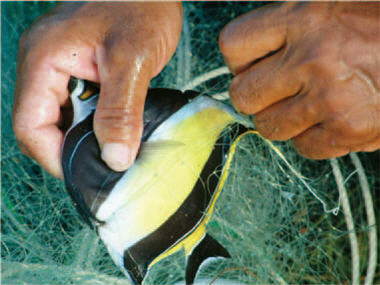
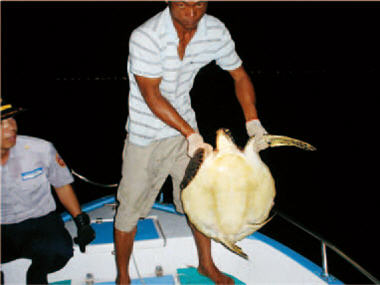
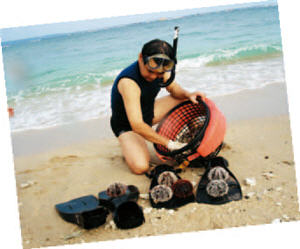
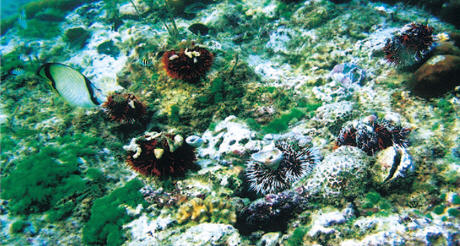
- upper left: Dr. Shyh-min Chao of National Museum of Natural Science is observing the growth of sea urchins in Houbihu MRPDA. / Photo provided by Houbihu Police Squad
- upper right: The fact that Houbihu MRPDA abounds with sea urchins really cheers conservationists up. / Photo provided by Houbihu Police Squad
- lower left&lower right: Saving dying butterflyfish, protecting Green Turtle (Chelonia mydas), and so on; these are the many difficulties KTNP staff must brave while implement their conservation tasks. / Photo provided by Kenting National Park
“In the past decade, fishermen had to travel farther and farther, for the fish have become so hard to find near the coasts. For these people, the impact of marine resource depletion is most deeply felt.”
The accumulated effects of overfishing have started to surface in the form of sharp drops in revenue, forcing some fishermen to develop leisure fishery instead, which opened the door for the promotion of marine conservation. In 2003, KTNP established “Houbihu Marine Resources Protection Demonstration Area,” an attempt to show the local community a new approach to the sea.
A Partnership in Conservation
Ma referred to a “bank account theory” to explain the MPA's importance. “Just consider the MPA a kind of time deposit with an extremely high annual yield. Let's say a female sea urchin in Houbihu produces 5 million eggs each year. Even if only one in ten thousand survives (its 'interest rate'), there will still be 500 baby sea urchins alive. Many of them will float outside of the MPA and benefit the fishermen. But if people break into the MPA to catch them, the entire account may be emptied and there won't be interests anymore.”
As a pioneer in Taiwan’s marine conservation, KTNP keeps seeking new ways to improve the relationship between local residents and the Park. “It is not the goal of the national parks to impose restrictions on the residents' activities. What matters is to help them see the big picture and understand the local marine culture,” Ma emphasized.
Actually, no one knows or cares about the sea more than fishermen do, for their livelihood would be at stake once the resources are exhausted. “The park can't just keep setting up bans on the locals without seeking solutions for them,” Ma pointed out.
A solution may be found in the concept called Partnership in Community Conservation. “KTNP works with local communities like Sheding and invites the residents to help with the observation of various species—Creasted Serpent Eagle (Spilornis cheela), Formosan sika deer (Cervus nippon taiouanus Blyth), Formosan rock monkeys (Macaca cyclopis), fireflies and Heng-chun birdwing butterflies (Yroides aeacus Kaguya Nakahara & Esaki). Through this, KTNP provides the locals with money as well as opportunities to appreciate the significance of conservation and a potentially lucrative future of eco-tourism,” Ma said.
A more complicated version of this partnership is being planned for the fishermen. If everything goes smoothly, research projects can benefit greatly from their expertise, and the fishermen can also be properly subsidized, and educated with concepts of conservation.
Promoting Ecotourism at Home
“We know a crab expert in Kenting. His skills at capturing crabs are truly phenomenal. KTNP wants to hire him for our marine resources surveys, and turn this crab seller into a great helper in conservation. We would also pay many local fishing experts to keep doing their jobs, but the fish they've caught will be studied rather than eaten,” Ma said. Only when the livelihood of local communities is taken care of will conservation work be consolidated.
Each year, a lot of Taiwanese people pay for expensive trips to famous resorts like the Barrier Reef and Palau, but the beauty of Kenting's coral reef is every bit as magnificent as its better known counterparts. Therefore, Ma believes that tourism can prove more profitable for Kenting than fishery, but a couple of problems must be addressed before that goal can be achieved.
According to Li Lo, a marine documentarian as well as a diving coach in Lutao, the behavior of most divers in Taiwan cause serious harm to the marine ecology. The observation is based on a related research project he currently works on. Despite the impressive efforts of the national parks, a lot still remains to be done in educating the public about ecotourism.
In the future, KTNP aims to offer guided diving tours, with certified professional divers serving as conservation educators for the tourists. “Let those who are enthusiastic about marine protection join us! Let the professional divers show our tourists the grandeur and liveliness of the marine world.” After all, for promoting conservation, a firsthand close-up experience under the sea would speak louder than hundreds of slides or thousands of pamphlets.
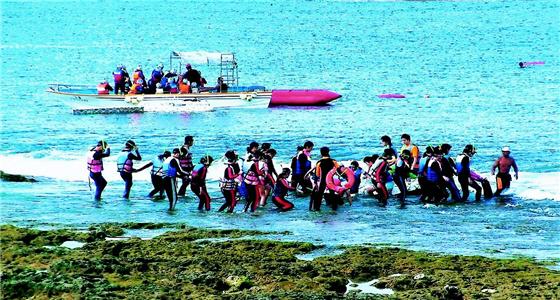
- upper left: The profits gained from recreational activities like sightseeing boat rides and snorkeling are no less than those from fishing. These activities, at the same time, contribute to the sustainability of the ocean./ Photo provided by Kenting National Park
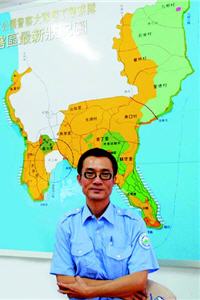
- upper right: Chief Xie-qun Ma of Kenting National Park Headquarters says that KTNP is planning a project that incorporate the participation of local communities into the survey of resources, which will be a great help to marine conservation of Taiwan. / by Wan-ching Lai


