
Stories on a Ring-Experience Birds' Life through Bird Banding
Most birds are migratory in nature. And as humans, we can't help but wonder how far birds can actually fly and where they eventually end up. In fact, a technique known as bird banding can rightly provide answers to these questions. Yi-shen Ho, Head of Guandu Nature Park (GDNP), is a veteran in the area of bird banding. From him we got to know more about the technique and appreciate the various data of birds' life acquired through bird banding.
It All Started with a Red Thread
Each year when it gets warmer, groups of swallows would nest and breed under the eaves of many buildings across Taiwan, and then leave with the entire family around autumn and come back next year. This cycle intrigued our ancestors long time ago as legend1 has it that in the Warring States Period the maids of the King of Wu would tie a red silk thread on the leg of a swallow as a mark and see if it would one day return. This suggests that the idea of bird banding could date back to ancient times.
Bird banding refers to the technique whereby a bird is first captured in a harmless way, then basic measurement of its body parts is taken and tags attached before the bird is released. Later when the very same bird is found again, data on its migration route, territoriality and population distribution can be acquired.
The earliest recorded attempt of bird banding for systematic investigation was initiated in 1890 by a Danish scientist. In Taiwan, the technique was first adopted in 1964 in a U.S.-led research project on migratory birds and infectious diseases. Then from 1986 to 1991, the Council of Agriculture launched a long-time, large-scale bird banding study administered by the Wild Bird Society of Taipei, Chinese Wild Bird Federation (CWBF) and other wild bird societies across Taiwan. Later the CWBF set up a banding center that has since coordinated banding-related activities and collect information home and abroad.
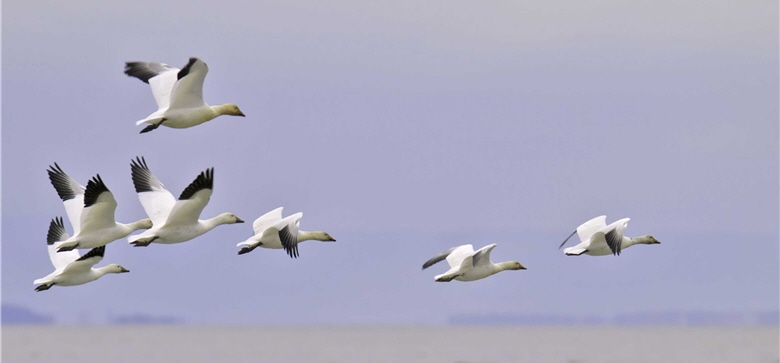
- upper: The epic migration of birds is truly respectable in human's eyes. / by Paul Liu
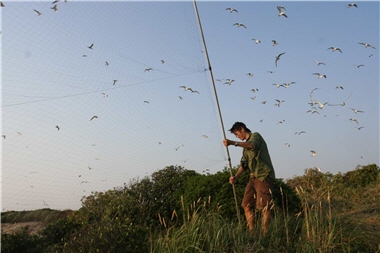
- lower left: Through bird banding, we can obtain precious information on birds and learn to appreciate the stories about their migration. /Photo provided by Yi-shen Ho
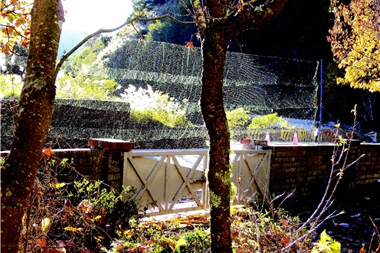
- lower right: The use of a mist net is the most common way when doing bird banding, but the circumstances on the spot play a role too. /Provided by Chao-chieh Chen
Interview & Text/ Jia-jun Lan
Special thanks to/ Yi-shen Ho, Head of Guandu Nature Park
Mr.Yong-hong Zhuang
Ling Lin, Section Chief of National Parks Division
Translator/ Yonglan Huang
Capturing the bird alive is the important first step in bird banding. It requires both experience and skill. Ho noted that each type of bird has different habits and habitats. The watchful Green-winged Teals (Anas crecca), for instance, may land in different places each year. Insufficient preparation, therefore, could render all the wait in vain. The use of a mist net is the most common way to catch a bird, but the circumstances on the spot play a role too. For instance, to capture water birds, the tidal movement needs to be factored in when deciding on the height of the net. Furthermore, if the net is placed in front of the reeds, more birds could be captured as reflection can be effectively reduced.
Be Nice to the Captured Birds
Both researchers and hunters capture birds, but for very different purposes. Researchers do it for both research and conservation purposes, so harm caused to the bird has to be minimized. Ho noted that timid as birds are, sometimes they are even scared off by bird-watchers who don't hide properly, not to mention when they are captured. Some birds, after getting caught, struggle so hard that their body temperatures quickly drop, while some others are even shocked to their sudden death.
To reduce the harm, the researchers need to patrol the net more frequently-sometimes on an hourly basis so that the birds won't be caught in the net for too long. All in all, from tagging to releasing, every step needs to be completed promptly. For example, researchers catching Crested Tern (Sterna bergii) on a desert island in Matsu need to shorten their stay on the island to lessen their impact on the birds' life. In short, the birds should be treated in a humane and careful way.
Besides the birds, the researchers also need to mind their own safety. Ho recalled that once his team took a boat to Guandu for some research and a team member didn't properly fasten the boat to the dock, so the boat drifted away as the tide rose. The team had to ask the people ashore for the rescue. There was another time when a team member accidentally fell into the drain and couldn't call for help. Luckily, a vigilant member found him missing and went back to save him.
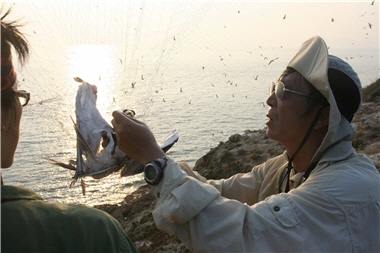
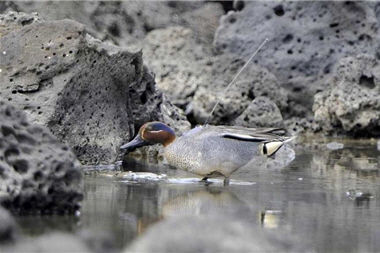
- upper left: Capturing the bird alive is the first step in bird banding. If one wants to observe the watchful Green-winged Teals (Anas crecca), one has to focus on each year's vanguard of the teals and watch carefully their gliding approach and habits. / Photo provided by Yi-shen Ho
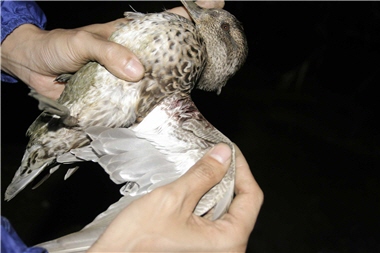
- upper right: Birds are timid animals. Some birds struggle so hard after getting caught that they get injured easily. The picture shows a Green-winged Teal (Anas crecca) cut by the net. /Photo provided by Yi-shen Ho
- lowr left: The use of a mist net is the most common way to catch a bird, but the researcher has to check out the nets more often in order to prevent the birds from being trapped for too long and getting seriously injured. /Photo provided by Yi-shen Ho
- lower right: A Korean bird watcher in Jeju Island, South Korea, took a picture of this Green-winged Teal (Anas crecca) banded in Taiwan, and then sent the photo back to Taiwan. /Photo provided by Yi-shen Ho
Technology and Transnational Cooperation
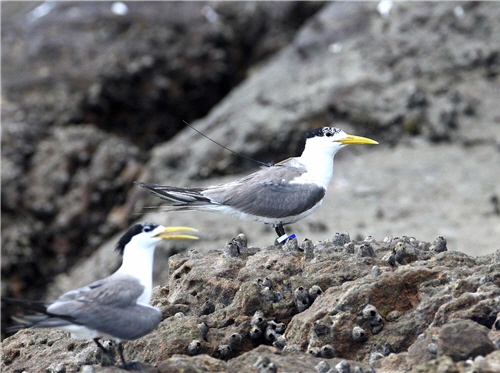
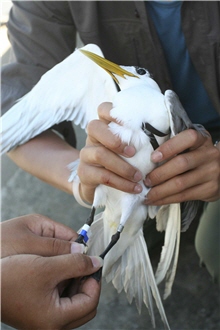
When a bird is captured for the first time, it needs to be tagged for future identification and tracking. In early days, a band was attached to the captured bird's leg, and has on it a contact mailbox for reporting and a unique serial number as an ID. More recently leg flags have also been used as they make observation easier. The original banding place can be identified from the color and the location of the flag on the leg, without the need to recapture the bird. Thus ordinary bird watchers can also take part in the ringing recovery through their own binoculars.
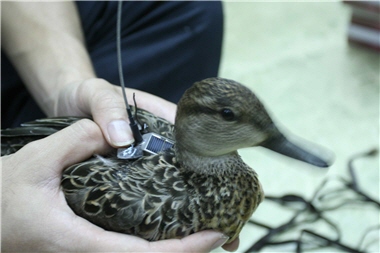
A tracker can record the complete migrating path of a bird. In the early days trackers were generally bulky and required batteries, so they were only suitable for large birds, since the instrument placed on the birds should not exceed 3.5% to 5% of the birds' weight. But thanks to the advances in technology, trackers are now mostly solar-powered and weigh less than 10 g, though they are also relatively more expensive.
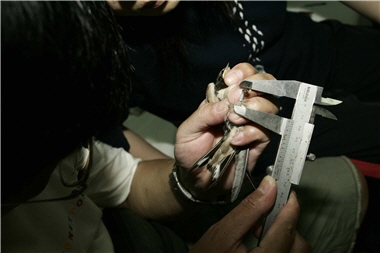
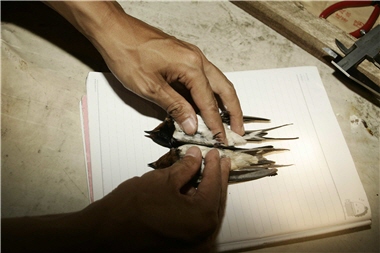
- upper left & upper right: The researchers should treat the birds in a humane and careful way. In upper left of picture , a researcher is measuring a Barn Swallow (Hirundo rustica); In upper right picture, by comparison, the male Barn Swallow has a longer tail. /Photo provided by Yi-shen Ho
- lower left: Through satellite transmitters we get to understand the amazing flying capability of some birds. The picture shows some Creasted Terns (Sterna bergii) with satellite transmitters and leg flags. /Photo provided by Yi-shen Ho, taken by Cheng-zhi Zhou
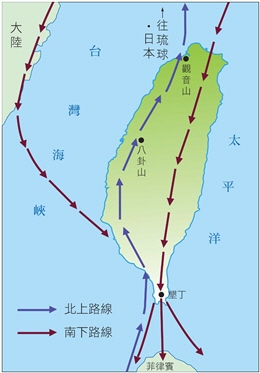
- lower right: The picture shows the migration route of Grey-faced Buzzards (Butastur indicus).
(Reference: Hengchun Peninsula Oudiv> http://163.32.133.8/yang/index.htm )
Epic Migration
A banded bird can be observed or recaptured in places other than the original banding location. Through the recovery of the data researchers get to connect the dots and picture the migratory path of the bird. In such a process, exchanges between people and countries are also made possible. For example, a researcher in Guandu once found a Barn Swallow(Hirundo rustica) from Japan. After he took measurement of the bird, he reported the updated data back according to the mail box specified on the band. The original bander was then interested in the place where the bird took a stay so he came all the way to Guandu. As for birds banded in Taiwan, banders have received data sent back as far as from Vietnam, Australia and even Siberia.
Through satellite transmitters we get to understand the amazing flying capability of some birds: the tiny Artic Tern (Sterna paradisaea ) can travel over 80,000 km back and forth the Antarctica; the Bar-tailed Godwit (Limosa lapponica) can fly up to 10,000 km for a whole week without any food, drink or any rest. This kind of epic migration is so astounding that we as humans cannot but deeply respect the birds.
Guandu Nature Park was once the most important bird banding place in Taiwan, with Ho getting involved as early as in 1989. He believes that Yangmingshan National Park and GDNP should further collaborate in research and conservation, and make known to the public the beauty of the birds as well as their impressive stories of migration.

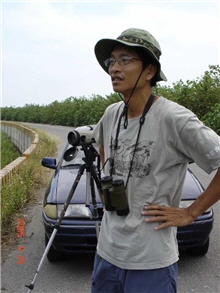
Yi-shen Ho
Director Ho studied business management in college, but then entered the Institute of Natural Resource Management of National Taipei University due to his interests. As a long-time nature lover since childhood, he had joined bird banding research in his school years, and had served in Chinese Wild Bird Federation. Ho is currently a member of Bird Society of Taipei, a lecturer of Youngho Community University and the director of Guandu Nature Park.
- upper lft: Leg flags have been used recently as they make observation easier; ordinary bird watchers can also take part in the ringing recovery through their own binoculars. The picture shows a Crested Tern (Sterna bergii). /Photo provided by Yi-shen Ho
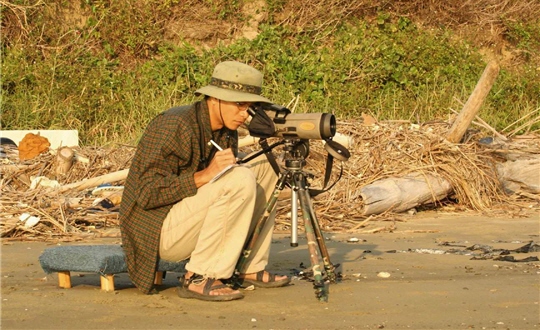
- upper right: The large amount of data behind bird banding research requires a long period of time to collect and compile. /Photo provided by Yi-shen Ho


