
All Those Trails and Stories-An Interview with Prof. Yi-chang Liu of the Institute of History and Philology, Academia Sinica.
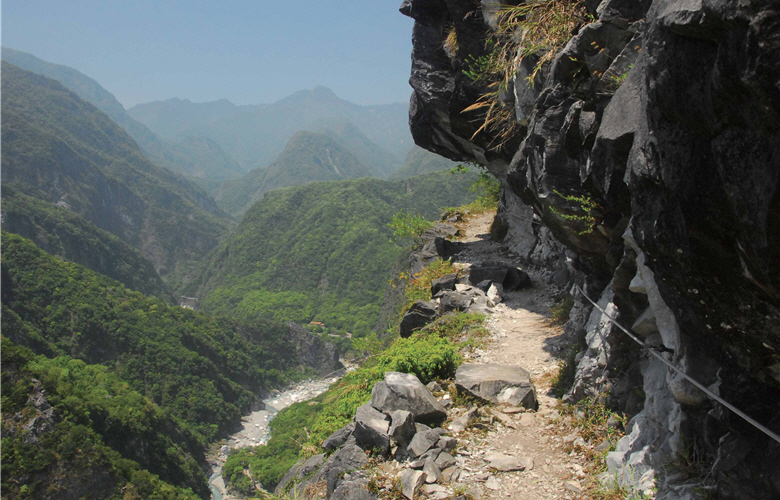
Historic trails bear the records of the lives of our ancestors. Whether these land trails were routes for hunting, intermarriaging, strategic purposes, or even ancient sea routes, they were shaped by our ancestors’activities. A great number of cultural remains could often be found along the trails and the associated architectures. But what were the original functions and cultural significance of those“ cultural remains”? To understand the past of historic trails, it is essential to study the
related archaeological sites along them.
“In my career as an archeologist, I’ve found that in Taiwan the nature and the face of archeology have been changing. I couldn’t help but ponder whether these studies can be of some value to Taiwan,” said Prof. Yi-chang Liu of IHP, Academia Sinica, with decades of experiences in archeology. He thinks that archeological research not only reveals how people in prehistoric era had lived on this island, but also help map out the developmental history of human activities in Taiwan.
Traces of the Past and the Present
As Taiwan is a long and narrow island oriented toward north-south axis with many rapid rivers running in east-west direction, it presents great difficulty for land transportation in the old days. And people back then had to, with impressive judgment and courage, build these historic trails, such as Balaka Historic Trail and Fishermen's Trail in Yangmingshan, Beikeng Creek Historic Trail in Shei-Pa, Old Cross-Hehuan Mountain Road in Taroko, and Batongguan Historic Trail in Yushan. These trails signify multiple meanings, such as military, trade and etc.
“Today most people think that historic trails are those roads and paths on land, but archeologically, the trails also include sailing routes on the sea. So historic trails should be defined as any transportation routes, on land or at sea alike,which existed prior to the advent of modern transportation facilities and infrastructure.” Liu pointed out that since the 1980s the history and culture of Taiwan has gradually been emphasized, and he has followed the trend and conducted numerous surveys on both land trails and sea routes using archaeological methods, including Fishermen's Trail, Alangyi Historic Trail, the east section of Batongguan Historic Trail,Zhufagang River, etc.
Historic trails in Taiwan exist in diverse landforms. The usage of these trails also varied due to the landforms. For example, those ancient main streets (official roads), which allowed vehicles like horse- or ox-drawn carriages, were mostly built on the plains and with wider road. In early Qing Dynasty, an official Yong-he Yu wrote in his book Bihai Travel Notes about how he travelled on an oxcart from Tainan all the way to Beitou for sulfur mining: “For nearly 80 or 90 km from Hsinchu to Nankan, not a single person or house was in sight,nor was a single tree for shade.” What Yu had once taken has now turned into an artery between the two cities and an important historic trail.
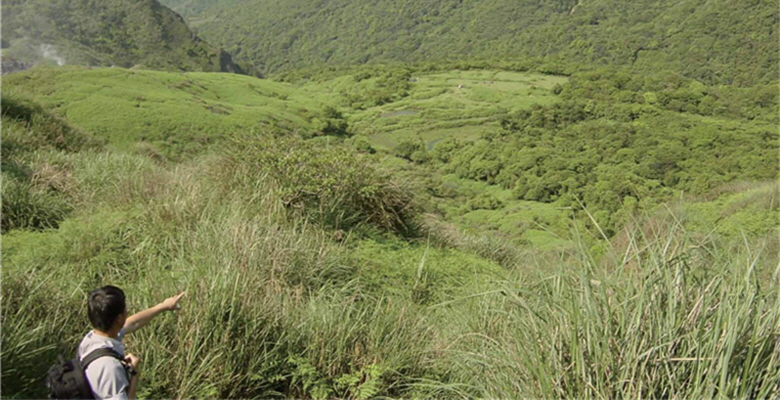
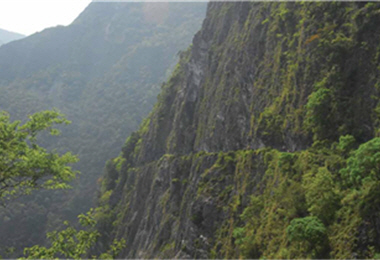
- upper:Beautiful Old Jhuilu Road of Taroko National Park. / by Mao-yao Lin
- lower:People in early days had to, with impressive judgment and courage, build one after another road or path which turned into valuable historic trails today. The picture shows the view at the Gate toward the path of Fishermen's Trail./ Provided by Yi-chang Liu
Interview / Jane Chiu
Compilation & Text /Jane Chiu、Zhi-ming Yang
Photo Provided by / Yi-chang Liu
Special Thanks to /Mei-chih Lin of the Instituteof History and Philology, Academia Sinica
In addition to the main streets paved and used by the authorities, many other roads had been built in connection with the aborigines in early days. For instance, Liu explained, Batongguan Historic Trail was initially used for the transportation among aboriginal tribes in ancient times, and later in 1870 expanded by the Qing general Guang-liang Wu for the purpose of pacifying the aborigines, marking Qing’s official presence in Taiwan and also making a profound impact on the subsequent history of Taiwan.
In the era of Japanese rule, the Japanese continued to build trails for different motivations and purposes. For example,the Fishermen's Trail and Japanese Occupation Batongguan Historic Trail were designed for the transportation of gun carriages and the artillery in order to fight the anti-Japan “rebel”Da-shi Jian, who was based in Datun Mountain.
Reconstructing the Historic Scenes
The significance of these historic trails is not merely their political or military functions, but also the cultural meanings that they possessed. “The most interesting example is probably the trails for the purpose of intermarriage as we often find proofs and records of marriage in the tribes along the trails. They all bear importance in Taiwan’s history. If people don’t find this important, then the value of these historic trails will be ignored.”
What’s also worth observing, Liu suggested, is the tribes and villages along the trails, through which the development of mining and agricultural activities can be revealed. One good example is Fishermen's Trail, which once served as a major passage for military and industrial functions as well as for sulfurmining and fish delivery. The relic of Deji Mining Company there is a solid proof of active sulfur-mining business back then in the area.
Fishermen's Trail was also once a route for the exchange of goods. “This can be proved by the fact that Hangbing’s House was a rest stop where food and drinks were sold to people who carried goods from Jinshan and took a break here before heading for the steep section of the trail.”
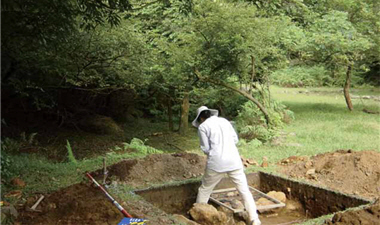
But how did archeologists determine Hangbing’s House was once a rest stop? “It’s because in the stratum there’re lots of fragments of bowls of the same texture and style,” explained Liu. “It can be reasonably assumed that this place couldn’t possibly be an ordinary family house where so many people lived together since the it was only a small house. At the same time, it was impossible that people just kept breaking bowls all the time. This house must have been a venue for people to take a break.”
In his research on the east section of Batongguan Historic Trail, Liu also paid close attention to what had been eaten and used by the Qing soldiers led by General Guang-liang Wu, and whether they brought things of Qing Dynasty into the houses of aborigines. The archeological results have shown that the interactions between the Han people and the aborigines had already been rather active back then.
“In fact, conducting archeological surveys on historic trails is not difficult. You just need to go ahead and do it. Be it things ever used (such as ceramics), road systems ever built and maintained (such as Batongguan Historic Trail), or places ever inhabited (such as Hangbing’s House), responsible archeologists must dig each one of them out by themselves,” Liu affirmed.
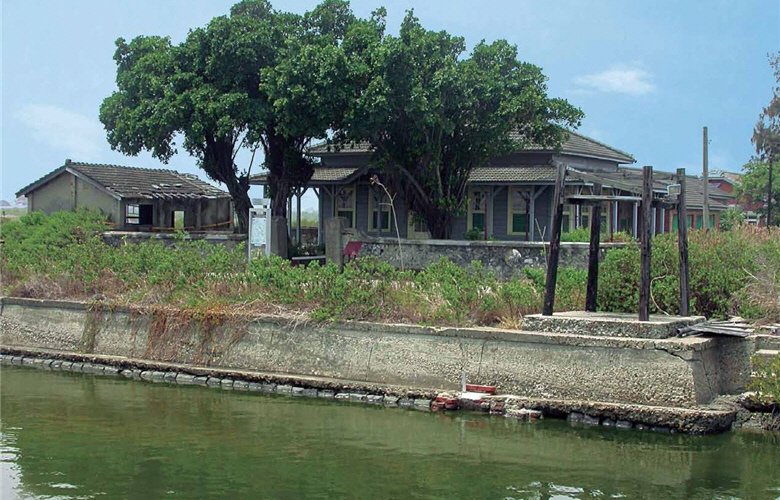
- upper:The wharf for salf transport and the office for salt business./ by Yi-cong Weng
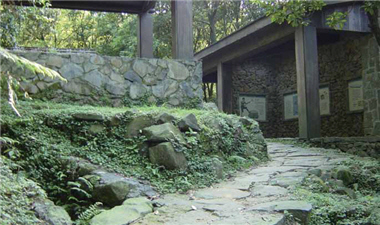
- lower left:Hangbing's House was once a tavern for people who took a break here before heading for the steep section of the trail./ Provided by Yi-chang Liu
- lower right:A responsible archeology researcher must dig through whatever is in sight at the site by themselves. In the picture researchers were conducting an archeological survey at Shouhuang Camp./ Provided by Yichang Liu
More Cultural Values to be Preserved
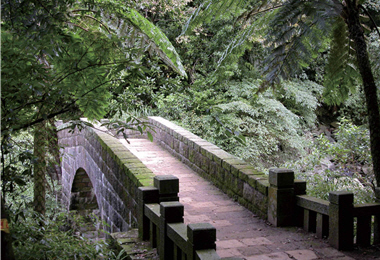
As far as the preservation and maintenance work on historic trails are concerned, Liu thinks that National Park of Taiwan is doing a rather good job. The only pity would be that most historic trails are just restored as paths for people to visit and walk upon. There should be more interactions between humans and the environment, which would highlight the true significance of historic trails. “For example, although the Fishermen's Trail had been restored, the sites related to the mining business still lack proper restoration, such as the office of Deji Mining Company. Additionally, the wine bottles left by the Japanese troops on Old Cross-Hehuan Mountain Road when at war with the Taroko Tribe, are evidence to test the importance of alcohol consumption even during the wartime. These are examples that fall short to be restored or presented with an interactive touch with tourists.”
In Mt. Nanren Nature Reserve in Kenting National Park, for instance, sit some stone slab houses because the area was once where people had dwelled. Liu hopes that the Park can consider human’s role in the ecosystem. The Park should take more holistic perspective to preserve the history and cultures of these trails. That way these trails are not just symbolic locations on the landscape, but are representations of the dynamic history for the last 400 years.
Historic trails, which live vividly in the history of Taiwan, are indispensible materials to the mastery of Taiwanese history.Through research on historic trails, we can understand human activities in Taiwan at different points of time and can piece together every detail of past human lives. In each of the journeys of time and space, we should slow down our pace and appreciate the beauty and sorrow of it. That way we can better understand the hardship our predecessors had went through and really use our heart to realize the stories behind every historic trails.

Yi-chang Liu
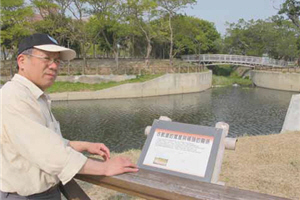
Liu has focused his major research interest on archeology, with ethnology and history as minors. He has long been dedicated to the investigation and establishment of the basic data for archeological sites in Taiwan, with an aim to determine the sequence of prehistoric cultures in order to facilitate the research of history of human activities in Taiwan. Liu is currently the head of Center of Archeological Research Topics at the Institute of History and Philology, Academia Sinica.
- upper left:Historic trails bear the records of the life of our ancestors.In the picture is the old Jhuilu Road /by Mao-yao Lin
- upper right:Historic trails should be restored not only as paths for people to visit and walk upon, but as a venue for more interactions between humans and the past.In the picture is the Syuyan Bridge./ Provided by YMSNP Headquarters


