
The Site Plan Blending in with the Mountains-The Taroko National Park Building Complex
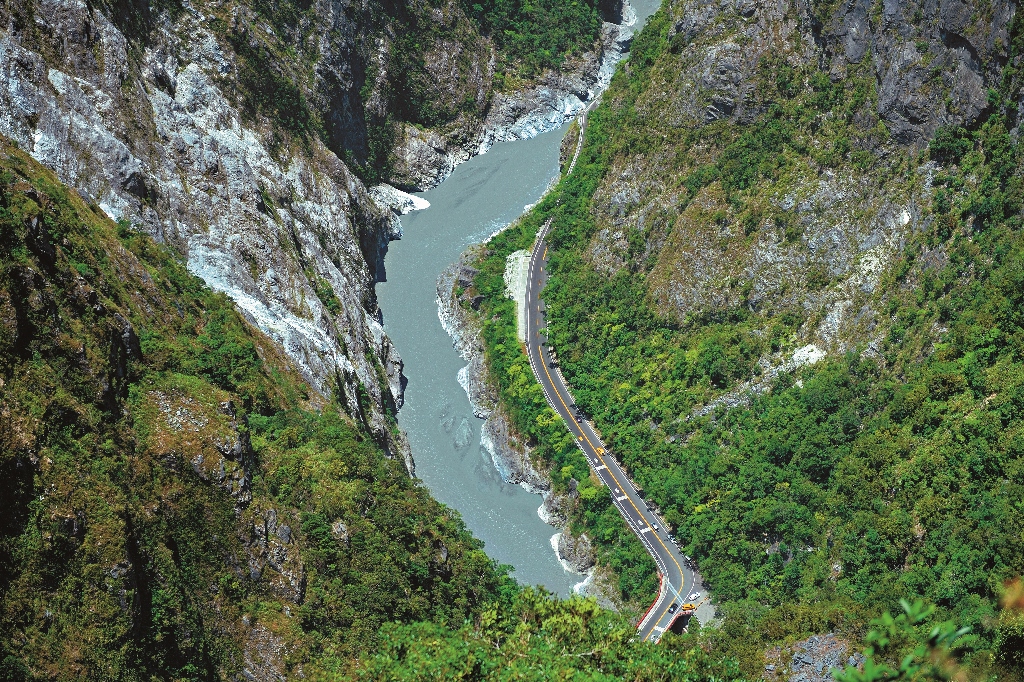
Taroko National Park, the forth national park established in Taiwan, has endless beautiful sceneries, ranging from the magnificent Qingshui Cliff which showcases the nature’s remarkable workmanship of geologic landscape, to the Zhuilu historical Trail which serves as a reminder of the hardships the predecessors endured while building it. However, this beautiful piece of land has encountered quite some resistance at the beginning of its establishment, causing delays in its developing progress. At that time, Taipower was preparing to use Liwu River to set up a hydropower plant, and Formosa Plastics was also planning on building a cement plant inside the park boundaries. Luckily, these two developments were thrown out by the government due to disputes over the destruction of the ecological environment, and Taroko National Park was then successfully established in 1986.
Design Specifically to Unique Features
Kuo-Shih Hsu was the very first deputy director of Taroko National Park Headquarters. Before taking the office, he investigated the local plant resources for a year, and was very familiar with the local environment. He knows all Taroko’s most valuable resources by heart, “Taroko can become a national park is because it contains primal areas such as Nanhu Mountain and Zhongyangjian Mountain, as well as its famous gorges and a highway running through. From the functionality standpoint of a national park, it is consisted of environmental education, conservation and recreation, and all three of these elements are developed here quite equally……this is one of the unique features of Taroko.”
Director Hsu went on and said, Taroko’s second feature is it has the convenience of Central Cross-Island Highway – Taiwan’s first highway that runs through the Central Mountain Range. It only takes people a two-hour drive traveling from the plains up to Hehuan Mountain which is over 3,500 meters in elevation, allowing them to enjoy the different sceneries from subtropical landscape to frigid settings. This kind of ecological structure is rare to find on earth. The third feature is due to the dry characteristic of limestone geology, allowing many unique local plant species to be preserved.
During the preparation process, Director Hsu had witnessed many problems Taroko National Park was facing, including the lack of infrastructures and places for visitors to stay, learn, and overlook the sceneries.
Especially at the beginning of Taroko National Park Headquarters’ establishment, the old Hualien County
Scenic Area Administration Office building at Lushui was adopted as the Headquarters’ temporary office, and
every time the typhoon struck, there is a risk of collapse; in addition, the national park would be packed with cars every holiday because the heavy traffic flow could not be diverted in time.
Moreover, when visitors come to watch the introduction video at the Lushui Headquarter, they have in fact already seen the gorges personally, which is actually logically backwards when it comes to interpretation. For these reasons, Taroko National Park Headquarters have planned the park into three areas, including Taroko Terrace, Tianxiang and Hehuan Mountain, in order to provide tourist services specifically to the different environmental features as well as to disperse the crowd. Director Hsu further explained in this regard, “We hope to use these three spots as center points, connecting them with highways and trails, and have accommodation, dining and recreation functions at all three places so that visitors would stay longer at each spot and not constantly be traveling on the road, which would also solve the traffic congestion problem.”
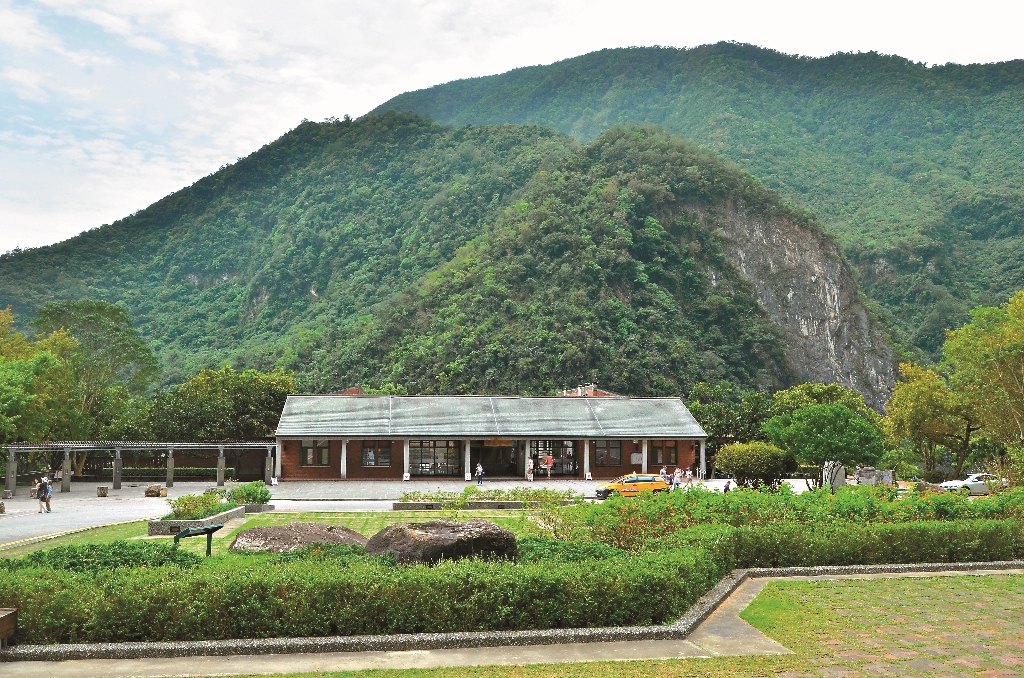
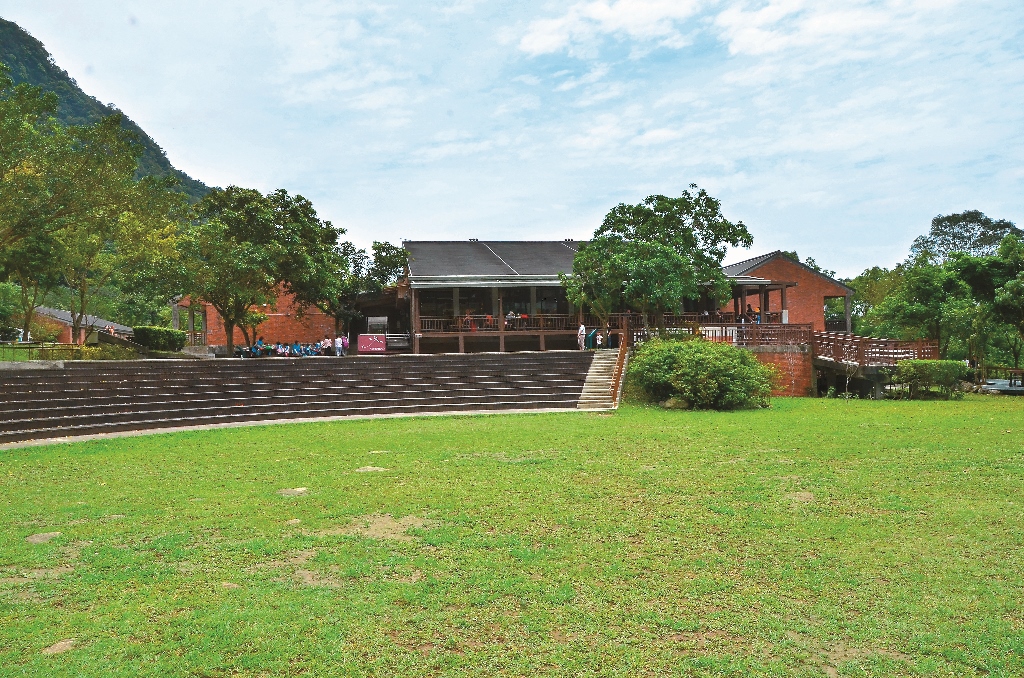
the visual volume by accommodating to the terrain.
Rising up from Difficult Situations
Taroko National Park is Taiwan’s first national park with a multimedia exhibition hall. This idea originated
from the US National Parks, which provides exhibition, interpretation and related services in visitor centers.
“Because the United States of America is the first country in the world to have national parks, the establishment of national parks in other countries were affected by them. This of course includes Taiwan.” Leading a young team, Director Hsu completed establishing the Lushui Exhibition Hall in the first year. But what is unexpected is that this old building renovation is like making a silk purse out of a sow’s ear.
The exhibition hall was originally a worker’s shed for the road workers, so the Taroko National Park Headquarters decided to use wood logs on the building’s exterior to retain the primal feeling, and inside projectors showing six films on the park’s introduction and three films on insects were set up, which were considered an innovative approach at that time. In addition, they also rebuilt the old Lushui Trail, and installed interpretative signage adopting the self-guided method. And then they began to concentrate on the implementation of regional planning. At the time of planning the Lushui Service Station, they were also carrying out the development plan of the Taroko terrace building complex.
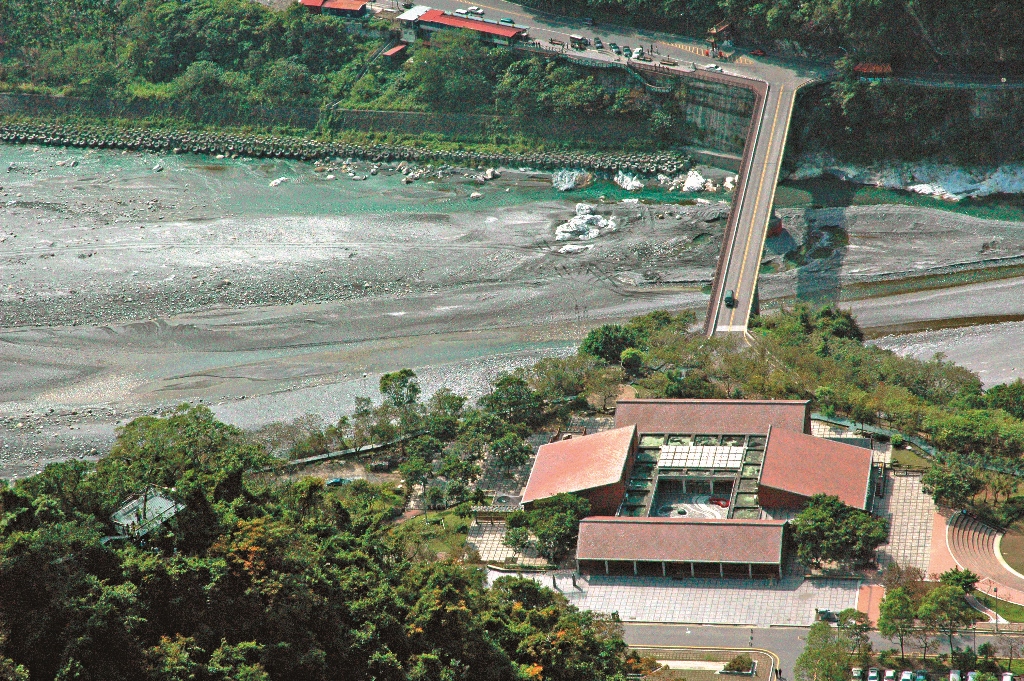
and has a wide hinterland, making it the first choice for
building the Taroko National Park Headquarters.
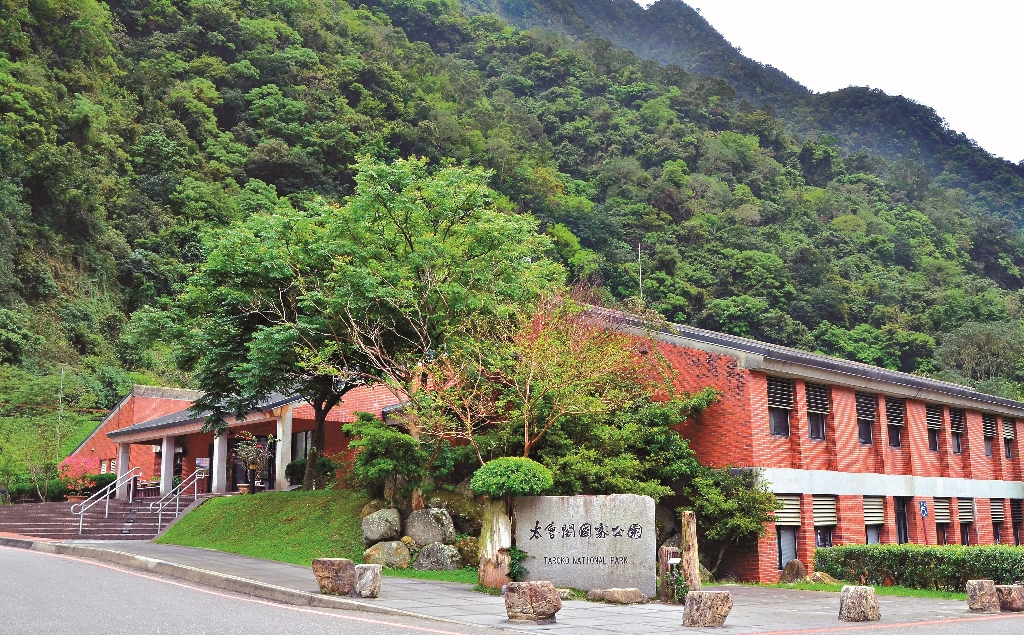
Buildings that Blend into Nature
Taroko terrace was selected as the location for the national park’s Headquarter is because it is located at
the east entrance of the national park, plus it has the Central Cross-Island Highway and Suhua Highway intersecting here. But good things never come easy. There was a military camp occupying the terrace at that
time, and after much coordination, the army finally agreed to move out. Construction can finally begin at
the Taroko terrace, and the visitor center, administrative office, staff dormitory and police station were then built brick by brick. The entire project at Taroko terrace was a huge assignment; it was divided into three phases and completed orderly then opened to the public. This development began in 1988, and was finally completed in 1992.
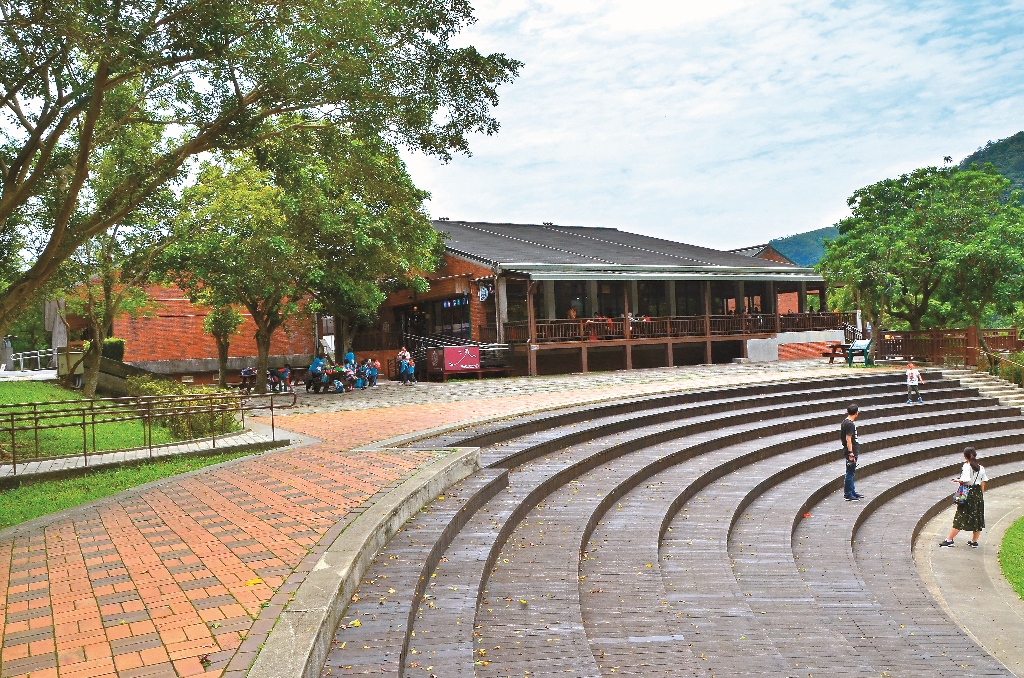
How does a manmade building complex blend into Taroko National Park, which is so rich with erratic natural ecology? The practice at that time, Director Hsu explains, is to minimize the height and abruption of the buildings, and choose colors that work well with the environment, making the buildings blend in withthe nature environment as much as possible. For these reasons, restrooms and old buildings (such as the BiluSacred Tree station) were restored with wood, and the visitor center appears to have only one story from the front but is actually a two story building, which is the best example of keeping with the terrain while cleverly reducing the visual volume of the architecture.
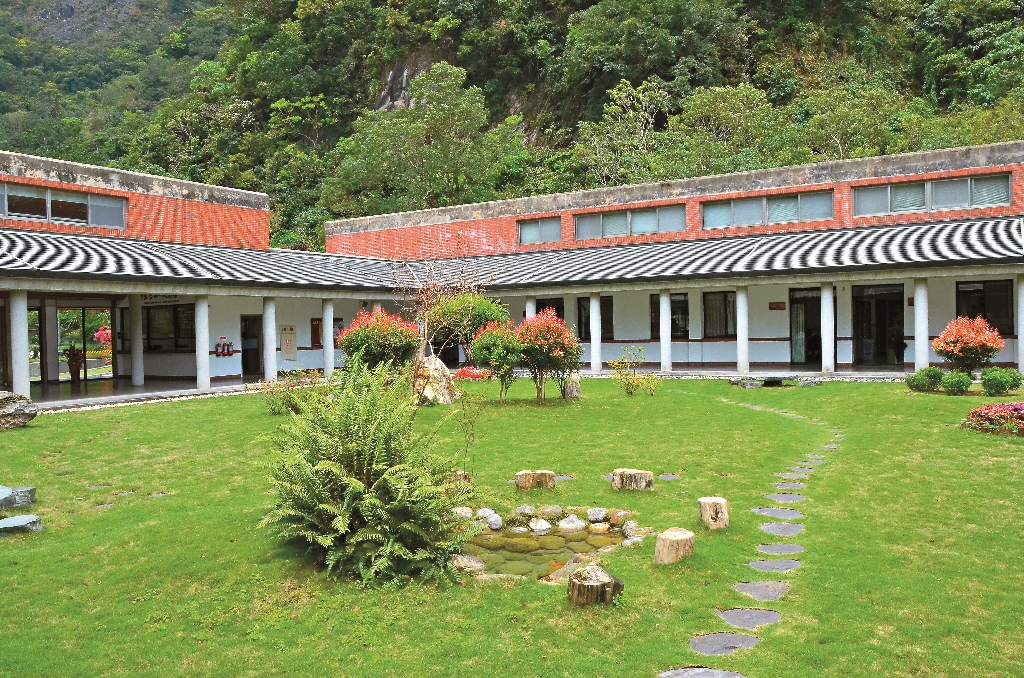
Complementing the Building Complex’s Space and Function
The building complex at Taroko terrace includes the visitor center and administrative building, which
each take the form of a four-section compound, and the police station, which takes the form of a threesection compound. Although the buildings retained the traditional color concept, they are tuned down even more, using only the basic tones of brown brick walls, black roof tiles, and white columns. It is worth mentioning that this building complex is different from the other national parks when it comes to the configuration of the building’s functions. The first thing people would see when they enter the park is the visitor center. This conspicuous arrangement allow visitors to easily find useful information when they arrive before entering further into the park. Further along the main passage is the administrative building, and then the police station which is located at the very end of the circulation.
Inside the visitor center there are exhibition halls, multimedia conference rooms and coffee shops.
Equipped with lavish and comprehensive hardware equipment, the software preparation is not inferior in
any respect. Back when it was first established, there were nine different films on display, as well as a film composed of music and photos – “Dialogue between Water and Stone” – which art circles celebrities such as Hsun Chiang and Mu-jung Hsi were invited to participate in the production. Since then, the use of multimedia can be widely found in the park. Among them, the Buluowan Station is the most exciting, hosting a 360-degree theater composed of 30 projectors, allowing visitors to experience traditional Truku and Amis culture and the beauty of Taroko’s magnificent natural landscape through high quality video and audio effects from more than 20 years ago, making it a memorable art feast.
The arrangement of the building complex is based on function and movement of the space. For example, there are three different sizes of conference rooms at the visitor center to house different group sizes, and can even accommodate 2 to 3 buses of visiting crowds. Because the visitor center was planned as a place for leisure from the very beginning, besides enjoying the nature, people can read about all sorts of materials related to Taroko on the second floor; or if it is raining outside, people can visit the exhibition halls on the main floor and watch the films, or enjoy some delicacies at the coffee shop.
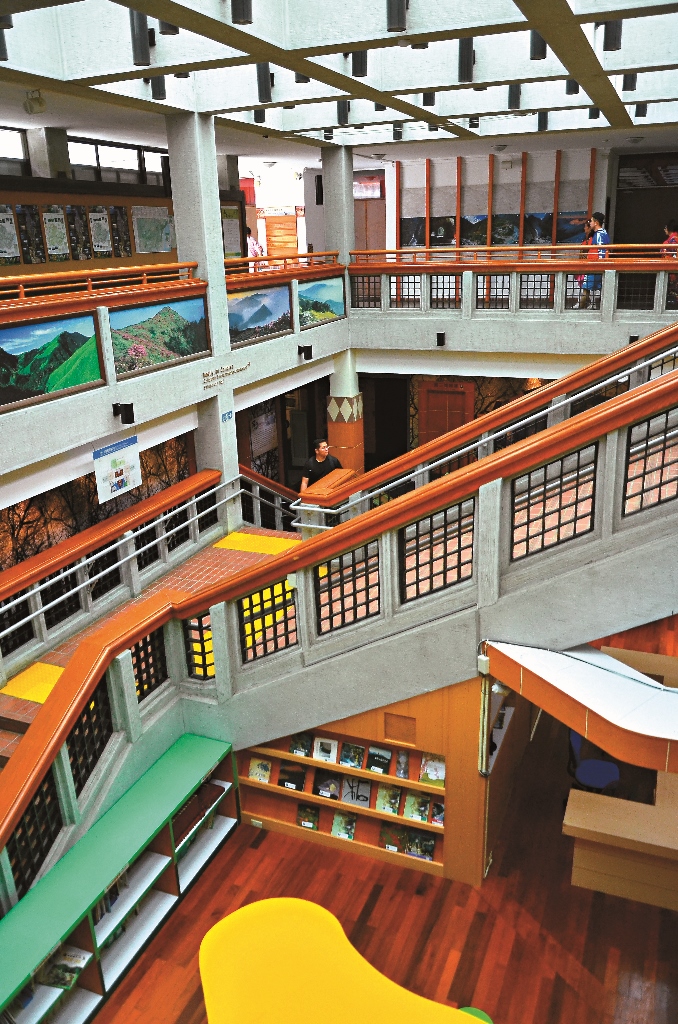
The administrative building which is part of the terrace building complex even has a library, and the research
reports and conservation books in the library was an important source of information back when information
technology was underdeveloped. The design of the police station included housing and work function. There are about 20 to 30 staff serving locally, and other small squads stationed in the vicinity. The establishment of the police squad is to prohibit illegal events in the park. It was temporarily set up at Wun Sun Hotel in 1988, and was moved to the terrace area four years later when the construction there was completed.
Staff dormitory is set closest to the northern hills, because this location has the most privacy, and could
better separate public and private spaces. The building style of the dormitory is significantly different from the other buildings at the Taroko terrace. This is because people living in a courtyard arrangement would easily
interfere with each other. The staff dormitory is mainly provided for single staff members; comfort is a must
when it comes to the spatial design, each unit has its own balcony, and the buildings are connected with corridors.
The Environmental Education Center at the Taroko terrace, which was completed in 2008, can hold all sorts
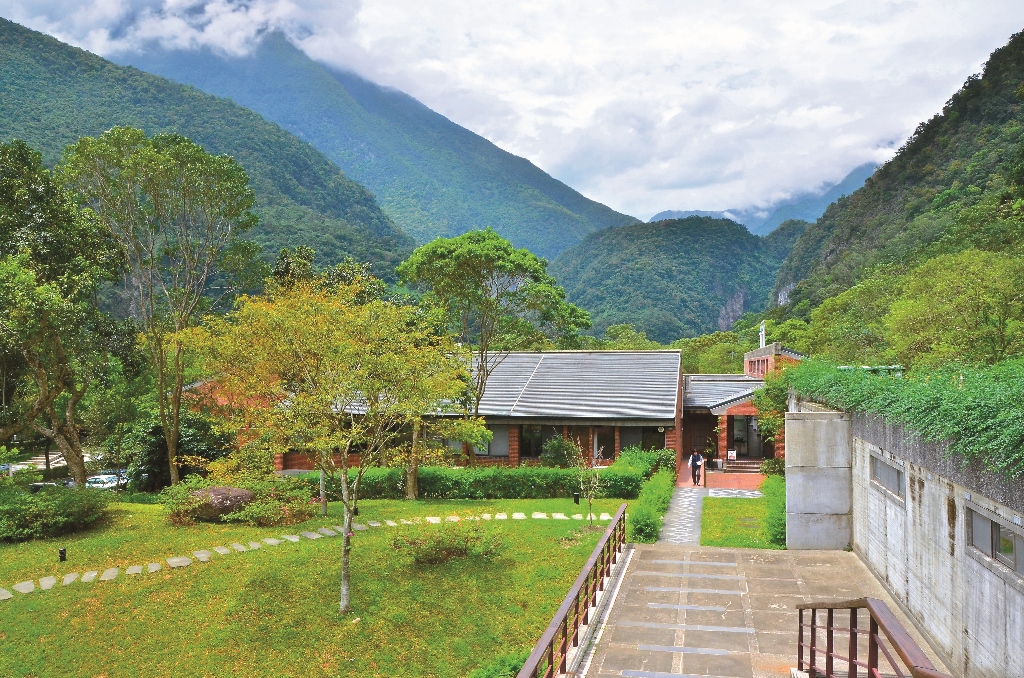
of environmental education activities such as exhibitions,lectures, workshops and volunteer trainings, making the function of Taroko terrace building complex even more comprehensive. The Environmental Education Center utilizes the space between the administrative building, police station, and staff dormitory and the height difference of the terrain, making the two-story building sitting on a slightly higher grade to the administrative building and police station, but the elevation of the entire building is still lower than the staff dormitory.
Research as the Foundation of Conservation
Conservation is one of the most important tasks of national parks. Besides studying and protecting the flora
and fauna ecology within the park boundary, Taroko National Park Headquarters also did a number of major
environmental friendly planning on its infrastructure, including establishing the first solar refuge cabin Nanhu Cabin. There are 18 solar panels set up on the roof of the cabin since 1990. After absorbing sunlight during the day and turning it into solar power, it can supply electricity for indoor lighting, communication equipment, and radio. In addition, lighting and audio interpretation at the tunnels of Baiyang Waterfall Trail are also powered by solar energy; the lights would automatically turn on when visitors pass by. Taroko National Park Headquarters also showed great determination when it comes to space management. “If people do not abide by the rules, you deal with it right away; every place should be looked after; if you do not take care of it, it will easily turn into chaos.” So after Taroko’s retail spaces were done, the sales department would ask the original vendors to register and strictly ban unregistered vendors.
This tourist attraction that is on the list of Taiwan’s potential world heritage site, started from making great effort on the planning of building complex and facilities in the beginning, to generation after generation of the Headquarters’ continuous operation and protection of the park. Even though it is incessantly marked by traces of time, and the rocks and cliffs of the Taroko gorge is constantly being sculpted by the nature, and the vegetation is continually nourishing by the rain, Taroko National Park is always ready with open arms to welcome every traveler that comes to visit.
About the Author
Zoe Lee Freelance writer, engaged in media interview and writing regarding tourism and everyday living topics for more than a decade. Her work can be found on news websites, in magazines and books.


