
Land Swapping for the Crabs-Seeing New Opportunities for the Conservation of Houwan Bay Land Crabs
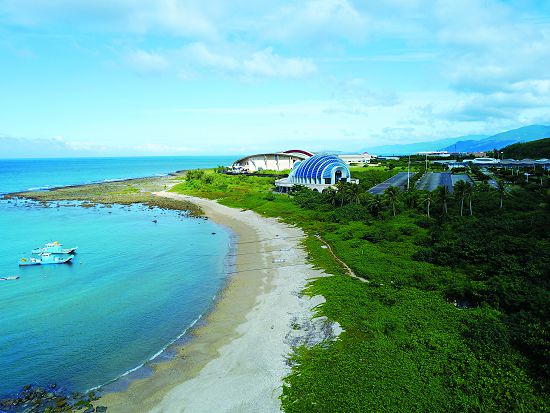
land crabs, and with the relevant conservation groups and 10 government agencies marking
an important milestone by swapping public and private lands for the purpose of conservation.
/ Huan-Yueh Liu
Interviewee / Pei-Tung Liu, Director of Kenting National Park Headquarters Hsieh-Chun Ma, Chief of Interpretation and Education Section Mao-Ching Hsu, Chief of Conservation Research Section
Article / Wei-Hong Chen
Photo / provided by Kenting National Park Headquarters
When economic development encounters natural conservation, which one is more important? For people with different positions, the answers are often very different. The landowners care about the development benefits, and the environmentalists emphasize the value of the ecosystem. It is not easy for the two parties to find common ground for dialogue. Consequently, it is not easy to reach a consensus. In order to protect the habitat of land crabs in Houwan Bay as well as the right of landholders, Kenting National Park Headquarters played as the bridge between the two parties and managed to work out a solution acceptable for both sides – use stateowned land to exchange for private land with conservation value, which set a national precedent in Taiwan’s conservation history.
The Exceptional Land Crab Habitat
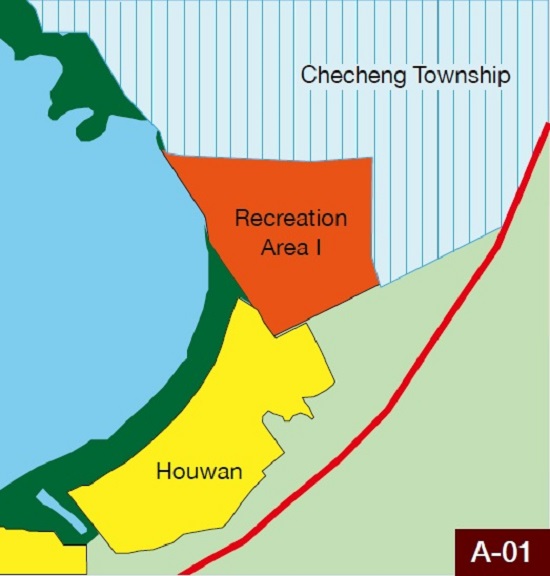
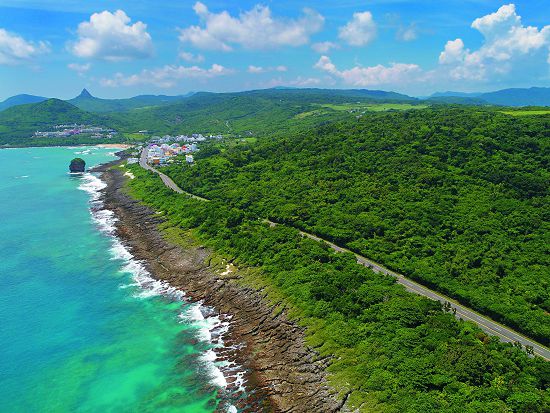
The piece of land which attracted the attention of the conservation sector for more than a decade has constantly been changing in its appearance because of natural succession. Kenting National Park has established the Kenting National Park Plan according to the law at its beginning stage. At that time, this land next to Houwan Village was mostly agricultural land and was designated as recreational land in the National Park Plan (Recreation Area I). The area is about 3.46 hectares, in which 25.8% of the land is owned by the Republic of China (the governing agency is the National Property Administration), and the rest is private land. Initially, the ecological character of this area is a plain of paddy fields due to long-term agricultural use. Then the hoteliers spotted the tourism potential of Houwan Bay area and began gradually acquiring land for hotel development. The acquired agricultural lands were no longer used for framing , and since the environment here is very suitable for the growth of coastal woods, they have progressively taken over other vegetation. With minimum human disturbance and natural vegetation cover, as a result, land crabs have gradually returned to inhabit this land.
What is so special about this land in Houwan Bay? How does it attract so many land crabs and why is this land crab inhabited peninsula so highly valued? To answer these questions, Director Pei-Tung Liu shared the possible reasons he discussed with former Director Fang of the National Museum of Marine Biology and Aquarium, “The coastal area of Houwan Bay has a higher groundwater level, where underground water source can be found at a depth of no more than 2 meters from the surface. So the land crabs that float here following the currents only need to make little effort to find a suitable place to dig a hole after landing.” It is this type of environmental advantage that made the land crabs loving this piece of land, which led to the subsequent land swapping discussion.
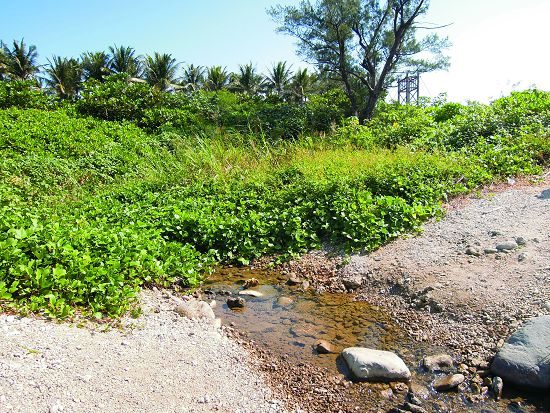
coverage and high groundwater level making it an ideal habitat for land crabs.
Land Crab Crisis vs. Land Rights
The incident that triggered this whole land crab conservation event actually occurred after the land acquisition. “In 2007, the landowner began clearing the woods for site preparation, and the removed branches were piled together for incineration,” said Hsieh-Chun Ma, “but many land crabs have been hiding under the wood piles during the process, so when they start burning the woods, many land crabs were burnt as well.” The massive death of land crabs was quickly discovered by the residents, Wetlands Taiwan Association, and Pingtung County Teachers' Association Ecological Education Center, and was reflected to the Kenting National Park Headquarters, in the hope of them as the governing agency, to handle this land crab death incident caused by development.
The practice of burning woods causing the death of land crabs is needed to be corrected, but the chosen hotel site is located in the Recreation Area designated by Kenting National Park, and the private sector is developing through legal means. Therefore, in the handling of this incident, it cannot be solved by simply saying the development was illegal. The safet y of land crabs has to be protected from the conservation perspective, but we must also take into account the rights of the private sectors. The role of Kenting Nati ona l Park Headquar ter s at that time was to provide the review committee with complete information on the ecological condition, survey and analysis data of the Houwan Bay land crabs, as well as the impact the development would cause to the land crabs during the environmental impact assessment process of the development. The rationality of subsequent development methods would be evaluated through a professional review system.
However, when the results of the environmental impact assessment (EIA) came out in 2009, a thorny issue surfaced again. The result of the EIA was condi tional ly approved, and the term was that if the land crabs population falls below 50%, the development will be suspended. In the face of such a result, Pei-Tung Liu expressed helplessly, “How do you define how much is more than 50%? And who should define it?” The environmental groups naturally were unable to accept such results and they continued to protest against the developer. However, the EIA was already passed and Kenting National Park Headquarters could not ignore the developer’s rights, and could only reconsider if there were other possible solutions.
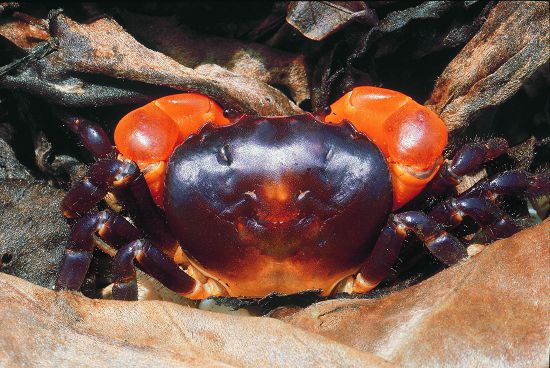
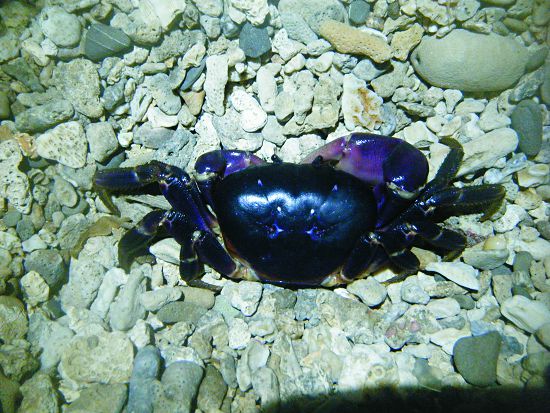
Land crab species in Houwan Bay area
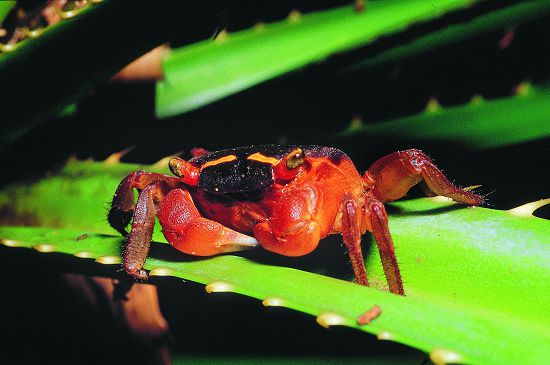
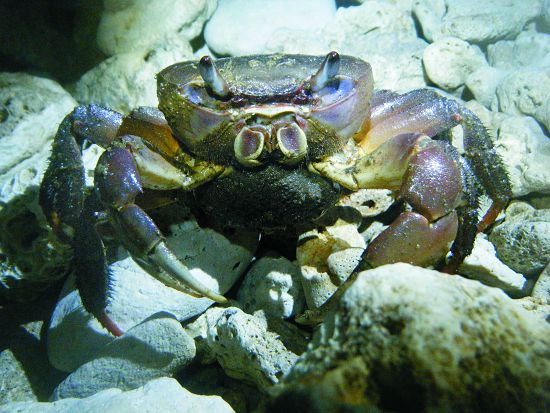
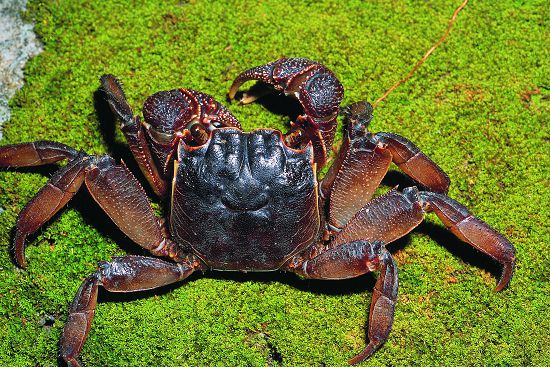
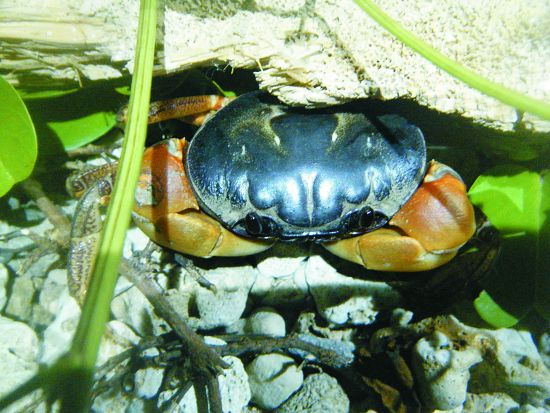
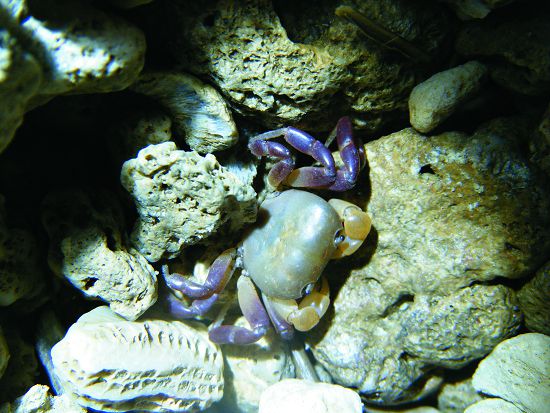
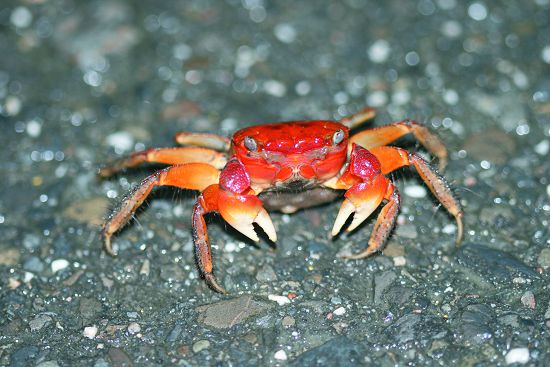
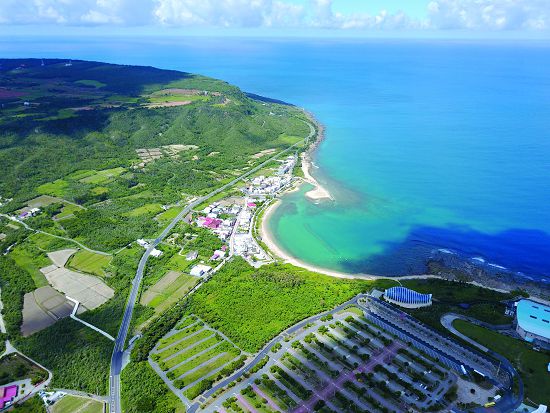
of Marine Biology and Aquarium parking lot, which are the proposed plot of lands
for rezoning and land swapping. / Huan-Yueh Liu
In Seek of a Solution
Pei-Tung Liu said that in 2011, some people in the National Park Association of Construction and Planning Agency Ministry of the interior had proposed the idea of land swapping, but the exchange of land requires the approval of many organizations, whether it is the developer or other land governmental agencies, the difficulties in the administrative and communication process caused this proposal to be suspended. In addition, the developer has also proposed an offsite compensation plan in their development plan, that is, to find a land outside the development area and create a land crab habitat with the same ecological conditions as the development site, allowing the land crabs that were inhabiting on the original site to relocate to the new compensation site. However, to create a habitat with identical biological, chemical, and geological conditions is not an easy task. There will be many controversies in the actual implementation, including the assessment of compensation benefits.
For these reasons, to minimize the impact caused by the development to the land crab’s ecosystem, Kenting National Park Headquarters first followed the previous land crab survey results and prepared a Detail Plan. On the one hand, they hope that the developer could reduce the development area to minimize the impact on the land crabs; on the other hand, they further divided the Recreation Area into recreation land use area and conservation land use area according to the groundwater level and the surveyed land crab activity hot spots. Then they explained their planning concept in the Detail Plan to the developers, and ask them to revise their original development plan according to the Detail Plan. Local environmental groups eagerly hoped the plan could head in the direction of zero land crab loss, so they have once again expressed their concerns to Kenting National Park Headquarters and also brought up the idea of land swapping.
However, because previous internal reviews showed there is little chance for land swapping, without full confidence, Pei-Tung Liu decided to go forth with the Detail Plan and the land exchange process parallel at the same time. After all, the developer still has to follow Kenting National Park’s Detail Plan to propose a new planning plan and send in an Environmental Impact Comparative Analysis Report to the Environmental Protection Agency for review which would not be hastily passed without supervision. Meanwhile, Kenting National Park Headquarters would also begin preparation work for land swapping.
The result of the environmental impact comparative analysis report evaluation came out in 2015, and the verdict was the developer did not meet the environmental assessment requirements for environmental protection and groundwater treatment, that is, they do not agree with the planning revision proposed by the developer. Therefore, the only solution left for this development project to go on was the long journey of land swapping.
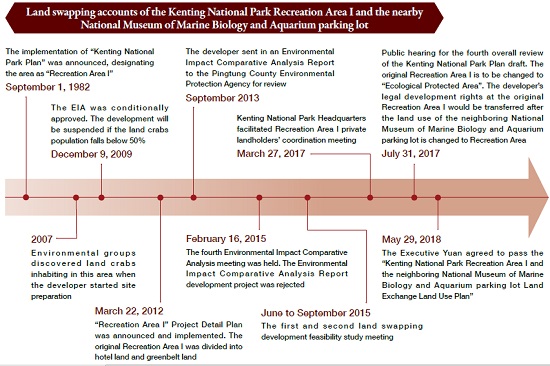
I and the neighboring National Museum of Marine Biology and Aquarium parking lot
/ redrawn by Chien-Wang Wu
Land exchange rezoning diagram of the Kenting National Park Recreation Area I and the neighboring National Museum of Marine Biology and Aquarium parking lot/ redrawn by Chien-Wang Wu
Balancing Conservation and Development
During the interview, Pei- Tung Liu said with a smile, “Land swapping simply is moving people to develop a different site, compensated people with a different piece of land, so that land crabs can continue to stay in their original habitat.” Talking about it now, it seems that this is much easier compared to moving the land crabs to a different land, but at that time when it is decided to start the process of land swapping, everything in the future was not yet clear. How should they proceed? Could they proceed? Everything was still up in the air. The complexity was no less than creating a new habitat.
“Private sectors could swap lands easily as long as the two parties agree, but the public sector has to consider many legal restrictions.” Hsieh-Chun Ma hit the nail on the head on the difficulty Kenting National Park Headquarters faced when dealing with this land swap case. To swap lands, a suitable location is a must. After considering many aspects, Kenting National Park Headquarters set their eyes on a piece of land belonging to the National Museum of Marine Biology and Aquarium. Therefore, Kenting National Park Headquarters first reached out and explained their situation to the National Museum of Marine Biology and Aquarium, hoping to obtain their consent. As an environmental protection institution itself, the Museum is also willing to see this matter resolved. However, since this is the first land swap case promoted by the public sector for conservation purposes in Taiwan, there is no precedent to follow. So even if both parties agree, they still have to return to the law and check if this kind of land swap complies with domestic laws and regulations.
During the conversation, we can feel that this land swap was not an easy task. It was like walking in an unfamiliar block of streets with no cell phone signal, among lines and lines of unknown alleys, is there an accessible route ahead or just dead ends? How much time and effort does it take? Nothing is for sure before taking the first step. There is also the possibility that residents in the area would think differently or even drive them away. But the Kenting National Park Headquarter took on such a role, and in this long journey, it seems that development and conservation may just end up in a win-win situation.
When Pei-Tung Liu first took office, he talked with local residents and understood that during the beginning of the establishment of the National Museum of Marine Biolog y and Aquarium, people expected a larg e venue could promote local development and create employment opportunities for local people. However, in reality, the economic benefits extended from the Museum were very limited, so many people turned to the hope that a hotel development could bring about new changes. In Kenting National Park’s position, they also hope within reasonable land use extent, there can be a development that is friendly to the environment, preserving local ecology, and at the same time improve the livelihood of local residents and create job oppor tuni ti e s. Therefore , on Kenting National Park’s overall local development blueprint, land swapping is just a small start. The subsequent development of the hotel is even a bigger part worthy of attention and concern.
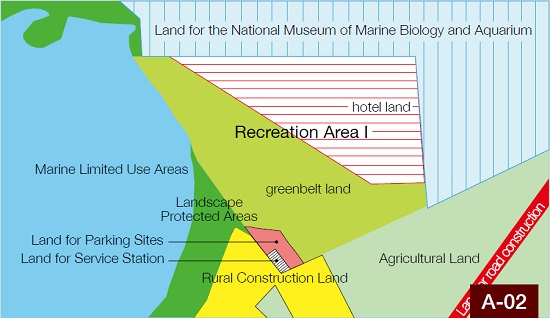
land and green colored greenbelt land
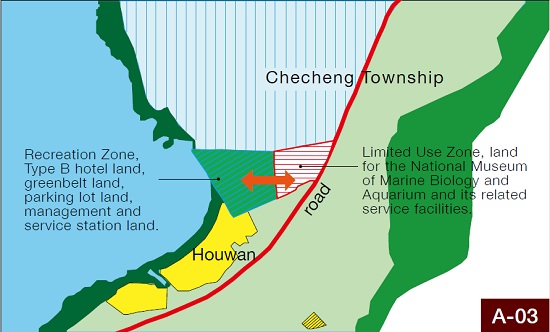
completing zoning change of Recreation Area I and the neighboring
National Museum of Marine Biology and Aquarium parking lot.
Looking at the Next Step of Conservation through Land Crab
The way people uses land is constantly changing. With the changes in technology, population, and lifestyle, land has evolved from simply for living and supplying food to complex and highly commercial valued real estate. As a result, it derived many issues and rapidly changed the relationship between human and nature.
Just like when there is a conflict between conservation and development, the topic of “how much is conservation worth” would always be brought up. Value is usually not equal to price. The environment itself provides us with many “ecosystem service”, such as fresh air, clean water, and mild climate, and these are all value created by nature. But we don’t seem to have ever paid for these services, so they are truly “invaluable”. From an economic point of view, the price is affected by the supply and demand of the “market”. Perhaps we should rethink how great our demand for these “ecosystem service” is, and when we lose these services that we used for free for all these years, how much actual payment will it cost us to acquire them?
If this event happened in the development-oriented Taiwan before the 60’s, would this land swap still pass ? Or would this development project be suspended because of land crabs? I think the outcome would be really different. Therefore, one of the reasons for this outcome is that in addition to the people who actually carried out the works, the emphasis of the entire society on conservation indicates the people on this land of Taiwan identify with the value brought by preserving natural habitat. This allowed Kenting National Park to find a new possibility between protecting land crab’s habitat and land development. This is indeed an important milestone in conservation. But after passing the milestone, what is our next step?
Because we know too little about nature, it is very difficultt oconsider all the possible problems we might encounter in the initial development planning stage. Therefore, our attitude towards development should be treading cautiously for each step to minimize the impact on the environment, and to correct it step by step in the process. After this land swap, the developer still has to propose a new development plan for the new location and then submi t the plan t o the Environmental Protection Agency for a new environmental impact assessment. Kenting National Park Headquarters will still adhere to the role of the national park’s land management authority, and do their best in protecting the ecological value of each land, and continue to care about the impact each step the usage of land has on its neighboring environment.
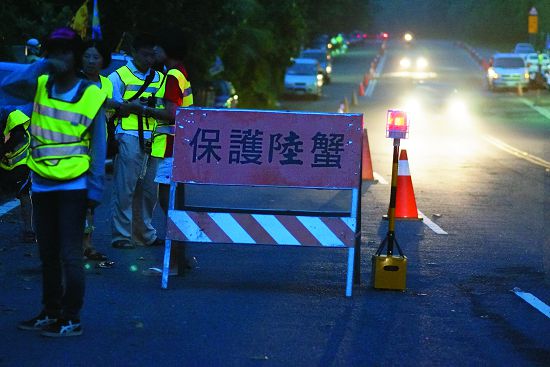
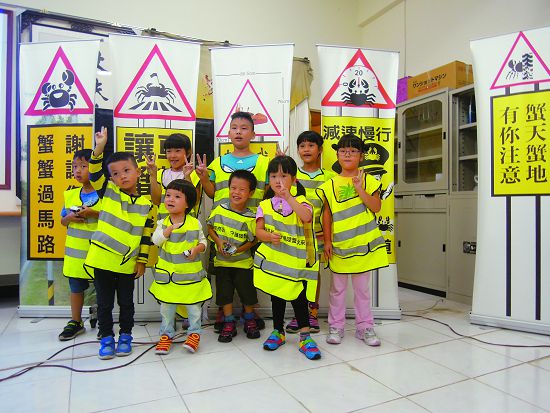
land crab protection action to allow volunteers regulating timing to
help land crabs crossing the road
Visiting Land Crabs during Autumn
July to September of each year is the land crab spawning season in Kenting area. You can find them around Siangjiao Bay, Houwan Bay, and Gang-Kou Creek. If you happen to come visit during these times, you may want to pay attention to related activity information.
Siangjiao Bay land crab protection action
Time:Three days before and after the full moon from July to October every year.
Location:The section from Siangjiao Bay to Shadao
Activity:"Stop 10, Drive 10" traffic control measure will be implemented to protect land crabs, closing two inner lanes to traffic every 10 minutes with trained volunteers on site assisting the land crabs crossing the road. Please comply with the traffic control measure when passing through. General public is welcome to participate and observe under the circumstances of not interfering with the crab protection action and safety of traffic. Catching or moving the crabs is forbidden.
Nighttime crab viewing experience
Time:May to October every year
Location:Gang-Kou Village
Activity:General public can sign up for nighttime crab interpretation tour. Participants would need to make an appointment 3 to 5 days in advance.
Author | Wei-Hong Chen
Graduated from the Department of Environmental Biology and Fisheries Sciences, National Taiwan Ocean University. Worked as an editor for textbooks and environmental teaching materials. Currently writes and compiles works in popular science and environmental education.

