
Have Fun in Spring:Enjoying the Wasps’ Life Episodes in Spring-
Are You Scared of Bees and Wasps?
The average person’s knowledge of bees is often limited to honeybees and hornets. Even little honeybees that have been portrayed in cartoons and are of industrious character may scare most people away with their stingers. Even more threatening to most people are hornets, a species that have historically caused numerous deaths.
For insect observers, however, hundreds of thousands species present wondrous phenomena; some of them frequent our living environment year-round, working hard to support their families. The only time they initiate an attack with their fatal weapons is if their lives are threatened.
The question remains: How do we avoid the causing misunderstanding between humans and bees?
As long as we put our prejudice aside, carefully observe, and learn about the living habits of bees, it is not difficult to achieve an understanding and eliminate our fear of them. Most importantly, we will avoid being attacked by bees due to our ignorance and invasion of their habitats!
Only through a thorough understanding from both sides can we live harmoniously with bees.
Compared with other kinds of insects, bees are, for daily observer, an insect whose ecological form is rather easy to observe and learn. They can be minutely observed and photographed throughout all four seasons as long as we avoid disturbing them.
During such a tricky season when the temperatures are fluctuating and cherry blossoms blooming, we can go outside and gain first-hand experience learning about the noisy and interesting life of bees.
Life Cycles of Bees: the Prologue
From late winter through early spring, the number of bees starts to dwindle compared to other times in a year, yet the visibility of bees is still much higher than of other insects.
The bees we usually see are honeybees under the apidae, which are bees collecting pollen and honey. Such bees are phytophagous, well organized, and socially prone insects. We can often find them around balconies, windowsills, parks and wild-lands. If you have the chance to closely observe them, you will discover a number of intriguing phenomena. How do they extend their mouths to extract honey? How do they carry pollen with the “basket” located at their rear feet? When are they most likely to appear? Will they visit the flowers at night?
Put modern technology to good use and take snapshots of these phenomena and characteristics. The internet is a great source for finding information about bees. And through the combination of experience and knowledge, we can better understand the living habits and life cycles of bees so we will no longer be fearful of them.
Greater Banded Hornets Start to Build Their Homes in March
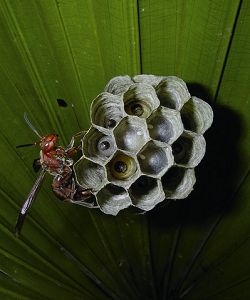
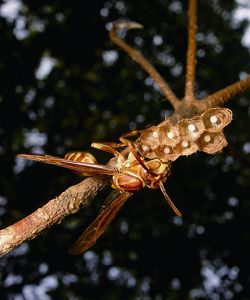
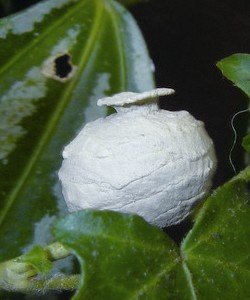
March is an excellent time for us to observe the early development of the Greater Band Hornets’ (Parapoliybia varia) hives. This process is easy to spot and observe in the Yangmingshan National Park (http://blog.xuite.net/ymsbigdavid/love01/16228348). Mother wasps work independently at this phase, which not only includes collecting pulps, building new hives, and laying eggs, but includes catching larvae of insects to feed their babies with their jaws as well. The mother wasps will chew these larvae to muddy flesh before feeding it to their babies. If they encounter any threats or disturbances, they will fly away or hide behind hives to secure their safety first. If they should die, the hive will be destroyed shortly after.
Therefore, the period of time when mother wasps tend to their wasp larvae is the best time for us to observe them closely and safely. The adeptness of the mother wasps and the crystal eggs they produce, will never fail to make us marvel at the wonder of Nature.
- left:A Polistes tenebricosus is building a nest.
- right:A Parapoliybia varia mother single-handedly builds her nest
Written & photos / Liu Ta-Wei
Paper Wasps Thrive in April and May
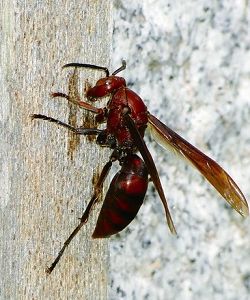
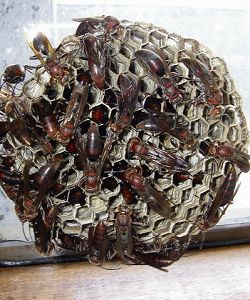
In April, mother wasps of paper wasps will begin to engage in the collection of pulps, building hives and laying eggs.
Compared with other types of bees, paper wasps are of a tender disposition and make better objects of observation. Wasps are inclined to live near human beings, as their wasp larvae are fed with the larvae of other insects. Usually they can support their families by living near parks or small farms. The junctions of forests and small farms are the places they love most.
Since Tianxieyuan Education Center of Yangmingshan National Park opened in May 19, 2007, almost every year, several paper wasp hives have been built outside the office at the entrance and ceiling of the interpretation pavilion. These hives serve as the best models for us to introduce tourists to the world of insects, and tourists are given the opportunity to observe them at a short distance.
Sometimes the worker bees happen to fly near us and stop over the wooden frame of the map board in the plaza of the center as we are about to head off. They frequently display pulp collection by slashing the tissues of pulps from the wooden frame with its jaws and saliva. Volunteers will stop to take advantage of these moments to offer explanations and allow tourists to take a closer look.
Isn’t this is one of the most natural interactions between bees that humans can witness?
At Various Time of Year You Can See Different Kinds of Bees
Located in the subtropical region, Taiwan enjoys year-round blossoms, making Taiwan not only the Formosa for people, but also a paradise for insects. Bees under the Hymenoptera are one of the insects we see most often during a year. We may observe various kinds of bees in various seasons.
Hornets Are Most Seen from May till October
Vespa ducalis start to raid on the larvae and pupae of wasps and Greater Banded Hornets during this season.
They fly into the hives and catch the larvae and pupae before grabbing them with their jaws and flying back to feed their babies. At times, they may even enjoy the food themselves. The smaller Greater Banded Hornets are no rival to Vespa ducalis, and often fall prey to them. Even paper wasps that often resist the attack with collaboration can seldom win during such raids.
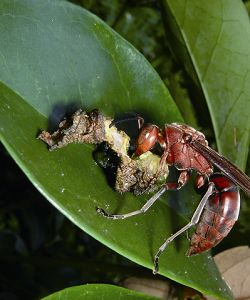
- left:A Polistes tenebricosus is collecting pulp
- right upper:A swarm of Polistes tenebricosus
- right lower:The workers of Polistes tenebricosus skin a caterpillar and chop it up into lumps.
Written & photos / Liu Ta-Wei
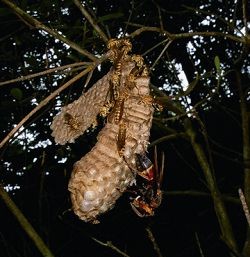
Another attacker Vespa velutina prefer bees over larvae when choosing food for their babies. From May to December, they will fly around the hives and catch worker bees.
If we are lucky enough to encounter such phenomena, we will definitely guide tourists to come closer to the battlefield and take a good look. Although we may still feel anxious, first-hand experiences are far better than watching a documentary on Discovery.
Potter Wasps Show Up from May to October
As the pottery artist of bees, potter wasps (Anterhynchium spp.) often appear around the manmade buildings. They mold all kinds of “clay hives” from vase-like, tunnel-like to chimney-like forms. During the process, they have to multi-task, sometimes absorbing water, blending mud, chumming, polishing, catching food (larvae), laying eggs, sealing the mouthpart and further polishing all simultaneously. No efforts are ever spared.
Their dedication and art of work is so inviting and wondrous. If you have the opportunity to meet them, feel free (with courtesy and politeness) to appreciate their creation process.
Sphex sp. Becomes Active from June to July
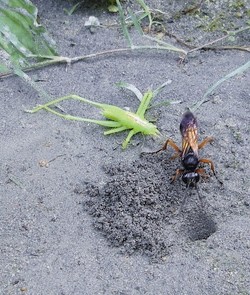
Sphex sp. works hard on lawns with bare soil. They are engaged in shoveling soil, digging holes and catching prey (grasshoppers). After anesthetizing them, they lay eggs on the bodies of grasshoppers and return soil onto holes. Some of them will take the time to decorate the holes to simulate the neighboring environment. They are a species that can be easily observed. The lawns of the parking space of Tianxieyuan are their favorite venue for making shows.
Mind Hornets from October to December
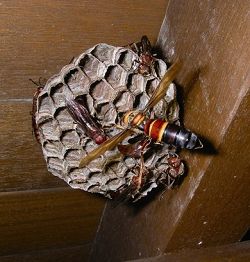
As Winter is approaching, all bees, except for honeybees and hornets, see a remarkable decrease in numbers or die slowly. Hornets, however, start to thrive in coldness. Oftentimes we may see a basketball-size beehive (nearly the size of half a person), in which large quantities of agitated bees live. If stirred by people or any outside animals, hornets will team up to attack the enemy, which poses real and fatal dangers to the “enemy”.
- left:Pottery work of potter wasps
- right upper: Paper wasps are attacking the nest of Polistes tenebricosus.
- right lower: A digger wasp (Sphex sp.) digs a burrow, captures a long-horned grasshopper, drags it into the burrow, lays an egg and covers the burrow.
Written & photos / Liu Ta-Wei
As long as you do not stray from the trail you are treading, such incidents rarely occur.
Particularly in November and December, some plants begin shedding leaves. It has been discovered that many huge hornet hives are hidden along the trails people regularly walk by. The residents and visitors who frequent the trail have seldom been attacked by hornets. This shows that as long as we mind our own space and stay aware of the surrounding conditions without causing any disturbances to the hives, the peace and harmony between hornets and humans can be maintained.
You Can Observe Parasitic Wasps All Year Round
Outside of honeybees, you may also see small-to-middle sized parasitic wasps (Chelonus spp.) in all seasons.
As indicated by the name, such parasitic wasps live as parasites inside other insects.
There are various kinds of parasitic wasps in different phases of maturity. They can take the form of eggs, larvae, pupae to adult insects.
So far the 100,000 types of parasitic wasps have been found, with their living habits varying greatly. Parasitic wasps are also a type of bees that can be spotted and observed rather easily.
Let’s go outside I’ll show you how to act (or react).
Is it easy to remain calm?
No, it is rather difficult.
It is necessary to remind yourself to stay calm before and during contact with bees.
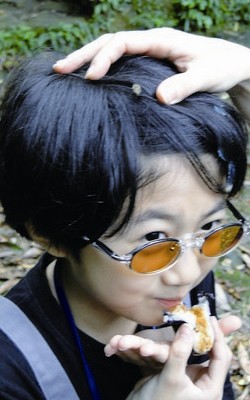
I have run across bees several times when touring. They did hover above our heads and even slipped through hair, but nobody has ever been stung. This is a good example of how effective it can be to give yourself a few friendly reminders to stay composed during a bee encounter. Guidelines to follow: “Don’t move! Don’t wave! Don’t be scared!”
Kids and their parents have followed my instructions to tenderly and slowly (though nervously) move fingers through their hair and pick bees out before setting them off.
This is the best example of how we can interact with bees in a friendly way when participating in oudiv>
Guidelines Regarding Safety
1. Don’t touch anything you don’t recognize.
2. When a bee flies by your side, be sure to move slowly and tenderly and avoid any sudden currents of air, which might trigger bees to initiate sting attacks.
3. If you hear the bees buzzing, never wave abruptly to chase them away or shun them violently. The utmost principle is to keep still.
4. If bees fly around your body, face or hands, please remain calm. The reason why bees fly near you might be that they smell perspiration, minerals or some kind of food they are seeking. They may crawl, sometimes gently biting at you with their jaws to make sure if this is the food that they crave. Such little bites, unlike stings, do not continue over a lengthy time; therefore, remind yourself don’t wildly wave your hands out of fright. Once they know that you are not a source for food, they fly away. If they remain for some time, you can hold out a finger as a bridge, invite it to climb onto your finger, and subsequently hold out that finger into high places, so they can fly at their digression. If they still linger, you can gently, slowly leave the venue. Up to the point, they may either know there is no food they are seeking, or realize they have deviated from the hive. They will leave the spot shortly.
5. Don’t wave a cane or umbrella to scare bees away. Such waving may disturb the bees at hives because some hives are built around the bushes along the trails. Violent vibrations might stir worker bees to fly in swarms and sting the culprit since they have an obligation to protect their homeland. This is the main cause of many sting cases.
6. Wear a topi instead of opening an umbrella to keep from touching bushes or branches accidently and getting stung by worker bees.
7. If there are bees flying inside a house or a camp, please turn off power, pull up curtains or close down windows. As darkness falls in the room, leave a brightly lit exit for bees to fly out.
- left upper:Paper wasps are attacking the nest of Polistes tenebricosus
- right:A bee stumbles into the little girl’s hair. The little girl eats her rice ball as if nothing is happening, while her mother gingerly captures the bee and releases it.
- left lower:Another potter wasp's work
Written & photos / Liu Ta-Wei
Profile

Liu, Da-Wei | Volunteer Interpreter of Yangming Shan National Park
Liu has been a member of the volunteer interpretation team in Yangmingshan National Park since 2004. He decided to become an interpreter for baby pearl spiders and their environments after he provided interpretation services to visitors one day after stumbling across stick insects and spiders.


