ESG/USR PARTNERS | USR UNIVERSITY PARTNER PERSPECTIVE
Article / Cheng Chih-Ya
Photos / Chang Mu-Lin
Interviewee / Chang Mu-Lin, Project Assistant Professor, Nature & Sustainability Division, Center for General Education, Tzu Chi University
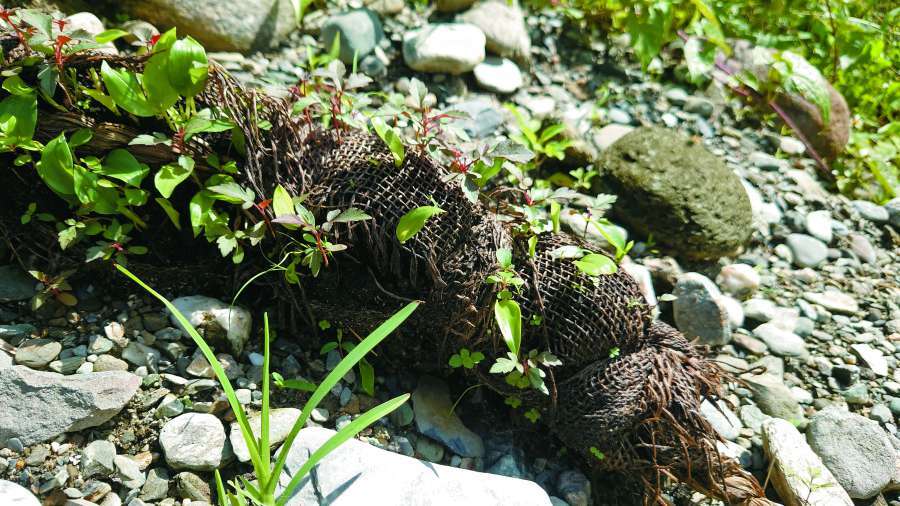
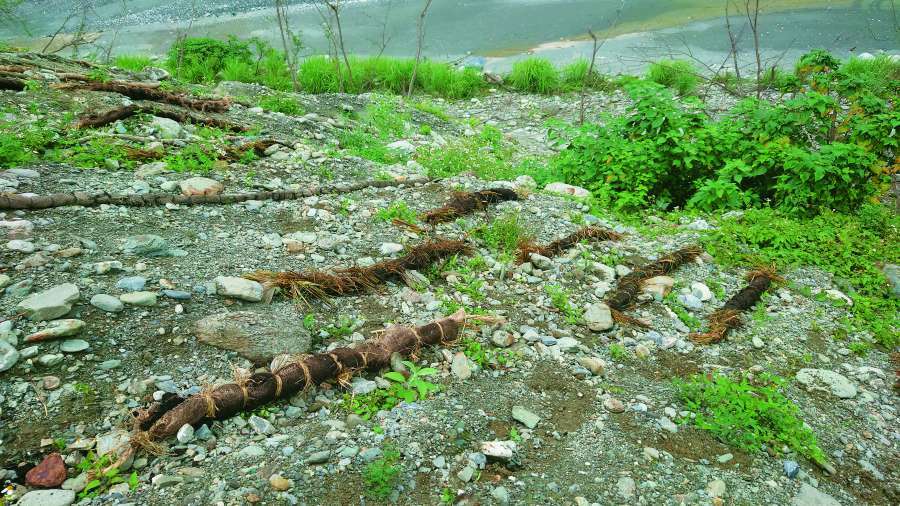
On the slopes near the Liwu River estuary, neatly hung seed bags on landslide terrain seem like the creation of a god, as if a legend is about to unfold… In fact, these unassuming yet mysterious seed bags are the bold experiment between Chang Mu-Lin, Project Assistant Professor in the Nature & Sustainability Division at Tzu Chi University’s Center for General Education, and Taroko National Park Headquarters. They are attempting to combat invasive species by using native plants, in hopes of bringing back Taiwan’s own green mountains.
After the April 3, 2024 Hualien earthquake, landslides damaged the banks of the Liwu River. Not even a blade of grass remained on this once lush and green area. The traditional belief is that if we leave such an area untouched, it will restore itself. “The Local Earth God knows best how to plant trees” – this is a common objection Chang often hears. He believes, instead, that before the land has fully recovered, the “Demon King” has already invaded, pushing the ecological environment to the brink of collapse.
The “Demon King” Chang refers to are invasive plants such as wild tamarind (Leucaena leucocephala) and Hairy Beggarticks (Bidens pilosa). Listed among the world’s top 100 invasive species, wild tamarind is particularly “evil”, as the mimosine secreted from its roots will inhibit the growth of other plants and rapidly form monospecific stands that severely damage biodiversity. “The plant has spread from the Liwu River estuary into Taroko Gorge. If we keep using traditional slope protection methods, the entire mountain will end up covered by wild tamarind,” Chang says.
He explains that in western Taiwan, winter usually brings water shortages, causing wild tamarind to shed a large amount of leaves. This brief period of leaf drop creates a window in which the invasive species becomes comparatively vulnerable — giving native plants a better chance to expand.In Hualien, however, winter rainfall is abundant, so native plants such as elephant’s ear (Macaranga tanarius) and paper mulberry (Broussonetia papyrifera) continue growing vigorously with little visible leaf loss. If conservationists take action precisely at the moment when wild tamarind is weakened, they may be able to “give the God of the Land a helping hand” and tip the ecological balance in favor of Taiwan’s native species.
Changing The Seed’s ‘Ballistics’
The restoration effort first took place at a demonstration site on a slope near the God of the Land Temple at TNPH entrance. Initially, the team tried making ‘seed balls’. However, climatic factors and constant slope collapses meant they were unable to monitor the seed balls’ growth. The seed balls that were thrown out vanished without a trace.
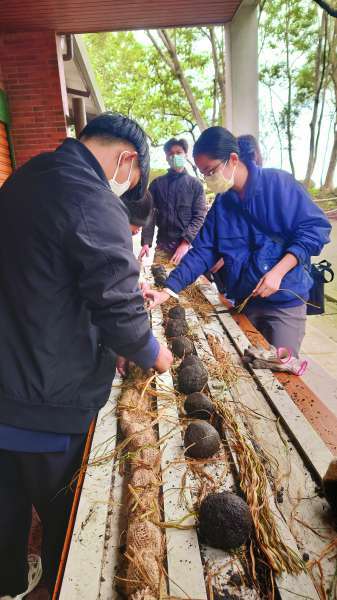
Following on from this, they decided to hang a modified version, 'seed strings' (which are long cylinders, rather than spheres), along the slope. "This not only makes growth tracking easier," says Chang, "but also greatly enhances germination rates. We also discovered that the timing for hanging seed strings is critical; seed strings hung last January performed well, while those hung after April or May showed markedly poorer results." Chang considers this to be the reason for using seed strings: Helping plants adapt to their environment when weather conditions cannot be modified. And yet, even though the seeds of native plants start germinating, invasive species often grow faster. The team thus has to remove these intruders from time to time, meaning it's certainly going to be more than one or two years' maintenance before they can see the results.
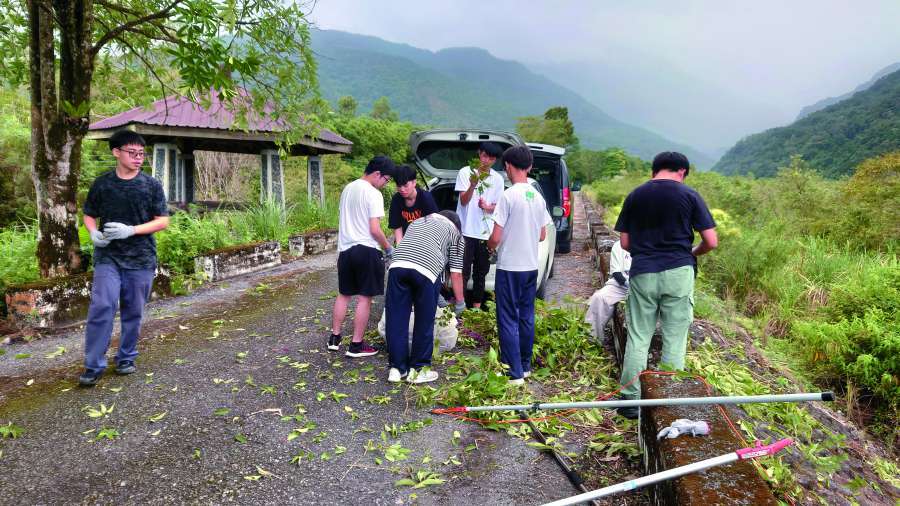
Now, Chang is leading students who enrolled in a course to take part in onsite restoration work. TNPH volunteers also enthusiastically join in to collect seeds and hang seed strings. Chang observes, “Most people grow up in the city, and feel disconnected from nature. By collecting seeds, observing plant growth, and touching the soil at the Liwu River estuary with their own hands, they can sense how environmental conservation is not empty talk.”

An Experimental Journey That Begins with an MOU
Why adopt an MOU for the collaboration with TNPH? Chang explains that, compared to a commissioned research program that requires establishing KPIs and acceptance criteria, an MOU offers greater flexibility. This allows experimental projects to progress incrementally.
After all, this is an unprecedented endeavor; no one knows if the restoration of native plants will succeed, given the current stark geological conditions in Taroko. Thus, signing the MOU strikes a balance between idealism and reality for both parties, representing a willingness to pursue what is right while allowing room for error. “The idea of restoring Taiwan’s native plants on slopes extends beyond ecological conservation,” says Chang. “We hope that it will also alleviate the psychological stress that visitors experience when they see a barren mountain, and that it will help Taroko return to normal operations sooner.”
Next, the team also plans to develop a “seed net”, in which native plant seeds will be densely embedded into a netted structure to fully cover a slope. Chang explains that the next step is to cover an area of 50 square meters. If the seeds germinate well and prove cost-effective, the method could be provided to other communities to implement on their own. By combining the efforts of many organizations, we can better combat intrusions by invasive plants; we can plant the seeds of hope for areas facing similar challenges throughout Taiwan, while charting a course toward rich biodiversity.