
Having Fun in Spring:Bright and Colorful Spring Gardens-
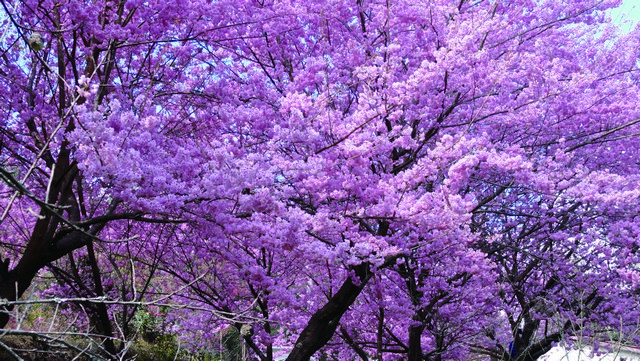
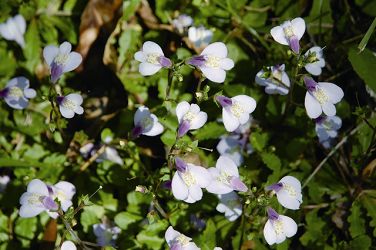
When the first light of spring shines on the slowly disappearing winter atmosphere, the melting snow, sweet as the morning dew reflects the morning sunlight and melts slowly away into the spring soil. Taiwan Cherries (Prunus campanulata Maxim.) blossom into a flamboyant rouge flame and sway in the brisk and somewhat chilly spring breeze. The tiny Divided-By-The-Brook (Mazus pumilus) and Rabbit Milkweed (Ixeris chinensis) are sprinkled with brilliantness that blankets everywhere. Hesitated, a Formosa Slug Snake (Pareas formosensis) wiggles its tongue to get a taste of spring, wondering if it is time to stretch its body. Unable to resist the fragrance of the flowers and the tenderness of the green leaves, insects are already bouncing from one drop of spring dew to the other. Birds are grooming their spring plumage; some of them are looking for their life mates and building their nests of love, while the others are packing up to go home like a traveler who has not been home in years. Throughout all of this fun, everything between the earth and sky begins to weave a whole new splendid season after a winter of resting.
- upper:Having Fun in Spring
- lower :Prumus taiwaniana
Article / Editors
Bright and Colorful Spring Gardens
The national parks of Taiwan feature a good diversity of geographic and cultural phenomena. There are Yushan, Shei-Pa and Taroko in the central mountain range, Yangmingshan featuring a volcano, Taijiang which is a precious wetland, Kenting and Dongsha Islands with their island landscapes, and Kinmen where cultural and historical heritages are the crown jewels. Each of these national parks has its own distinct characteristics — as do the local vegetation and landscapes.
In the mountains, temperatures oscillate between cold and warm rapidly during early spring. Some of the areas such as the Main Peak and North Peak of Mt. Jade, Mount Syue, and the peaks of Mt. Hehuan may still be covered in snow and ice. Many plants that wither in the winter, such as the Taiwan Lily (Lilium formosanum) and Polygonum cuspidatum, do not germinate until the snow melts and only blossom in the summer and the fall. Therefore in the mountains, grass grows the most in autumn from Sep. to Oct.. On the other hand, plants that blossoms in spring are mostly woody ones that hibernate in the winter, such as Rosaceae, Ericaceae, Salicaceae and Berberidaceae. Those that are most popular and best known are the temperate plants Prunus, Pyrus and Malus of Rosaceae — e.g. plums, cherries, prunes, peaches and apples. Most of these plants are cultivated in Taiwan, and they are planted in the national parks at recreational areas for public viewing.
When it comes to flowering cherry paradises in Taiwan, Ali Mountain has always been the top choice. Most of the flowering cherries seen here are Prunus x yedoensis cv. Yedoensis dates back to Japanese colonial times. Later, a variety of cherries were planted and grown extensively in Yangmingshan, Formosan Aboriginal Culture Village, Wuling Farm and Cingjing Farm, including Oshima cherry, Yaezakura cherry, double-petaled Taiwan cherry, and Pink Lady. Flowering cherry-viewing is gradually becoming one of the important annual events held in early spring in Taiwan just as it is in Japan.
Shei-Pa National Park
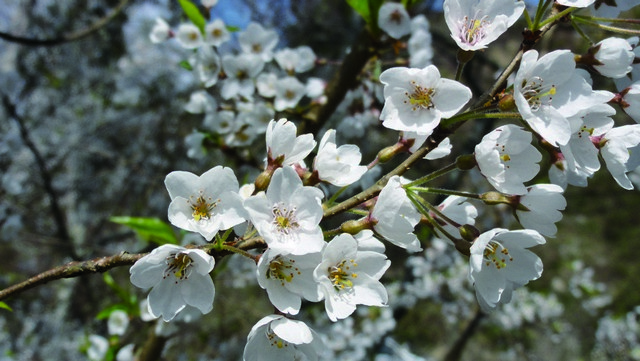
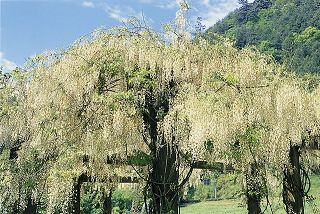
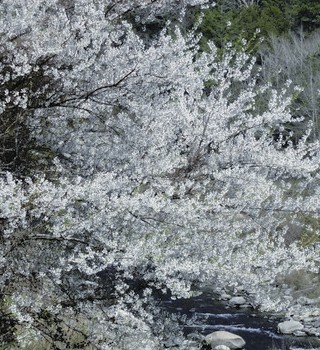
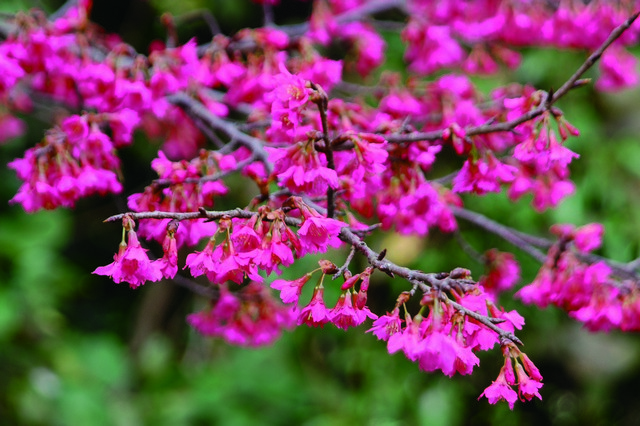
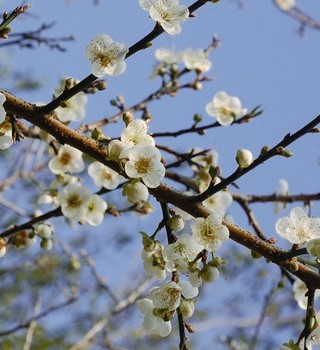
The flowering cherry season at Wuling Farm starts in February when the Taiwan cherries (Prunus campanulata Maxim.) begin to explode into a sea of flowers. Following Yiin late February is the hybrid “Pink Lady”, which is the leading lady of the flowering cherry season at Wuling. The pink tone of Pink Ladies is gentler and lovelier than the red of Taiwan Cherries. Its calyx is similar to that of the Taiwan Cherries and the same lateral grains are also obvious on the stems; it has laterally spreading branches, silken stipules and nectar-glazed leaves — though not as distinctive as that of Taiwan Cherries. There are five petals as well but they unfold much more widely than those of Taiwan Cherries. How the Pink Lady comes to be is lost somewhere in history. The Wushe cherries (Prunus Taiwaniana Hayata) — which blossom later (from late February to early March) — have pure white flowers that are much brisker and more fairy-like. The Wushe cherry is a rare species unique to Taiwan. These plants are widely scattered along several highways, such as Tai 14, Tai 14A, and Tai 8 between the altitudes of 900~2,400, somewhere around Lushan Hot Spring, Meifeng, Lishan and Cingjing Farm. Individuals of this species are easily spotted in the sea of trees only during its blossoming season, and that makes it all the more precious. At Wuling Farm, there are more varieties of flowers to appreciate, such as pears, double-petaled plums, peach, Prunus persica, apples and other temperate Rosaceae plants, in addition to cherries; however, these are not native plants. Quite often these plants blossom after the “Pink Lady.” “Pink Lady” is the ambassadors of Wuling Farm and as such “greet the spring.” However, the real “spring greeter” is actually a different flower entirely, the Primrose Jasmine (Jasminum mesnyi Hance). The Primrose Jasmine originally hails from Yunan China and blossoms from Nov. to Mar.. It has bright yellow flowers and its branches drape down from its stem. It is now mostly grown on slopes or balconies for aesthetic enhancement. Wuling Farm serves as a destination of recreation and seasonal activities as it is located in the recreational area at Shei-Pa National Park. In addition to the fruit trees commonly seen in the orchards, flowers are grown here as well for the public’s viewing pleasure — including Japanese wisterias (Wisteria floribunda), narcissus (Narcissus hybrida) , calendulas (Calendula officinalis L.), flowering kales (Brassica oleracea var. acephala) and pansies. The Japanese wisterias grown here at Wuling are phenomenal, and they are so numerous in fact that in all of Taiwan only Zhaoping Train Station and Tzuyun Temple in the Alishan National Scenic Area have a comparable quantity of them. They blossom mostly from late March to early April. There are fewer native species when it comes to flowers planted purely for aesthetic purposes. One reason is the limits of weather, and another is that the breeding, development and marketing of these flowers require the cooperation of both governmental and private sectors. However, there are some native wild flowers grown on grassy farmlands, such as Veronica persica and Viola confusa. Although less glamorous than gardening flowers, you will learn to appreciate their beauty so long as you are willing to crouch down — or even to lie recumbent upon the ground — to view these flowery fairies that grow less than 10cm tall.
Yangmingshan National Park
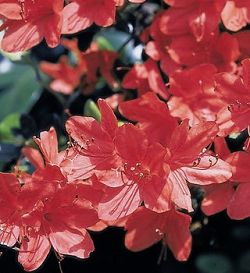
Springtime at Yangmingshan starts with an explosion of cherry blossoms, calla lilies (Alocasia odora (Lodd.) Spach.), rhododendrons (Rhododendron spp.) and camellias (Camellia spp.). For cherries, there are Taiwan Cherries, Prunus x yedoensis cv. Yedoensis, Yaezakura Cherry, Oshima Cherry, and some hybrids with no name.
The Prunus x yedoensis cv. Yedoensis, Yaezakura Cherry and Oshima Cherry were introduced during Japanese colonial times, and were grown widely after WWII. In February, red and pink cherry blossoms start to spread like a wild fire of flowers along Yangde Boulevard, the Flower Clock, Yangming Park, Visit Center — Yangmingshan National Park Headquarters, the rhododendron and camellia gardens, Zhuzihu and Macao. They may not be as concentrated in large areas as Prunus x yedoensis cv. Yedoensis is at Alishan or the Pink Ladies are at Wuling Farm, but that gives visitors the feeling that every spot is a precious spot proffering delightful views of these flowers. Combining that with the rich cultural ambience of Yangmingshan, there is an atmosphere of elegance and tranquility with a backdrop of drizzling and coldness even if there are but a few flowering cherries.
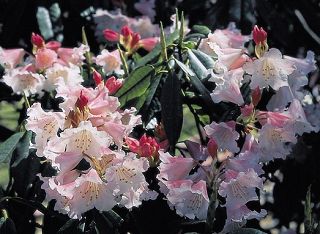
There are a number of rhododendron and camellia species in the rhododendron and camellia gardens at Yangmingshan. The former includes Rhododendron oldhamii Maxim, Rhododendron kanehirai Wilson, Rhododendron ellipticum, Rhododendron leptosanthum, Rhododendron hyperythrum, Rhododendron x mucronatum, Rhododendron indicum, Rhododendron mariesii Hemsl. & Wilson, and Rhododendron leptosanthum. The Rhododendron kanehirai Wilson is an endangered species originating from Wulai, New Taipei City. Its original habitat is now submerged in the Feitsui Reservoir.
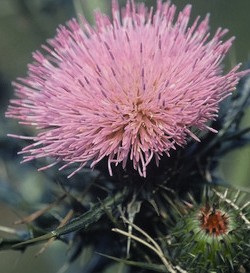
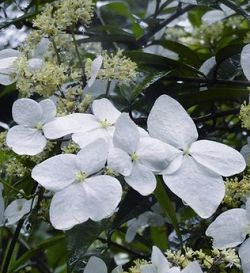
Across the grassy lands of Yangmingshan, there are some native grassy flowers such as Veronica persica, Mazus pumilus, Viola confusa, Viola arcuata, and Cirsium japonicum. At the edge of forest or the undergrowth in the woods, native plants like Farfugium japonicum (L.) Kitamura, Iris formosana, Hydrangea chinensis Maxim, Blastus cochinchinensis, Crateva adansonii may not catch too many eyes when they blossom, but their white or yellow petals give a different kind of quiet and peaceful beauty in the forests of rainy Yangmingshan after a brisk shower in the flowery bushes where there is the hustle and bustle of cars and passersby.
- upper:Beautiful stretches of pink blossoms
- left upper: Oriental plums
- left middle : Japanese wisteria
- left lower: Wushe cherry is a rare kind of indigenous cherry blossoms.
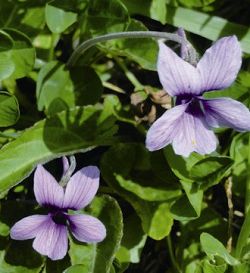
- lower left: Viola confusa looks like a little elf over the pasture.
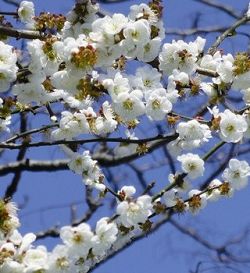
- lower middle: Double-petal plum blossoms
- lower right: Oldham's Rhododendron
Article & Photos / Chang, Chi-Yiin
Yushan National Park
Yushan National Park is a very large national park that covers from as low as tens of meters in altitude up to the highest peak in Taiwan at 3,952m. The climate spans from tropical weather at low altitudes to a frigid climate at high altitudes. The vegetation ranges from evergreen broadleaf woods to short bushes above the forest limit. These rich variations are a microcosm of the ecology of Taiwan. Most of the grassy plants wither in winter to adapt to the alpine climate, and new shoots are hardly spotted in early spring when temperature fluctuates radically. Therefore, one has to wait until summer and fall to see flower buds shooting forth from the ground, Yushan Arrow Bamboos (Yushania niitakayamensis) patches and grassy lands ravaged by forest fires. To follow the footsteps of blossom season in spring, one has to keep an eye on Rosaceae and Cuculidae plants.
On the way to Tataka Visitor Center along the New Cross Island Highway (Tai 21), there are plenty of plum, prune, peach and Taiwan Cherries at Sinyi Township. The plum is the first to blossom in January, and it starts blossoming first from lower altitudes, then cascading upwards towards higher altitudes. The tourist attractions along the way include Fongguidou, Tongfu, Guanfong and Guanshan–the place with the most Taiwan Cherries. In February, the season of peak florescence, tourists always pull over to admire the blossoms. Also because Taiwan Cherries provide food for birds, there are quite a large number of birds coming to feed, including Formosan Yuhinas (Yuhina brunneiceps), White-eared Sibias (Heterophasia auricularis), Green-backed Tits (Parus monticolus Swinhoe), Red-headed Tits (Aegithalos concinnus) and Japanese White-eyes (Zosterops japonica). It is very common to see birdwatchers among blossom-seekers.
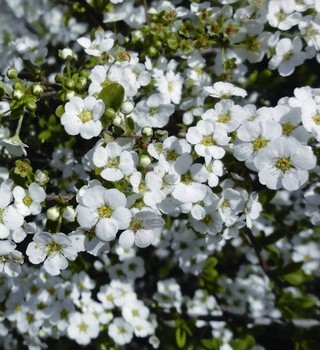
On the South Cross Island Highway, one enters the premises of Yushan National Park as one arrives at Maishan in Taoyuan Kaohsiung. At the Meishan Native Plant Garden and Meishan Tribe, the highway is sandwiched between ranks of greeting Taiwan Cherries. On the sheer cliffs along the way, the Taiwan bridal wreath spiraeas hang down just like the veil of a beautiful bride. These flowers prefer to grow on exposed rock walls. The pure white petals and the bundled spicas look like prune blossoms but smaller, resembling the bright smile on an infant’s jovial face. At the logging house azalea(at the 115 km mark of Tai 20), there are plum and prune plantations, and the road is lined with blossoms of Taiwan Cherries, peaches and Prunus persica. This is arguably the most beautiful section of the South Cross Island Highway in spring.
Taroko National Park
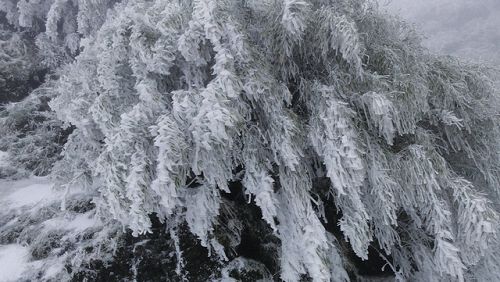
Like Yushan National Park, Taroko National Park is geographically located in the mountains. It features the world-class Liwu River Gorge and the Suhua Scenic Highway by the Pacific Ocean. Within the park, the section from Kunyang to Mt. Hehuan is the best location to see snow in Taiwan. Every year during the snowy season of January and February, the peaks of Mt. Hehuan are covered in snow. The Yushan Arrow Bamboos are still in hibernation, and many plants like Polygonum cuspidatum and Taiwan Lily are dry and withered. Therefore, Taiwan Cherries are still the stars of the blossoming season in Taroko during the early spring. They are distributed mainly along the Cross Island Highway between Dayuling to Taroko, and there are tourist attractions along the way including Guanyuan, Tsu-en Lodge and Tianxiang.
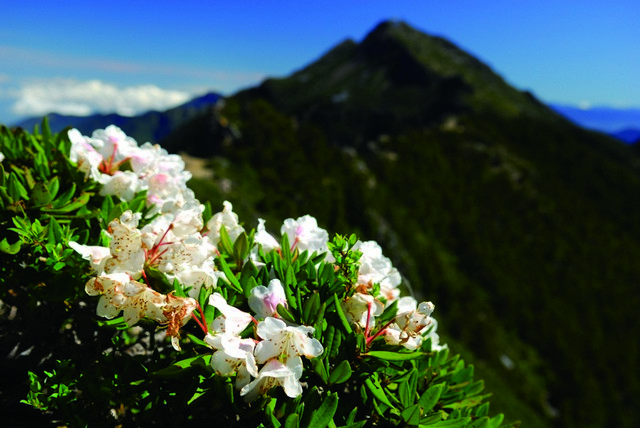
As April arrives, the white and red blossoms of Yushan rhododendron (Rhododendron pseudochrysanthum) start to flourish at Xinrengang along Route Tai 14A into the belt of hemlocks. With the tall and upstanding Taiwanese hemlocks (Tsuga chinensis var. formosana ) as companions in the misty clouds, one wonders if one is in a paradisiacal wonderland.
Among the native rhododendrons, Rhododendron ellipticum may be a stranger to general visitors, as they are often tucked away in the trees. One can only tell where they are when their distinctive pink flowers begin to bloom; the undertone and the elegance say it all for these flowers, unlike Rhododendron rubro-pilosum Hayata that grow in large patches in alpine grasslands. It is actually difficult not to see them. The best location to watch Rhododendron ellipticum is around the Bilu Sacred Tree.
Immediately after Yushan rhododendrons (Rhodo-dendron pseudochrysanthum Hayata), Rhododendron rubropilosum Hayata is seen blossoming unrestrained between Cuifeng and Yuanfeng and across the north peak of Mt. Hehuan. This could easily be considered the best place for flower-viewing.
Kinmen National Park
Kinmen National Park is spread across the entirety of Kinmen. It is easily accessible and feels like a small park in the neighborhood. Despite their inclusion in the national park, the traditional settlements are still a place some people call home.
When spring comes to Kinmen National Park, there is no explosion of visitors to see the blossoming flowers as there is in the national parks on the main island of Taiwan. Additionally, there are no alpine blossoms effusively pouring forth from the landscape. What we have here are thorny wild flowers like Rosa cymosa, Rosa bracteata Wendl. and Cirsium japonicum scattered like battlefield defense devices, or Evening Primroses (Oenothera biennis) on wastelands and beaches that are trying to lure bees with their brightly-colored flowers.
Rosa cymosa are common bushes in the wilderness of Kinmen, but very rare on the flatlands of Taiwan. As a result, when people first see it, they tend to believe that they were grown purposely for aesthetics. Despite the thorny leanings of common Rosa family, they do not grow into an unapproachable mess like Rosa transmorrisonensis Hayata or Yushan roses (Rosa sericea var. morrisonensis). On the contrary, they grow orderly and methodically like garden roses. In particular at South Taiwu Mountain, the Rosa cymosa climbs on the rock faces, and the white flowers cascade like a white waterfall. That is certainly a sight to see! This native plant blossoms for 4-6 months, and consequently, is worth being developed into a plant for aesthetic appreciation.
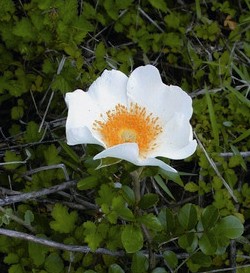
Rosa bracteata Wendl. is a relatively rare species that yields solitary flowers, thus smaller flowers than those of Rosa cymosa. Its florescence is similar to that of Rosa cymosa, and that makes this species worth promoting for native planting.
Cirsium japonicum is a common plant in Kinmen. The thrones that cover the entire plant are probably developed to fend off grazing cattle throughout Kinmen. However, this does not prevent them from being trampled by the cattle. Nevertheless, they have still come up with a countermeasure:
keeping themselves as low as possible and having their leaves flat against the ground — thus increasing their survival rate even after having been trampled; furthermore, this is a good strategy to prevent the strong sea winds from snapping their stems and leaves.
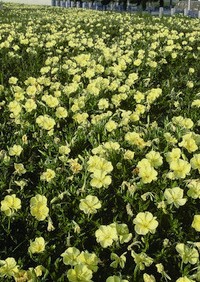
The bright yellow flowers of Evening Primroses are commonly seen across the entirety of Kinmen, but this plant is an alien species of wild flowers rarely seen in Taiwan. The florescence of the evening primrose can be as long as 6 months (from April to September approximately). These flowers blossom at night, hence the name.
The more common relative of the evening primrose in Taiwan is the American Oenother (Oenothera laciniata). These two species may prefer the coastal environment to grow, but God seems to favor Kinmen as evidenced by giving Kinmen such beautiful wild flowers that look like dancers’ swirling yellow skirts.
When they blossom in patches, it is indicative of the arrival of spring and it gives the people of Kinmen the hope of a bright future in a place filled with war heritage and the ambience of lonely traditional settlements. (Note: The largest population of evening primroses in Kinmen that the author had found was at the desalination plant next to Taihu Lake. However, its population today is not as spectacular as it was in times since passed. They can also be found at the Tsuti of Tsuhu.)
Spring flowers are blossoming in national parks like the endearing smile of a pretty girl. This warm, playful romance is the most beautiful sight in the light of spring. Cherish this gift that God has sent us. Leave the flowers where they grow for everybody who comes after you, so that they too have the chance to appreciate them as you did.
- upper:Prunis campanulata
- left upper: Taiwan bridal wreath spiraeas
- left middle: Plum blossoms in early spring.
- left lower: Yushan Rhododendron
- middle left :A snow-covered Mt. Hehuan in early spring.
- middle right: The bright yellowness of the Evening Primrose is a shining emblem of Kinmen.
- lower left: Thorny Rosa bracteata Wendl is interspersed amid the stretches of fields of Kinmen.
- lower middle: Cephalanoplos segetum
- lower right: Chinese Hydrangea
Article & Photos / Chang, Chi-Yiin
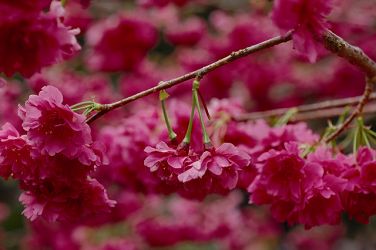
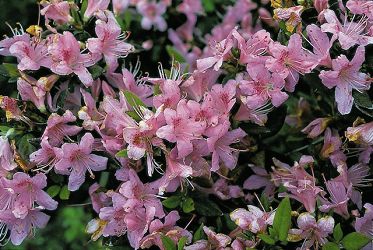
- upper left:Yangmingshan enjoys a rich variety of cherry blossoms; this is double-petal red cherry.
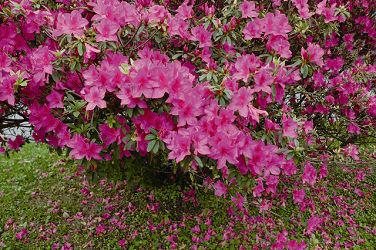
- upper right:Snow azalea
- lower left:Divided-By-The-Brook is one of the earliest blossoms at springtime.
- lower right:Red-hairy Rhododendron
Article & Photos / Chang, Chi-Yiin
Profile

Chang, Chi-yi | Environmental Worker
Born in Minghsiung, Chiayi, Mr. Chang is a B. E. of National Cheng Kung University and a Master of Science in Landscape Studies of Tunghai University. Growing up amidst nature, Mr. Chang loves and worships it. He currently enjoys his work documenting all phenomena of nature and communicating the seeds of ecological conservation with the world.


