
Have Fun in Spring:Snakes Appear When the Spring Comes-The Tale of Snake in Grass Mountain-
The Sound of Thunder
At 3am on the morning of February 23rd, a hugethunder awoke all living beings. It was the the 2nd ofFebruary on the lunar calendar. It is said that on the 2ndof February, the dragon awakes and the scorpions andcentipedes are ready for new life. This saying represents theincreasing rainwater and vitality of all lives. In February,all lives are awakened by the shake of thunder. This is thespring awakening. The dormant worms start to emerge fromunderground. The life that lay dormant throughout thewinter is awakened by the spring thunder and the rainwater,beginning their new circle of life. The ancestors describedsnakes as the long worm and a typical ectotherm becauseits movement is highly related to the temperature of itsenvironment. Because Taiwan is a subtropical island, in thewinter, it is only cold enough for snakes to hibernate for afew days at most.
Speaking of snakes, most people have an aversion tothem because of their unappealing appearance, mysticalmovements, and are misrepresented as aggressive creatures.Snakes have rarely been presented as a friendly animalstarting from stories told long ago. Yet many people havestill heard of a Chinese legend, “Tale of White Snake,” whichis a heartbreaking tale of a human and a snake. Xuan Wu(god) who achieved salvation once he gave up evil, subduedthe rebellion started by the turtle and the snake which werethe incarnations of his stomach and intestines in the humanworld. Individuals who have committed themselves tomedical care are quite familiar with the snake on the badge ofmedical institutions, the symbol of reincarnated life.
Civic Culture
Most people are fearful of snakes having not had thechance to observe them. That is why not many snakeshave been named and those with names are ones thathumans frequently come into contact with. For example, inTaiwanese, the Taiwan Stink Snake (Elaphe carinata ), TaiwanBeauty Snake (Elaphe taeniura friesei ), South Snake (Ptyasmucosus ), Big-eyed Rat Snake (Zaocys dhumnades ) and soon often show up around houses and prey on livestock and are commonly killed for revenge. Turtle-designed Snake(Trimeresurus mucrosquamatus ) and Taiwan Bamboo Viper(Trimeresurus stejnegeri stejnegeri ) have been known tocause injury or death of people working in mountainousareas. They are often killed without exception because theyare poisonous and aggressive. Snakes such as the CommonScaled Water Snake (Xenochrophis piscator ), Flower Snake(Amphiesma stolata ) and the Water Snake frequently comeinto contact with farmers in paddy fields but they are notaggressive. They are proof that humans and snakes can livein peace. They have even become subjects of a famous tale,described as the god of earth’s son, helping farmers patrol thefields.
How Close Are Snakes to Us?
There are 49 species of snakes in Taiwan and theyare divided into several categories, Typhlopidae, ColuberCaspius, Elapidae and Viperidae. These snakes are widelydistributed from seashore to the tallest mountains. The timethat snakes are active is gradually getting longer year by yearas a result of global warming. The “spring awakening” onthe lunar calendar was formulated by ancestors and may facethe challenge of redefinition in this century. Now, it is easyto see snakes during the spring and the public should takeadvantage and try to learn about these mystical lives. Why isYangmingshan National Park that recorded the most snakespecies? Do snakes only live on land? What can we do if werun into snakes?
How to Get Along with Snakes?
In the countryside, it is hard to avoid snakes, but mostpeople are too afraid of snakes to react when seeing them.We can live with snakes in peace if we learn more aboutthem. Firstly, most snakes do not attack humans unlessyou provoke them. When you run into a snake, they usuallyrun away before you do.
When walking in countryside or forests, you can usea stick, bat, and umbrella or tree branch to scare themaway by disturbing the plants nearby or softly knockingrocks on the ground. If you run into a snake, you can keepa distance from it and allow it to leave quietly or makeavoid disturbing it by going on a detour. Certainly someaggressive snakes do not run away and may even attackyou for invading its territory. It is advised to wear high shoesor rain boots to prevent from getting hurt when movingaround the countryside.
Here is some advice for more safety when in thecountryside:
1. Do not try to catch or provoke snakes
2. Remember to “stir the grass and startle the snake” whengoing into dense piles of hay or bushes.
3. Do not put your hands in the hollow pile of hay, bushes,caves and the bottom of rock without checking carefully.
4. In summer time, snake like to hide in cool places soplease keep an eye on your rain boots, hats, clothes,and back packs.
5. When camping oudiv>
6. Most snakes are good at swimming. If there are snakesin water, please leave the water as soon as possible.
77. Wear high shoes or rain boots when going to thecountryside. Wear a hat to avoid arboreal snakes.
8. In the case of an emergency, please remember theappearance of the snake, conduct first-aid, and report tothe correct department as soon as possible.
- upper:Snakes AppearWhen the Spring Comes
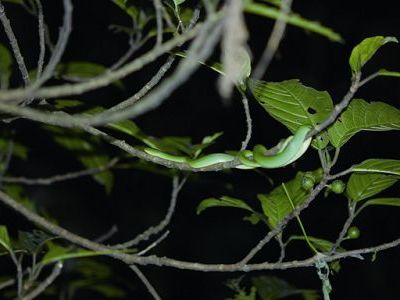
- lower:Chinese Green Snake (Cyclophiops major )
Article & Photos / Editors
The Tale of Snake in Grass Mountain
There have been rumors that the snakes inhabiting the suburbs of Taipei City, in Yangmingshan National Park (formerly known as Grass Mountain), are there as a result of the poisonous snakes that were being researched and released by the Japanese. It is said that a snake institute was established during the Japanese Colonial Period in this area (such as Sha Mao Shan) after the Japanese were defeated in World War II.
Was there really a snake institute? At the moment, we only know that the Presidential Palace Central Research Institute during the Japanese Colonial Period established the SnakeTropical Medicine Institute Shih-lin Branch in Fudeyang Shangzijiao, Shilin Street, Qixing County, Taipei State (near the current Ming Chuan University ) to conduct researches in tropical medicine. There are some studies and research related to poisonous snake bites and anti-venom. But we don’t know if these studies were conducted by the Snake Institute in Yangmingshan or if there may have been a misunderstandings caused by the change of organization names during the Japanese Colonial Period. There is no evidence to prove that a massive number of snakes were released at the end of World War II. Most species of snakes in Taiwan are distributed in the middle mountain area, but because humans started to build an increasing number of houses and roads, it is now much more likely to run into snakes. This is how the rumored snake institute became a reasonable explanation for the appearance of snakes in Yangmingshan.
Grass Mountain is Suitable as a Snake Habitat
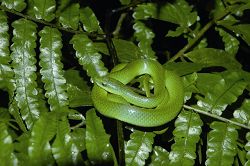
A more accurate and scientific documentation of the distribution of different species of snakes in the area of the Grass Mountain dates back earlier than any other area in Taiwan. Since the Japanese Colonial Period, there were Seiichi Takahashi and Yasuichi Horikawa who respectively mentioned the snake species in the area known present day as Yangmingshan (Grass Mountain, Mt. Datun, Zhuzihu and etc) in their snake-related publications. At the time when overall records of snakes’ appearances were commonly unclear and indefinite, the records of snakes in Grass Mountain area were fairly accurate. Compared to the locations of other national parks in Taiwan, the convenient transportation may have helped snakes get the attention of researchers more easily and much earlier, resulting in much more detailed records. There are already 34 species of snakes recorded in the local area which accounts for up to 74% of all snake species on Taiwan’s soil. These snakes are divided into several categories based on their different habitat and space. The fossorial snake which lives in caves, cracks, or under piles of dried branches and falling leaves, include the Collared Reed Snake (Calamaria pavimentata) and Ornate Kukri Snake (Oligodon ornatus). The terrestrial snake which predominantly moves on the ground include the Chinese Cobra (Naja atra) and Red-banded Snake (Dinodon rufozonatum). The arboreal snake which stays in trees more than on the ground include the Keelung Cat Snake (Boiga kraepelini) and Chinese Green Snake (Cyclophiops major). There are some species with biological characteristics between two types of snakes and are not easy to be categorized. They are extremely adaptive between two types of environments.
- left:Chinese Green Snake
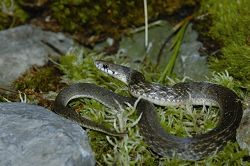
- middle:Chinese Mountain Snake
- right:Keelung Cat Snake
Article & Photos / Mao, Jean-Jay
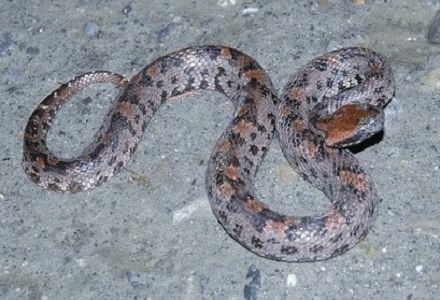
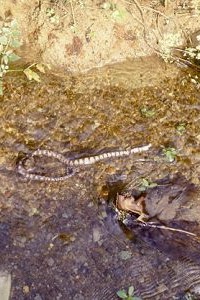
Take semi-aquatic snake for instance, they are good at moving in running or still waters but they move to land for biological needs such as reproduction and thermal regulation. Olive Keelback (Sinonatrix percarinata suriki) and Rice Paddy Snakes (Enhydris plumbea) are included in this type of snake. There is also a semi-arboreal snake which lives on land but often climbs trees for hunting, this includes the Formosa Wolf Snake (Lycodon ruhstrati) and Formosa Slug Snake (Pareas formosensis). The everchanging climate, diverse habitats, and complicated geographic conditions in Yangmingshan National Park along with its unique location provide multiple and complex habitats for different species of snakes to co-habitate in this area. The development of cities on low lands around the mountains might have forced some wild life to move to this area that made Yangmingshan National Park a shelter for wild life in Taipei City.
Watch Out for Snakes When Driving!
There is an increasing number of roads and traffic in the Yangmingshan area. The original snake habitats that were destroyed by the building of roads surprisingly created a unique and warm forest and grass land fringe environment which nurtures plentiful food for snakes and increases the opportunities of them appearing near the roads. Sometime they are even forced to cross the roads to hunt or mate and many of them are accidentally or deliberately run over by vehicles. Some living snakes become subjects of observation for fans of amphibians and reptiles in Taipei City while the dead ones on the road become a part of the local ecological studies.
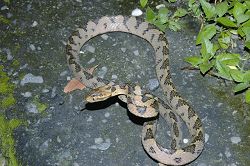
How many innocent wild lives have been killed on the roads in Yangmingshan National Park? Prior to 2006, a roughly 10-years of research statistics has recorded over 13,000 road kill which is considered a huge waste and great damage to our precious biological resources and fragile ecological environment. This data also reminds people who frequent this area to slow down their vehicles. Among the piles of bodies collected on the road and stored at the National Park Headquarters’ refrigerator, new species were found (i.e. the Chinese Mountain Snake). To the public, the Chinese Mountain Snake is a species of small non-poisonous snakes with dark yellow brown skin and live in caves, but to the researchers, the road-killed specimen offers the basis for a comparative description in new documents. In addition, the mystical Taiwan Mountain Pityiper (as known as Alishan Pityiper) draws the attentions of researchers and fans of reptiles. Taiwan Mountain Pityiper is poisonous and often shows up on rainy and misty nights during the cold winter. It does not like to travel, therefore, under normal conditions, it presents no harm to humans. However, the season and the weather condition of its movement breaks the Taiwanese myth that all snakes are dormant throughout the winter.
Can We See Water Snake Again?
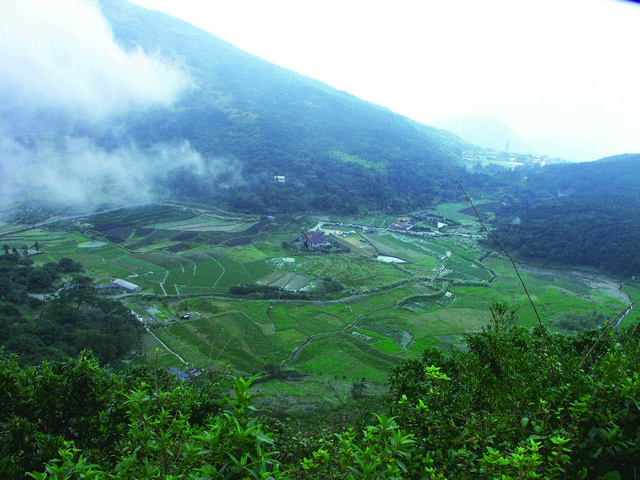
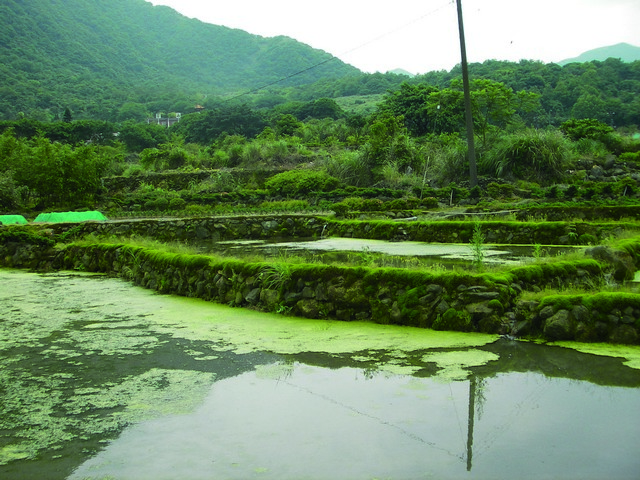
The focus of Taiwanese habitat ecological conservation in recently years has gradually been shifting to agricultural paddy fields or terraced fields. These kinds of wetlands depend on constant human cultivation to maintain balance. They preserve many rare lives (i.e. the Asian Snakehead (Channa asiatica)) which were commonly seen before the large scale development in the western plains of Taiwan. During the Japanese Colonial Period, Yangmingshan used to be the area for rice introduction. Today, it still preserves many paddy fields with good ecological environments. These surroundings and the adjacent streams and irrigation canals for water diversion not only create a complete wetland ecological network, but also provide one of the last few habitats for some of Taiwan’s endangered semi-aquatic snakes including the Ringed Water Snake, Chinese Water Snake, and Rice Paddy Snake. Some of these snakes were distributed widely in Taiwan western plains. In 1914, the Japanese scholar, Massamitsu Oshima, reported that the number of water snakes which threatened the cultured fish was steadily decreasing due to the massive disappearance of their habitats. According to past studies, these water snakes live in small spaces and are loyal to one habitat. They are also the top predator of the wetland’s food chain and quickly adapt to their environments. These characteristics make them the key indicator of the health of the wetland’s ecological environment. The paddy fields where they are seen might be suitable for organic rice cultivation and can be proof of a good ecological environment. Grass Mountain used to be the first area where snakes were clearly recorded, but at present is the last shelter for these water snakes. Whether we have the chance to see these diverse snakes in the future or not depends on the actions of humans. We should not envy the natural beauty of other countries if we cannot take care of our own precious ecological environment.
- left:Taiwan Mountain Pitviper
- right:Ringed Water Snake
- lower:Terrace in Yangmingshan
Article & Photos / Mao, Jean-Jay
Profile

Mao, Jean-Jay | Dept. of Forestry and Natural Resources, National Ilan University
Mao is an Assistant Professor in the Department of Forestry and Natural Resources, National Ilan University, Taiwan. He is interested in field ecological studies, techniques, and the conservation of squamates. His current research focus is on the ecological relative issues of venomous snakes, and the wetland water snakes.


