
Have Fun in Spring:Snakes Appear When the Spring Comes-Sea Snakes of Southern Taiwan — Tracks Back t-
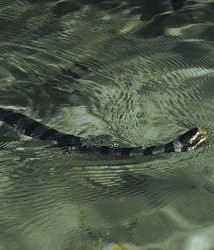
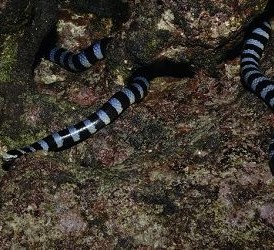
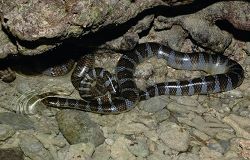
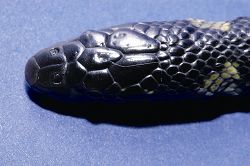
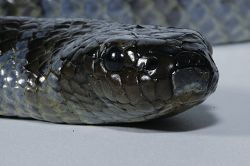
It’s springtime. Beach goers are still scarce in Southern Taiwan, but not the Yellow-lipped Sea Krait (Laticauda colubrina). The Yellow-lipped Sea Krait is the one of the three Laticaudinae species in Taiwan that is found on dry land. It is typical to see them on dry land far away from the sea. The other two species of Laticaudinae are the Black-lipped Sea Krait (Laticauda laticauda) and Wide-striped Sea Krait (Laticauda semifasciata). The Black-lipped Sea Kraits sometimes climb up the rocks by the shore, but do not often stray far away from water. Out of these three species, the Wide-striped Sea Kraits are the ones least likely to be found on dry land. They stay in water most of the time and only come out of the water in secluded places like snake pits.
Do Sea Snakes Live in the Sea?
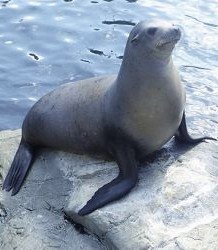
Are they supposed to live in the sea? Why are they on dry land? This is a question similar “Are marine mammals supposed to live in the sea? Why are they on dry land?” Sea snakes and marine mammals are both vertebrates that went back to sea from land. The better an animal adapts to marine life, the less likely it will return to land. Among marine mammals, whales and dolphins adapt to marine life the best. They no longer have to, and in fact can no longer return to land life. Sea lions and seals still have to return to dry land to rest or breed. The same goes for sea snakes. The better they adapt to marine life, the less likely they will come back up. This phenomenon is not only observed in the broad-tailed sea snake family, but also in the extended sea snake family.
Difference in Sea Snake Family
There are two groups of sea snakes in this big family, one being the true sea snake (Hydrophiidae), and the other being the broad-tailed sea snakes (Laticaudidae). These two groups both had their origins traced back to Elapidae but despite this returned to the sea separately. True sea snakes adapt to marine life better than broad-tailed sea snakes do. The result is that they are no longer fit for land life similarly to whales and dolphins. They do not have the ability to climb ashore, as their belly scales have degenerated. In some species like the yellow bellied sea snake (Pelamis platurus), their belly scales have degenerated to the point that there is no telling if they are belly scales or ordinary body scales. Their bodies have evolved into a flat, paddle-like shape, i.e. the distance between both sides of the body shrinks and the axis along the back and belly elongates in order to adapt to swimming in water. A change like this gives them an advantage and provides them with a large surface area to propel water by swinging the body left to right and right to left. However, they can be stranded on dry land if they are pushed ashore by waves. True sea snakes have nostrils similar to those of whales and dolphins, which move to the top of snub and can be shut with valves. This evolution allows these sea snakes to breathe at the surface and keep water from penetrating into the nostrils when submerged.
The nostrils of broad-tailed sea snakes, which are on the sides of the body, do not have valves to keep water out. However, they keep their nostrils open or shut by having the tissues around the nostrils flooded with or drained of blood, respectively. Their belly scales may be smaller, but they are still distinguishable from the body scales around them, thus giving the broad-tailed sea snakes the ability to crawl on dry land. It seems very important to still have this ability when it comes to reproduction, as broad-tailed sea snakes still lay eggs like their ancestors did. On the other hand, true sea snakes, which spend their lives entirely in water, are now viviparous animals that give birth to little babies. Broad-tailed sea snakes need a dark, humid place that is out of the reach of sea water to lay their eggs. Without the ability to crawl, they will be unable to pass on their genes. These hatcheries are often secluded and out of human reach. We were lucky to find a hatchery like this at Lanyu.
- upper left:A banded yellow-lip sea snake starts its life in early spring.
- upper middle:A black-lip sea snake just climbed up a rock not far away from the water.
- upper right:Sea lion resting on shore
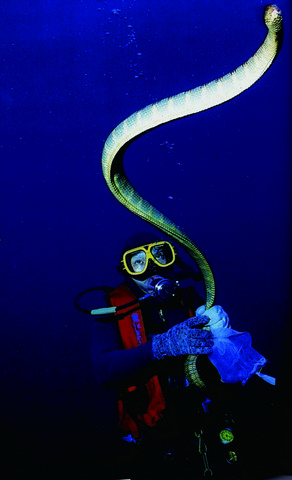
- left upper:Banded yellow-lip sea snakes spend most of time in water and only come out of water in secluded snake pits.
- left middle:The nostrils of true sea snake move to the top of the snub and have valves to close them.
- left lower:The nostrils of yellow bellied sea snake are still on both sides of the snub and there are no valves.
Article & Photos / Tu, Ming-Chung
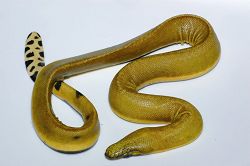
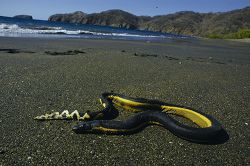
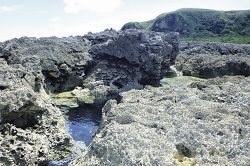
The rocks at shore above high tide provide not only a hatchery for broad-tailed sea snakes, but also a safe haven where they will rest or wait to shed their outer skin. Our recent studies showed that broad-tailed sea snakes need fresh water. However, they are hard to find at river estuaries where there is plenty of fresh water, as there are only fine sands and pebbles and not many rocks for them to hide. It is much easier to find gatherings of broad-tailed sea snakes in an environment where the rocks are above high tide lines and there is an inflow of fresh water. True sea snakes are naturally free from such a restrictions as they no longer have the need to rest or crawl on dry land. Many species of true sea snakes have evolved to venture out of the coral reefs. For example, common sea serpents (Hydrophis cyanocinctus) or slender-necked sea snakes (Hydrophis melanocephalus) are often found where there is silted bottom and no coral reefs.
Tracks Leading Back to Sea
True sea snakes and broad-tailed sea snakes allow us to learn how snakes found their way back to the ocean. The morphology, physiology and use of habitats display great difference between these two groups. Let’s say we keep our eyes on the broad-tailed sea snake family. Lucky enough for us, we are able to see how gradually they have evolved back to marine life. As it just so happens, the three species of broad-tailed sea snakes registered in Taiwan are representative species of different levels of adaptation to marine life. The wide-striped sea snakes have the highest level of adaptation to marine life, followed by the black-lipped sea snakes, and the banded yellow-lip sea snakes are the weakest in this regard. They may look similar on the outside, but there are still subtle changes that tell how they have evolved. The wide-striped sea snakes have the most distinctive ridge protruding along the centerline of belly scales. There is such a ridge in black-lipped sea snakes but it is not as obvious, and the banded yellow-lip sea snakes have no such ridge. This ridge allows the body to be flattened sideways. There is no obvious change observed in the banded yellow-lip sea snakes when they are on land, as they are able to flatten their bodies when swimming. Their feeding preference tells how much they are connected to the land-based ancestors. The banded yellow-lip sea snakes and the black-lipped sea snakes feed underwater, climb ashore and have their food slowly digested while they are resting on land. These two sea snakes eat nothing but eels, as opposed to the wide-striped sea snakes which feed on all kind of coral reef fish. Interestingly, their land-based ancestors fed on other snakes. Yellow and black-lipped sea snakes, which are not very adaptive to marine life, eat food similar to what their ancestors fed on, which are all slender in shape. On the other hand, the wide-striped sea snakes, which are more adaptive to marine life, have evolved out of the shadow of their ancestors. They have shed off the legacy of their ancestors and embraced the ocean, and that is why these three sea snakes are different when on dry land.
The Coral Reef Sanctuary in National Parks
I have to recognize how lucky we are to have these species representative of different stages of evolution. The existence of national parks provides protection of the habitats of sea snakes in coral reefs and high elevated coral rocks. They allow these witnesses of evolutionary history to roam in them. Millions of years of evolution and adaptation have left marks on the morphology, physiology and behaviors of sea snakes’. We will be able to read this ancient story chapter after chapter if we are willing and attentive enough. We need to understand that evolution takes an extremely long time to develop. It allows us to learn to be humble, and know how to live harmoniously with all living things on earth.
- upper left:The belly scales of yellow bellied sea snake have shrunk to the point that they are hardly distinguishable from body scales.
- upper middle:A yellow bellied sea snake stranded on shore.
- upper right:The body of yellow bellied sea snake is flattened sideways
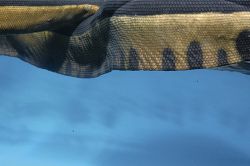
- left:The ridge protruding along the centerline of belly scales allows the wide-striped sea snakes to flatten their bodies. (photo by Su, Yen)
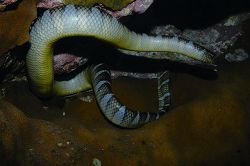
- lower left:The belly scales of broad-tailed sea snakes may be smaller than before, but they are still distinguishable from body scales next to them.
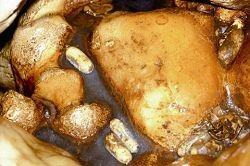
- lower middle:Eggs and shells found in a hatchery of broad-tailed sea snakes.
- lower right:Rocks rising above tidal level are important habitats for broad-tailed sea snakes
Article & Photos / Tu, Ming-Chung
Profile

Tu, Ming-Chung | Professor of National Taiwan Normal University Department of Life Science
Born and raised near the coast of Miaoli, Dr. Tu’s fascination with snakes began when he enrolled in National Taiwan Normal University Department of Biology (today’s Department of Life Science). His years of experience studying snakes not only give him an outstanding reputation in this field of research, but has also helped him in his advocacy for ophidian ecology and conservation.


