
Have Fun in Spring:Homeward Bound: The Winter Migrant Bird’s Return North-
The Nomadic Life of Migrant Birds
Around September and October each year, the wintermigrant birds descend upon or pass over Taiwan in droves.During this time, bird-watching locations are alwaysincredibly popular — among them Kenting National Parkis considered the most spectacular. The stars of the show,however, are the birds themselve s— a cause for nationalcelebration — and notably in their midst is the Gray-facedBuzzard Eagle (Butastur indicus ). At the same time, we’reintrigued by these special birds and can’t help but wonder atwhat time during the advent of autumn they will make theirreturn home to warmer southern climes.
Simply put, migrant birds migrate in concert with theseasons. So long as their homes switch seasons or the climatechanges, thus rendering it unsuitable for their lifestyles, thesebirds will temporarily depart from their homelands to a moreappropriate location. Couldn’t this be considered akin to thebehavior of nomadic tribes who go wherever there is waterand grass for their livestock?
Nomads primarily change with respect to altitudeand not latitude; in fact, it is exceedingly rare for them tochange latitudes. On the other hand, migrant birds possessthe special characteristic of traversing distant latitudes as theseasons cycle. In the summer, they spend their time at higherlatitudes to procreate; whereas, in the winter, they descend tothe lower latitudes to spend their winters.
It is thus that nearing the end of summer and the dawnof autumn that these birds take flight from their matinggrounds — their homes — at higher temperate latitudes andvoyage to lower tropical latitudes to spend their winters. Thefollowing spring, they will return to their northern homes toreproduce.
These birds that chase the seasons are referred to as“migrants”. This tendency to follow the natural cycles ofthe seasons and to move house twice a year is known as“migration”. Its defining characteristics are its occurrence atregular intervals, in particular directions, en masse.
Winter & Summer Visitors
These migrant birds can be classified based by the time of year in which they appear. For example, during Taiwan’s spring and summer, a group of birds referred to as “summer visitors” migrates from the south in order to reproduce (one such bird is the Cuckoo (Cuculus spp.)). Conversely, in the winter we have the so-called “winter visitors” who hail from the north (among them, the Black-faced Spoonbill (Platalea minor)).
Whereas, if the birds reproduce in locations farther north than Taiwan and spend winters farther south, then they will only stop for a short time in Taiwan during their autumnal and spring migrations. These birds are referred to as “transients” (a noteworthy example being the Gray-faced Buzzard Eagle).
The same species of bird spotted at different observation points might be classified in a different migratory group than others of their ilk. For example, the Grey Frog Hawk (Accipiter soloensis) is considered a “transient” bird in relation to Taiwan, yet is a “winter visitor” during its tenure in the Philippines. Furthermore, it is a “summer visitor” while in Japan.
Not all birds are travelers, though. Some spend the entirety of the year living in a single environment; these birds are called “residents”. Additionally, some birds in a given area might be very far from their supposed homes or are found well away from their normal migration route — this might have happened either because occasionally birds will lose their way or due to certain unusual climatic factors. This occurrence is quite rare and will only happen once every few years. These birds are referred to as “vagrants”.
Heat-seeking Birds
The most noteworthy migration routes in the northern hemisphere are as follows: the Atlantic Flyway, the Mississippi Flyway, the Central Flyway, the Pacific Flyway, the EastAsia/Australia Flyway, the Central Asia Flyway, the Eastern European Flyway and the Western European Flyway.
East Asian migrant birds generally migrate southbound in the fall and winter from the PRC’s north & northeast, Japan, Korea or even as far north as Siberia, the Mongolian Plateau, the North Pole and Alaska. Should they follow along the coastline, they will then pass by the Aleutian Islands, the Kurile Islands, the Japanese archipelago, the Ryukyu archipelago and Taiwan. They will then fly on to their destinations in the Philippines, Borneo or even as far south as Australia and New Zealand. If they do not follow along the coastline, then they will fly over the Indochinese peninsula and then fly southbound towards Borneo, Australia and New Zealand. Upon the arrival of spring, these birds will trace their steps and fly back to their northern home on the same path that brought them south.
The Ideal Winter Wonderland
Taiwan has territory located in tropical and subtropical regions, thus it’s the perfect stop on many birds’ migratory odysseys and an ideal place to spend the winter months. Moreover, Taiwan is situated in the center of the Festoon Islands and, therefore, is a perfect resting spot for these distant travelers.
There are two major flyways that include Taiwan: 1.) the path that follows the coastline of mainland China until Fujian province, then cuts eastward towards Taiwan and continues south; and 2.) the path that traverses Korea and Japan, then follows the coast south and then proceeds onward toward Taiwan.
A portion of these birds will remain in Taiwan for the winter and the other contingent will follow the coastline southward and proceed on towards the Indochinese peninsula or onwards to the Philippines and Borneo — yet again, some will travel as far as Australia and New Zealand, though.
Every year these migratory birds will descend upon Taiwan on their journeys. Near the summer solstice the birds arrive in Taiwan to refresh themselves before continuing their voyage south. Near the vernal equinox at the end of spring, the birds will once again briefly rest in Taiwan before resuming their northbound odyssey back to their mating grounds.
The “summer visitors” and “winter visitors” exhibit differences with regard to their chosen paths: when spring becomes summer, the “summer visitors” will come from tropical climes to Taiwan in order to reproduce; come autumn, the birds and their now mature young will fly back to the tropics for winter.
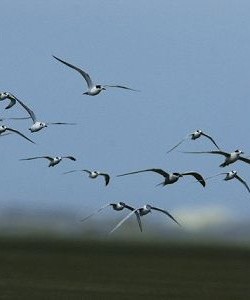
- upper left:The nomadic sensibilities of the migrant Tern (Chiu Lu, Su-Lan)
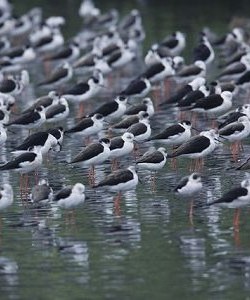
- upper middle:A flock of Black-winged Stilts (Chiu Lu, Su-Lan)
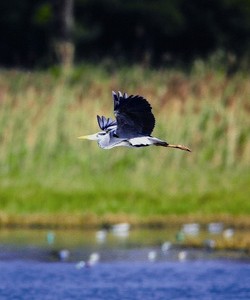
- upper right:Resting spot on the sea path (Chiu Lu, Su-Lan)
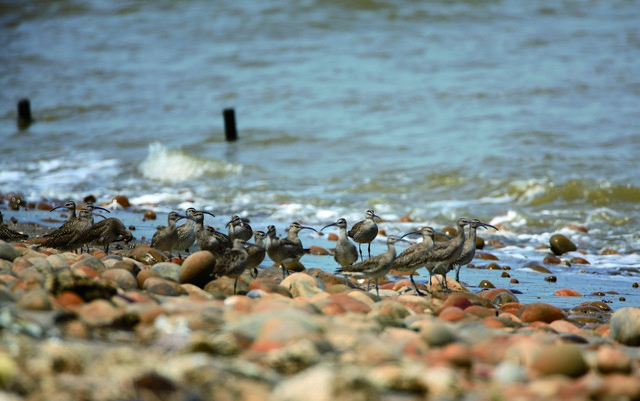
- lower:Seafaring Whimbrels (Chiu Lu, Su-Lan)
Article / Lyu, Huei-Ying & Liu, Shu-Ying
Materials / Kenting National Park Headquarters & Taijiang National Park Headquarters
Photos / Chiu Lu, Su-Lan, Kenting National Park Headquarters & Taijiang National Park Headquarters
The Winter Visitors’ Return Home
The winter contingent of Taiwan’s migrant bird population returns from whence they came anywhere from March to May — the last wave of birds returning around Tomb Sweeping Day. What, though, makes this northbound migration so special?
As previously mentioned, the “winter visitors” return home in the springtime in order to mate. However, they must first shed their dreary winter coats to make way for their mating coats — a much more lustrous and vibrantly-colored coat. The radiant spring sun reveals a cornucopia of visual splendor from the coats of the water birds of the Anatidae family. In fact, the beauty of their coat is directly correlated with their attractiveness to potential mates. These gorgeous displays of feathers are the very reason why so many bird-watchers delight in their chosen activity.
The resting spot these “winter visitors” will choose in Taiwan varies depending on the climate or the time of year at which they arrive. At times the Hengchun peninsula at the southern tip of Taiwan will be a hot spot for migrant birds. As they traverse southern Taiwan, the majority will go up through the west and only a few will chose to traverse via the east. Those that choose the west take one of two paths that can be divided based on bird species or air current: the mountain path or the sea path.
Those that choose the mountain path are more dependent upon the forest for sustenance. These birds are also more adept at navigating ascending air currents that arise because of the surrounding topographic features — this enables them to conserve precious energy for their lengthy voyages.
On the other hand, those that choose the sea path are primarily waterfowl or shorebirds, which are adept at foraging in shallow marshes and mudflats or at foraging along cliff faces on the coast. The rich assortment of resources in these wetlands enables them to quickly re-energize themselves for their journey north.
The Best Spots for Observing Birds: Kenting National Park & Taijiang National Park
There is no better place to observe northbound birds than Kenting & Taijiang National Parks. Lake Lungluantan in Kenting National Park is bustling with life from October until March — bustling with bird life, that is.
Lake Lungluantan is a national wetland located on the Hengchun peninsula’s southernmost point. It is the convergence point for many different rivers and rainwater outlets. The surface area of the lake increases with the seasons or more precisely with the amount of rainfall. Surrounding the lake are various paddies and fisheries. In the more elevated surroundings are grasslands, bush-woods and forests.
The less-developed area surrounding this lake has made it into a superb ecological oasis. As such, Lake Lungluantan has become a magnificent resting spot for “winter visitors” on their way back to their northern homes.
In the fisheries, marshes, paddies and gullies (anywhere there is shallow water and wetlands), waterfowl such as Herons, Plovers, Sandpipers, Snipes and Rails rest their weary wings. The so-called swimming birds (e.g. ducks) rest upon the deeper waters of the lake itself, some fisheries and scattered pools.
Of all the birds that spend their winter at Lake Lungluantan, the most numerous are the Tufted Ducks (Aythya fuligula), next are the Spot-billed Ducks (Anas poecilorhyncha), the Green-winged Teals (Anas crecca), the Northern Shoveler (Anas clypeata), and the Northern Pintail (Anas acuta) whose numbers are also noteworthy.
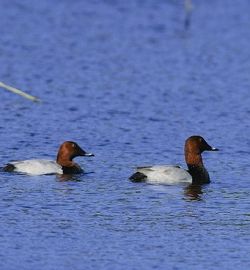
Among these fragile birds is the Common Pochard (Aythya ferina), a rare bird indeed. From the neck up, it sports a fashionable burnt ochre-colored head. It gracefully glides across the water as it rests its tired wings. Yet it can also dive deep into the water in search of food. This gave rise to its more common name: the Red-headed Diving Duck.
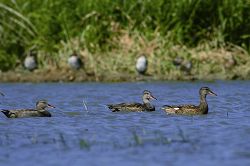
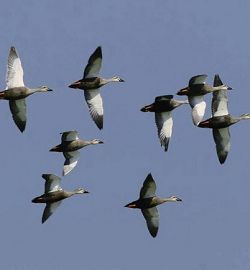
Of course amidst the ducks, there are those who are more low-key (e.g. the Spot-billed Ducks & the Gadwalls (Anas strepera)). The Spot-billed Duck is a larger duck and is the only duck that can be seen year-round at Lake Lungluantan. Moreover, with the exception of the Mandarin Duck (Aix galericulata), it is the only duck that will procreate in the flatlands of Taiwan. That said, the Spot-billed Duck is also easily startled and at the drop of a hat will take flight to evade any perceived danger.
In Taijiang National Park there are varied terrains ranging from river mouths to coasts and lagoons, so many in fact that they provide all that a bird could ever desire, especially the waterfowl — areas such as mangroves, intertidal zones, grassy wetlands, salt flats, fisheries, and wind-sheltered forests. Consequently, myriad birds flock to Taijiang to spend the winter months or to procreate and rear their young in the spring.
In the salt flats and intertidal zones, you will often see “transient” springtime birds such as the Red-necked Stint (Calidris ruficollis) and the Curlew Sandpiper (Calidris ferruginea). On the other hand, the Kentish Plover and the Black-winged Stilt enjoy building nests on the ridges of the salt flats and rocky beaches. When bird-watching in the spring, you mustn’t miss these birds’ interesting mating habits. The Black-winged Stilts also have exceedingly strong parental instincts: if an intruder ventures too close to their young, the parent will chase them away regardless of the size difference between the bird and the intruder (they will even fearlessly chase much larger humans away).
The mangroves are the domain of the Egrets & the Herons; it is also a popular mating ground for them. The Cattle Egret (Bubulcus ibis), the Black-crowned Night Heron (Nycticorax nycticorax), the Little Egret (Egretta garzetta) and the Yellow Bittern (Ixobrychus sinensis) can all be found here.
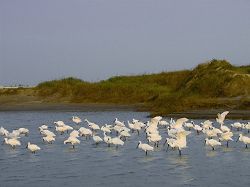
The fisheries tend to be filled with Black-faced Spoonbills and Ducks—such as the Eurasian Teal, the Eurasian Wigeon (Anas penelope), the Northern Pintail and the Northern Shoveler.
The wind-sheltered forests & the protected forests play host to a multitude of “transient” land birds — on rare occasions you will see members of the Sylviidae family of birds and maybe even Eastern Marsh Harriers.
During springtime in Taijiang, you can observe the spectacular demonstration of these waterfowls’ natural gifts — whether it’s watching them use their nature-given body structures fit right into their niches or watching them forage as the tides ebb and flow or even watching their meticulous search for an ideal nesting area — with good sun exposure, yet cool enough not to roast themselves and that’s safe from flooding.
Watch as the egrets gracefully walk or stand in the waters and use blinding speed to snap up their unsuspecting prey. Or watch as the Black-faced Spoonbill skillfully moves its bill to and fro in an effort to catch the fish that feed it. The delicate Kentish Plover, on the other hand, runs sporadically in the mudflats, but then stops to snap up its prey.
With a bicycle and a pair of binoculars, let’s go in pursuit of the “winter visitors” as they make their way back north.
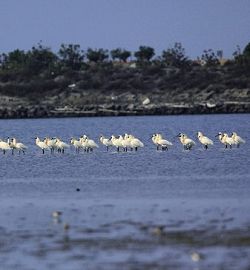
- upper left:Taijiang’s Qigu Lagoon is a pivotal resting place for Black-faced Spoonbills. (Chiu Lu, Su-Lan)
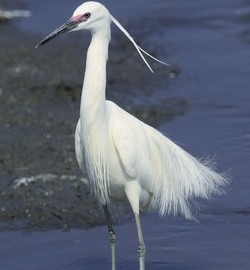
- upper middle:A Little Egret after to growing his mating coat. (Chiu Lu, Su-Lan)
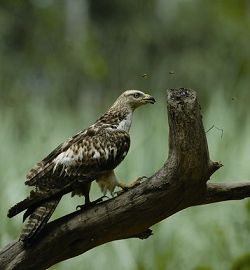
- upper right:A Honey Buzzard on the mountain path (Chiu Lu, Su-Lan)
- lower left:Gadwalls (Kenting National Park Headquarters )
- lower middle:Taijiang National Park cooperated with Tainan University to create the shallow fish farm as the habitat for Black-faced Spoonbill and other waterbirds, and successfully to attract a large number of black-faced spoonbills come for foraging and roosting. (Chen, Shang-Cin)
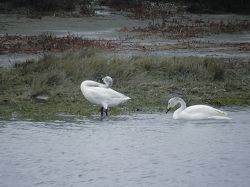
- lower right:The first time in 10 years, Tundra Swans (Cygnus columbianus) came to the Qigu regional for wintering. From far away breeding areas in northern Siberia tundra, they rambled in wetlands of Taijiang National Park. (Chen, Shang-Cin)
Article / Lyu, Huei-Ying & Liu, Shu-Ying
Materials / Kenting National Park Headquarters & Taijiang National Park Headquarters
Photos / Chiu Lu, Su-Lan, Kenting National Park Headquarters & Taijiang National Park Headquarters
Let’s Enjoy Bird-watching
Taiwan’s unique location has made it into the place to transfer in East Asia; no sooner than the winter visitors depart, do the summer visitors come to occupy their place. Every year Taiwan is the stage for an ineffably epic, ecological spectacle. Through observing the northbound migration of these winter visitors, perhaps we can better understand and protect these fragile birds. Additionally, we will be able to see just how pivotal Taiwan is to these species during their migration.
As we pursue these migrating visitors, let’s remember touphold the basic tenets of bird-watching etiquette:
1. So as not to startle the birds, kindly refrain from wearingbrightly-colored clothing.
2. Do not shout and remember to speak softly to yourcompanions.
3. If a bird adopts a defensive posture, do not approach it.
4. When bird-watching, should you stumble upon a birdnest or a bird rearing its young, it is imperative that youremember to observe from afar and to not meddle, as it couldlead to the death of the creatures involved.
5. Do not attempt to coax the bird into approaching you.
6. When photographing birds refrain from using flash.
7. When bird-watching in groups, follow your guide’sinstructions and have as your guiding principle that youshould not interfere with the birds in any way, shape or form.
8. Do not remove plant life and do not litter, as it bringsthe risk of destroying the ecosystem these birds depend on tosurvive.
9. Respect the birds’ right to live: do not collect any birdeggs and do not capture wild birds.
10. If you should spot a banded bird, please record the timeand place of the spotting, take a picture of the informationon the band and forward it to a relevant research authoritysuch as a college, zoo or wildlife association so as to furthertheir important research.
- left:Spot-billed Ducks (Kenting National Park Headquarters)
- middle:Common Pochards (Kenting National Park Headquarters)
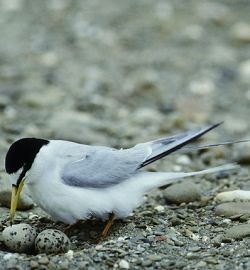
- right:A Little Tern in Taijiang National Park (Huang, Guang-Ying)
Article / Lyu, Huei-Ying & Liu, Shu-Ying
Materials / Kenting National Park Headquarters & Taijiang National Park Headquarters
Photos / Chiu Lu, Su-Lan, Kenting National Park Headquarters & Taijiang National Park Headquarters


